


Wydawcy
Katalog tematyczny
- Archeologia (109)
- Ekonomia, finanse, business (13704)
- Filozofia (1445)
- Historia (3040)
- Języki i językoznawstwo (2356)
- Lifestyle, hobby i rozrywka (475)
- Medycyna (9704)
- Nauki humanistyczne (4)
- Nauki o Ziemi i środowisku (2638)
- Nauki ścisłe (20412)
- Astronomia (294)
- Biologia (5119)
- Chemia (6540)
- Fizyka (3309)
- Elektryczność i magnetyzm (90)
- Fizyka atomowa i molekularna (110)
- Fizyka cząstek elementarnych (36)
- Fizyka jądra atomowego (36)
- Fizyka kwantowa (210)
- Fizyka matematyczna (121)
- Fizyka relatywistyczna (36)
- Fizyka statystyczna (51)
- Fizyka stosowana (498)
- Mechanika klasyczna (186)
- Optyka i światło (133)
- Stany materii (202)
- Matematyka (4574)
- Nauki ścisłe, ogólnie (503)
- Nauki społeczne (8486)
- Nauki techniczne (13450)
- Prawo (1696)
- Publikacje informacyjne i interdyscyplinarne (1288)
- Religia i wierzenia (917)
- Technika komputerowa (4067)
- Zdrowie, relacje międzyludzkie i rozwój osobisty (657)





Informacje szczegółowe o książce
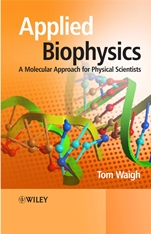
Applied Biophysics: A Molecular Approach for Physical Scientists
ISBN 9780470017173
Autor: Thomas Andrew Waigh
Wydawca: Wiley
Dostępność: 3-6 tygodni
Cena: 751,80 zł
Przed złożeniem zamówienia prosimy o kontakt mailowy celem potwierdzenia ceny.
ISBN13: |
9780470017173 |
ISBN10: |
0470017171 |
Autor: |
Thomas Andrew Waigh |
Oprawa: |
Hardback |
Rok Wydania: |
2007-07-27 |
Ilość stron: |
436 |
Wymiary: |
237x160 |
Tematy: |
PH |
This text presents a ‘nuts and bolts’ approach to the topic of biophysics. The presentation focuses on the simple underlying concepts and demonstrates them using a series of up–to–date applications.
The book aims to explain the constructions and machinery of biological molecules, in a similar way as a civil engineer would examine the construction of a building or a mechanical engineer would examine the dynamics of a turbine. Little or no recourse is taken to the chemical side of the subject, instead modern physical ideas are introduced to explain aspects of the phenomena that are confronted. These ideas provide an alternative complementary set of tools to solve biophysical problems.
The book begins with a discussion of the biological building blocks and the mesoscopic forces that occur between them. It then moves on to discuss such aspects as phase transitions, liquid crystallinity, motility, self–assembly and surface phenomena. The author then applies these principles to the behaviour of biomacromolecules, charged ions, polymers, and membranes. Furthermore applications in continuum mechanics, chromosomal structure, biorheology and modern experimental techniques are explored. Each chapter concludes with tutorial questions to challenge the reader as they progress through the text.
It is hoped that the approach taken within this text will appeal to physical scientists at all levels who are confronted with biological questions for the first time, as they become involved in the current biotechnological revolution
Spis treści:
Preface.
Acknowledgements.
1 The Building Blocks.
1.1 Proteins.
1.2 Lipids.
1.3 Nucleic Acids.
1.4 Carbohydrates.
1.5 Water.
1.6 Proteoglycans and Glycoproteins.
1.7 Cells (Complex Constructs of Biomolecules).
1.8 Viruses (Complex Constructs of Biomolecules).
1.9 Bacteria (Complex Constructs of Biomolecules).
1.10 Other Molecules.
Further Rea
ding.
Tutorial Questions.
2 Mesoscopic Forces.
2.1 Cohesive Forces.
2.2 Hydrogen Bonding.
2.3 Electrostatics.
2.3.1 Unscreened Electrostatic Interactions.
2.3.2 Screened Electrostatic Interactions.
2.3.3 The Force Between Charged Spheres in Solution.
2.4 Steric and Fluctuation Forces.
2.5 Depletion Forces.
2.6 Hydrodynamic Interactions.
2.7 Direct Experimental Measurements of Intermolecular and Surface Forces.
Further Reading.
Tutorial Questions.
3 Phase Transitions.
3.1 The Basics.
3.2 Helix–Coil Transition.
3.3 Globule–Coil Transition.
3.4 Crystallisation.
3.5 Liquid–Liquid Demixing (Phase Separation).
Further Reading.
Tutorial Questions.
4 Liquid Crystallinity.
4.1 The Basics.
4.2 Liquid–Nematic–Smectic Transitions.
4.3 Defects.
4.4 More Exotic Possibilities for Liquid Crystalline Phases.
Further Reading.
Tutorial Questions.
5 Motility.
5.1 Diffusion.
5.2 Low Reynold’s Number Dynamics.
5.3 Motility.
5.4 First Passage Problem.
5.5 Rate Theories of Chemical Reactions.
Further Reading.
Tutorial Questions.
6 Aggregating Self–Assembly.
6.1 Surfactants.
6.2 Viruses.
6.3 Self–Assembly of Proteins.
6.4 Polymerisation of Cytoskeletal Filaments (Motility).
Further Reading.
Tutorial Questions.
7 Surface Phenomena.
7.1 Surface Tension.
7.2 Adhesion.
7.3 Wetting.
7.4 Capillarity.
7.5 Experimental Techniques.
7.6 Friction.
7.7 Other Surface Phenomena.
Further Reading.
Tutorial Question.
8 Biomacromolecules.
8.1 Flexibility of Macromolecules.
8.2 Good/Bad Solvents and the Size of Polymers.
8.3 Elasticity.
8.4 Damped Motion of Soft Molecules.
8.5 Dynamics of Polymer Chains.
8.6 Topology of Polymer Chains – Super Coiling.
Further Reading.
Tutorial Questions.
9 Charged Ions and Polymers.
9.1 Electrostatics.
9.2 Debye–Huckel Theory.
9.3 Ionic Radius.
9.4 The Behaviour of Polyelectrolytes.
9.5 Donnan Equilibria.
9.6 Titration Curves.
9.7 Poisson–Boltzmann Theory for Cylindrical Charge Distributions.
9.8 Charge Condensation.
9.9 Other Polyelectrolyte Phenomena.
Further Reading.
Tutorial Questions.
10 Membranes.
10.1 Undulations.
10.2 Bending Resistance.
10.3 Elasticity.
10.4 Intermembrane Forces.
Further Reading.
Tutorial Questions.
11 Continuum Mechanics.
11.1 Structural Mechanics.
11.2 Composites.
11.3 Foams.
11.4 Fracture.
11.5 Morphology.
Further Reading.
Tutorial Questions.
12 Biorheology.
12.1 Storage and Loss Moduli.
12.2 Rheological Functions.
12.3 Examples from Biology.
12.3.1 Neutral Polymer Solutions.
12.3.2 Polyelectrolytes.
12.3.3 Gels.
12.3.4 Colloids.
12.3.5 Liquid Crystalline Polymers.
12.3.6 Glassy Materials.
12.3.7 Microfluidics in Channels.
Further Reading.
Tutorial Questions.
13 Experimental Techniques.
13.1 Static Scattering Techniques.
13.2 Dynamic Scattering Techniques.
13.3 Osmotic Pressure.
13.4 Force Measurement.
13.5 Electrophoresis.
13.6 Sedimentation.
13.7 Rheology.
13.8 Tribology.
13.9 Solid Properties.
Further Reading.
Tutorial Questions.
14 Motors.
14.1 Self–assembling Motility – Polymerisation of Actin and Tubulin.
14.2 Parallelised Linear Stepper Motors – Striated Muscle.
14.3 Rotatory Motors.
14.4 Ratchet Models.
14.5 Other Systems.
Further Reading.
Tutorial Question.
15 Structural Biomaterials.
15.1 Cartilage – Tough Shock Absorber in Human Joints.
15.2 Spider Silk.
15.3 Elastin and Resilin.
15.4 Bone.
15.5 Adhesive Proteins.
15.6 Nacre and Mineral Composites.
Further Reading.
Tutorial Questions.
16 Phase Behaviour of DNA.16.1 Chromatin – Naturally Packaged DNA Chains.
16.2 DNA Compaction – An Example of Polyelectrolyte Complexation.
16.3 Facilitated Diffusion.
Further Reading.
Appendix.
Answers to Tutorial Questions.
Index.
Nota biograficzna:
Tom A.Waigh, Biological Physics, School of Physics and Astronomy, University of Manchester, UK
Okładka tylna:
This text presents a ‘nuts and bolts’ approach to the topic of biophysics. The presentation focuses on the simple underlying concepts and demonstrates them using a series of up–to–date applications.
The book aims to explain the constructions and machinery of biological molecules, in a similar way as a civil engineer would examine the construction of a building or a mechanical engineer would examine the dynamics of a turbine. Little or no recourse is taken to the chemical side of the subject, instead modern physical ideas are introduced to explain aspects of the phenomena that are confronted. These ideas provide an alternative complementary set of tools to solve biophysical problems.
The book begins with a discussion of the biological building blocks and the mesoscopic forces that occur between them. It then moves on to discuss such aspects as phase transitions, liquid crystallinity, motility, self–assembly and surface phenomena. The author then applies these principles to the behaviour of biomacromolecules, charged ions, polymers, and membranes. Furthermore applications in continuum mechanics, chromosomal structure, biorheology and modern experimental techniques are explored. Each chapter concludes with tutorial questions to challenge the reader as they progress through the text.
It is hoped that the approach taken within this text will appeal to physical scientists at all levels who are confronted with biological questions for the first time, as they become involved in the current biotechnological revolution
Koszyk
Książek w koszyku: 0 szt.
Wartość zakupów: 0,00 zł
Informacje


Kontakt
Gambit
Centrum Oprogramowania
i Szkoleń Sp. z o.o.
Al. Pokoju 29b/22-24
31-564 Kraków
Siedziba Księgarni
ul. Kordylewskiego 1
31-542 Kraków
+48 12 410 5991
+48 12 410 5987
+48 12 410 5989
Subskrypcje
Administratorem danych osobowych jest firma Gambit COiS Sp. z o.o. Na podany adres będzie wysyłany wyłącznie biuletyn informacyjny.
Autoryzacja płatności

Informacje na temat autoryzacji płatności poprzez PayU.

© Copyright 2012: GAMBIT COiS Sp. z o.o. Wszelkie prawa zastrzeżone.
Projekt i wykonanie: Alchemia Studio Reklamy