


Wydawcy
Katalog tematyczny
- Archeologia (109)
- Ekonomia, finanse, business (13704)
- Filozofia (1445)
- Historia (3040)
- Języki i językoznawstwo (2356)
- Lifestyle, hobby i rozrywka (475)
- Medycyna (9704)
- Nauki humanistyczne (4)
- Nauki o Ziemi i środowisku (2638)
- Nauki ścisłe (20412)
- Nauki społeczne (8486)
- Nauki techniczne (13450)
- Budownictwo lądowe (1045)
- Chemia przemysłowa (2258)
- Elektronika i telekomunikacja (3287)
- Energetyka (1122)
- Inne nauki stosowane (363)
- Inżynieria biochemiczna (507)
- Inżynieria transportu (232)
- Mechanika i materiały (3316)
- Nauka o środowisku (321)
- Rolnictwo (507)
- Technika, ogólnie (475)
- Prawo (1696)
- Publikacje informacyjne i interdyscyplinarne (1288)
- Religia i wierzenia (917)
- Technika komputerowa (4067)
- Zdrowie, relacje międzyludzkie i rozwój osobisty (657)





Informacje szczegółowe o książce
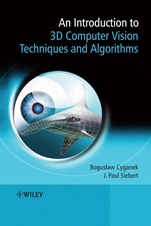
An Introduction to 3D Computer Vision Techniques and Algorithms
ISBN 9780470017043
Autor: Boguslaw Cyganek, J. Paul Siebert
Wydawca: Wiley
Dostępność: 3-6 tygodni
Cena: 589,05 zł
Przed złożeniem zamówienia prosimy o kontakt mailowy celem potwierdzenia ceny.
ISBN13: |
9780470017043 |
ISBN10: |
047001704X |
Autor: |
Boguslaw Cyganek, J. Paul Siebert |
Oprawa: |
Hardback |
Rok Wydania: |
2009-01-09 |
Ilość stron: |
504 |
Wymiary: |
256x177 |
Tematy: |
TJ |
Computer vision encompasses the construction of integrated visionsystems and the application of vision to problems of real–worldimportance. The process of creating 3D models is still ratherdifficult, requiring mechanical measurement of the camera positionsor manual alignment of partial 3D views of a scene. However usingalgorithms, it is possible to take a collection of stereo–pairimages of a scene and then automatically produce a photo–realistic,geometrically accurate digital 3D model.
This book provides a comprehensive introduction to the methods,theories and algorithms of 3D computer vision. Almost everytheoretical issue is underpinned with practical implementation or aworking algorithm using pseudo–code and complete code written inC++ and MatLab®. There is the additional clarification of anaccompanying website with downloadable software. Organised in threeparts, Cyganek and Siebert give a brief history of vision research,and subsequently:
present basic low–level image processing operations for imagematching, including a separate chapter on image matchingalgorithms explain scale–space vision, as well as space reconstruction andmultiview integration demonstrate a variety of practical applications for 3D surfaceimaging and analysis provide concise appendices on topics such as the basics ofprojective geometry and tensor calculus for image processing,distortion and noise in images plus image warping proceduresAn Introduction to 3D Computer Vision Techniques andAlgorithms is a valuable reference for practitioners andprogrammers working in 3D computer vision, image processing andanalysis as well as computer visualisation. It would also be ofinterest to advanced students and researchers in the fields ofengineering, computer science, clinical photography, robotics,graphics and mathematics.
Preface.
Acknowledgements.
Notation and Abbreviations.
Part I.
1 Introduction.
1.1 Stereo–pair Images and Depth Perception.
1.2 3D Vision Systems.
1.3 3D Vision Applications.
1.4 Contents Overview: The 3D Vision Task in Stages.
2 Brief History of Research on Vision.
2.1 Abstract.
2.2 Retrospective of Vision Research.
2.3 Closure.
Part II.
3 2D and 3D Vision Formation.
3.1 Abstract.
3.2 Human Visual System.
3.3 Geometry and Acquisition of a Single Image.
3.4 Stereoscopic Acquisition Systems.
3.5 Stereo Matching Constraints.
3.6 Calibration of Cameras.
3.7 Practical Examples.
3.8 Appendix: Derivation of the Pin–hole CameraTransformation.
3.9 Closure.
4 Low–level Image Processing for Image Matching.
4.1 Abstract.
4.2 Basic Concepts.
4.3 Discrete Averaging.
4.4 Discrete Differentiation.
4.5 Edge Detection.
4.6 Structural Tensor.
4.7 Corner Detection.
4.8 Practical Examples.
4.9 Closure.
5 Scale–space Vision.
5.1 Abstract.
5.2 Basic Concepts.
5.3 Constructing a Scale–space.
5.4 Multi–resolution Pyramids.
5.5 Practical Examples.
5.6 Closure.
6 Image Matching Algorithms.
6.1 Abstract.
6.2 Basic Concepts.
6.3 Match Measures.
6.4 Computational Aspects of Matching.
6.5 Diversity of Stereo Matching Methods.
6.6 Area–based Matching.
6.7 Area–based Elastic Matching.
6.8 Feature–based Image Matching.
6.9 Gradient–based Matching.
6.10 Method of Dynamic Programming.
6.11 Graph Cut Approach.
6.12 Optical Flow.
6.13 Practical Examples.
6.14 Closure.
7 Space Reconstruction and Multiview Integration.
7.1 Abstract.
7.2 General 3D Reconstruction.
7.3 Multiview Integration.
7.4 Closure.
8 Case Examples.
8.1 Abstract.
8.2 3D System for Vision–Impaired Persons.
8.3 Face and Body Modelling.
8.4 Clinical and Veterinary Applications.
8.5 Movie Restoration.
8.6 Closure.
Part III.
9 Basics of the Projective Geometry.
9.1 Abstract.
9.2 Homogeneous Coordinates.
9.3 Point, Line and the Rule of Duality.
9.4 Point and Line at Infinity.
9.5 Basics on Conics.
9.6 Group of Projective Transformations.
9.7 Projective Invariants.
9.8 Closure.
10 Basics of Tensor Calculus for Image Processing.
10.1 Abstract.
10.2 Basic Concepts.
10.3 Change of a Base.
10.4 Laws of Tensor Transformations.
10.5 The Metric Tensor.
10.6 Simple Tensor Algebra.
10.7 Closure.
11 Distortions and Noise in Images.
11.1 Abstract.
11.2 Types and Models of Noise.
11.3 Generating Noisy Test Images.
11.4 Generating Random Numbers with Normal Distributions.
11.5 Closure.
12 Image Warping Procedures.
12.1 Abstract.
12.2 Architecture of the Warping System.
12.3 Coordinate Transformation Module.
12.4 Interpolation of Pixel Values.
12.5 The Warp Engine.
12.6 Software Model of the Warping Schemes.
12.7 Warp Examples.
12.8 Finding the Linear Transformation from PointCorrespondences.
12.9 Closure.
13 Programming Techniques for Image Processing and ComputerVision.
13.1 Abstract.
13.2 Useful Techniques and Methodology.
13.3 Design Patterns.
13.4 Object Lifetime and Memory Management.
13.5 Image Processing Platforms.
13.6 Closure.
14 Image Processing Library.
References.
Index.
Boguslaw Cyganek, AGH University of Science andTechnology, Department of Computer Science, Signal ProcessingLaboratory, Krakow, Poland
Boguslaw Cyganek has been teaching at the AGH Universityof Science and Technology since 1993 and is now a Lecturer andResearcher in the Department of Electronics and Computer Science.His research interests include the development of image processingsystems, robot vision and neural networks. During this time, he hasgained several years of practical experience working as a SoftwareDevelopment Manager and a Software Engineer both in the USA andPoland. He has also written Three Dimensional ImageProcessing (Academic Publisher House, 2002) and 18 academicpapers on image processing and algorithms.
Paul Siebert, Department of Computing Science, Universityof Glasgow, 3D–MATIC Research Laboratory, Scotland
Dr Jan Paul Siebert is currently Director of the 3D–MATICResearch Laboratory in the Department of Computing Science atGlasgow University. His research interests are in computer vision,image processing, and 3D imaging by stereo photogrammetry and itsapplications in 3D whole human body imaging. He is Scottish Chairof the BMVC and prior to his current position he was ChiefExecutive of the of the Turing Institute, Glasgow, which developedthe C3D imaging technology. He has written over 50journal, technical and conference papers on 3D image processing,modelling virtual images and photogrammetry.
This text is a valuable reference for practitioners andprogrammers working in 3D computer vision, image processing andanalysis as well as computer visualisation. It would also be ofinterest to advanced students and researchers in the fields ofengineering, computer science, clinical photography, robotics,graphics and mathematics. (Zentralblatt MATH,2012)
Koszyk
Książek w koszyku: 0 szt.
Wartość zakupów: 0,00 zł
Informacje


Kontakt
Gambit
Centrum Oprogramowania
i Szkoleń Sp. z o.o.
Al. Pokoju 29b/22-24
31-564 Kraków
Siedziba Księgarni
ul. Kordylewskiego 1
31-542 Kraków
+48 12 410 5991
+48 12 410 5987
+48 12 410 5989
Subskrypcje
Administratorem danych osobowych jest firma Gambit COiS Sp. z o.o. Na podany adres będzie wysyłany wyłącznie biuletyn informacyjny.
Autoryzacja płatności

Informacje na temat autoryzacji płatności poprzez PayU.

© Copyright 2012: GAMBIT COiS Sp. z o.o. Wszelkie prawa zastrzeżone.
Projekt i wykonanie: Alchemia Studio Reklamy