


Wydawcy
Katalog tematyczny
- Archeologia (109)
- Ekonomia, finanse, business (13704)
- Filozofia (1445)
- Historia (3040)
- Języki i językoznawstwo (2356)
- Lifestyle, hobby i rozrywka (475)
- Medycyna (9704)
- Nauki humanistyczne (4)
- Nauki o Ziemi i środowisku (2638)
- Nauki ścisłe (20412)
- Nauki społeczne (8486)
- Nauki techniczne (13450)
- Budownictwo lądowe (1045)
- Chemia przemysłowa (2258)
- Elektronika i telekomunikacja (3287)
- Energetyka (1122)
- Inne nauki stosowane (363)
- Inżynieria biochemiczna (507)
- Inżynieria transportu (232)
- Mechanika i materiały (3316)
- Nauka o środowisku (321)
- Rolnictwo (507)
- Technika, ogólnie (475)
- Prawo (1696)
- Publikacje informacyjne i interdyscyplinarne (1288)
- Religia i wierzenia (917)
- Technika komputerowa (4067)
- Zdrowie, relacje międzyludzkie i rozwój osobisty (657)





Informacje szczegółowe o książce
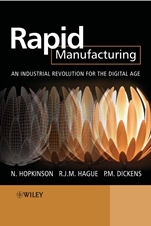
Rapid Manufacturing: An Industrial Revolution for the Digital Age
ISBN 9780470016138
Autor: Neil Hopkinson, Richard Hague, Philip Dickens
Wydawca: Wiley
Dostępność: 3-6 tygodni
Cena: 684,60 zł
Przed złożeniem zamówienia prosimy o kontakt mailowy celem potwierdzenia ceny.
ISBN13: |
9780470016138 |
ISBN10: |
0470016132 |
Autor: |
Neil Hopkinson, Richard Hague, Philip Dickens |
Oprawa: |
Hardback |
Rok Wydania: |
2005-11-11 |
Ilość stron: |
304 |
Wymiary: |
251x172 |
Tematy: |
TG |
Rapid Manufacturing is a new area of manufacturing developed from a family of technologies known as Rapid Prototyping. These processes have already had the effect of both improving products and reducing their development time; this in turn resulted in the development of the technology of Rapid Tooling, which implemented Rapid Prototyping techniques to improve its own processes. Rapid Manufacturing has developed as the next stage, in which the need for tooling is eliminated. It has been shown that it is economically feasible to use existing commercial Rapid Prototyping systems to manufacture series parts in quantities of up to 20,000 and customised parts in quantities of hundreds of thousands. This form of manufacturing can be incredibly cost–effective and the process is far more flexible than conventional manufacturing.
Rapid Manufacturing: An Industrial Revolution for the Digital Age addresses the academic fundamentals of Rapid Manufacturing as well as focussing on case studies and applications across a wide range of industry sectors. As a technology that allows manufacturers to create products without tools, it enables previously impossible geometries to be made. This book is abundant with images depicting the fantastic array of products that are now being commercially manufactured using these technologies.Includes contributions from leading researchers working at the forefront of industry.Features detailed illustrations throughout.
Rapid Manufacturing: An Industrial Revolution for the Digital Age is a groundbreaking text that provides excellent coverage of this fast emerging industry. It will interest manufacturing industry practitioners in research and development, product design and materials science, as well as having a theoretical appeal to researchers and post–graduate students in manufacturing engineering, product design, CAD/CAM and CIFM.
Spis treści:
List of Contributors.
Editors.<
br>Foreword (Terry Wohlers).
1 Introduction to Rapid Manufacturing (Neil Hopkinson, Richard Hague and Phill Dickens).
1.1 Definition of Rapid Manufacturing.
1.2 Latitude of Applications.
1.3 Design Freedom.
1.4 Economic for Volumes down to One.
1.5 Overcoming the Legacy of Rapid Prototyping.
1.6 A Disruptive Technology.
1.7 A Breakdown of the Field of Rapid Manufacturing.
2 Unlocking the Design Potential of Rapid Manufacturing (Richard Hague).
2.1 Introduction.
2.2 Potential of Rapid Manufacturing on Design.
2.3 Geometrical Freedom.
2.4 Material Combinations.
2.5 Summary.
3 Customer Input and Customisation (R.I. Campbell).
3.1 Introduction.
3.2 Why Is Customer Input Needed?
3.3 What Input can the Customer Make?
3.4 How Can Customer Input Be Captured?
3.5 Using Customer Input within the Design Process.
3.6 What Is Customisation?
3.7 Determining Which Features to Customise.
3.8 Additional Customisation Issues.
3.9 Case Study – Customising Garden Fork Handles.
3.10 Conclusions.
4 CAD and Rapid Manufacturing (Rik Knoppers and Richard Hague).
4.1 Introduction.
4.2 CAD Background.
4.3 Relations between CAD and Rapid Manufacturing.
4.4 Future Developments Serving Rapid Manufacturing.
4.5 CAD for Functionally Graded Materials (FGMs).
4.6 Conclusion.
5 Emerging Rapid Manufacturing Processes (Neil Hopkinson and Phill Dickens).
5.1 Introduction.
5.2 Liquid–Based Processes.
5.3 Powder–Based Processes.
5.4 Solid–Based Processes.
6 Materials Issues in Rapid Manufacturing (David L. Bourell).
6.1 Role of Materials in Rapid Manufacturing.
6.2 Viscous Flow.
6.3 Photopolymerization.
6.4 Sintering.
6.5 Infiltration.
6.6 Mechanical Properties of RM Parts.
6.7 Materials for RM Processes.
6.8 The Future of Materials in Rapid Manufacturing.
7 Functionally Graded Materials (Poonj
olai Erasenthiran and Valter Beal).
7.1 Introduction.
7.2 Processing Technologies.
7.3 Rapid Manufacturing of FGM Parts – Laser Fusion.
7.4 Modelling and Software Issues.
7.5 Characterisation of Properties.
7.6 Deposition Systems.
7.7 Applications.
8 Materials and Process Control for Rapid Manufacture (Tim Gornet).
8.1 Introduction.
8.2 Stereolithography.
8.3 Selective Laser Sintering.
8.4 Fused Deposition Modeling.
8.5 Metal–Based Processes.
9 Production Economics of Rapid Manufacture (Neil Hopkinson).
9.1 Introduction.
9.2 Machine Costs.
9.3 Material Costs.
9.4 Labour Costs.
9.5 Comparing the Costs of Rapid Manufacture with Injection Moulding.
10 Management and Implementation of Rapid Manufacturing (Chris Tuck and Richard Hague).
10.1 Introduction.
10.2 Costs of Manufacture.
10.3 Overhead Allocation.
10.4 Business Costs.
10.5 Stock and Work in Progress.
10.6 Location and Distribution.
10.7 Supply Chain Management.
10.8 Change.
10.9 Conclusions.
11 Medical Applications (Russ Harris and Monica Savalani).
11.1 Introduction.
11.2 Pre–Surgery RM.
11.3 Orthodontics.
11.4 Drug Delivery Devices.
11.5 Limb Prosthesis.
11.6 Specific Advances in Computer Aided Design (CAD).
11.7 In Vivo Devices.
12 Rapid Manufacturing in the Hearing Industry (Martin Masters, Therese Velde and Fred McBagonluri).
12.1 The Hearing Industry.
12.2 Manual Manufacturing.
12.3 Digital Manufacturing.
12.4 Scanning.
12.5 Electronic Detailing.
12.6 Electronic Modeling.
12.7 Fabrication.
12.8 Equipment.
12.9 Selective Laser Sintering (SLS).
12.10 Stereolithography Apparatus (SLA).
12.11 Raster–Based Manufacturing.
12.12 Materials.
12.13 Conclusion.
13 Automotive Applications (Graham Tromans).
13.1 Introduction.
13.2 Formula 1.
13.3 Cooling Duct.
13.4 The ‘Flickscab&#
8217;.
13.5 NASCAR.
13.6 Formula Student.
14 Rapid Manufacture in the Aeronautical Industry (Brad Fox).
14.1 Opportunity.
14.2 Overview.
14.3 Historical Perspective.
14.4 Aeronautical Requirements for RM.
14.5 Why RM Is Uniquely Suited to the Aeronautical Field.
14.6 Acceptable Technologies.
14.7 Qualifying RM Systems.
14.7.1 Qualifying SLS at British Aerospace (BAe).
14.7.2 Qualifying SLS at Northrop Grumman.
14.8 Summary.
14.9 Case Studies.
15 Aeronautical Case Studies using Rapid Manufacture (John Wooten).
15.1 Introduction.
15.2 Problem and Proposed Solution.
15.3 Benefits of a Rapid Manufacture Solution.
15.4 Pre–Production Program.
15.5 Production.
15.6 Summary.
16 Space Applications (Roger Spielman).
16.1 Introduction.
16.2 Building the Team.
16.3 Quality Assurance.
16.4 How to ‘Qualify’ a Part Created Using This Process.
16.5 Producing Hardware.
17 Additive Manufacturing Technologies for the Construction Industry (Rupert Soar).
17.1 Introduction.
17.2 The Emergence of Freeform Construction.
17.3 Freeform Construction Processes: A Matter of Scale.
17.4 Conclusions.
18 Rapid Manufacture for the Retail Industry (Janne Kyttanen).
18.1 Introduction.
18.2 Fascinating Technology with Little Consumer Knowledge.
18.3 The Need for Rapid Prototyping to Change to Rapid Manufacturing.
18.4 Rapid Manufacturing Retail Applications.
18.4.1 Lighting.
18.4.2 Three–Dimensional Textiles.
18.5 Mass Customisation.
18.5.1 Mass Customised Retail Products.
18.5.2 Future Posibilities of Mass Customised RM Products.
18.5.3 Limitations and Possibilities.
18.6 Experimentation and Future Applications.
Index.
Nota biograficzna:
Neil Hopkinson is a lecturer in the Wolfson School of Mechanical and Manufacturing Engineering at Loughborough University, UK. Having obtained his P
Koszyk
Książek w koszyku: 0 szt.
Wartość zakupów: 0,00 zł
Informacje


Kontakt
Gambit
Centrum Oprogramowania
i Szkoleń Sp. z o.o.
Al. Pokoju 29b/22-24
31-564 Kraków
Siedziba Księgarni
ul. Kordylewskiego 1
31-542 Kraków
+48 12 410 5991
+48 12 410 5987
+48 12 410 5989
Subskrypcje
Administratorem danych osobowych jest firma Gambit COiS Sp. z o.o. Na podany adres będzie wysyłany wyłącznie biuletyn informacyjny.
Autoryzacja płatności

Informacje na temat autoryzacji płatności poprzez PayU.

© Copyright 2012: GAMBIT COiS Sp. z o.o. Wszelkie prawa zastrzeżone.
Projekt i wykonanie: Alchemia Studio Reklamy