


Wydawcy
Katalog tematyczny
- Archeologia (109)
- Ekonomia, finanse, business (13704)
- Filozofia (1445)
- Historia (3040)
- Języki i językoznawstwo (2356)
- Lifestyle, hobby i rozrywka (475)
- Medycyna (9704)
- Nauki humanistyczne (4)
- Nauki o Ziemi i środowisku (2638)
- Nauki ścisłe (20412)
- Nauki społeczne (8486)
- Nauki techniczne (13450)
- Prawo (1696)
- Publikacje informacyjne i interdyscyplinarne (1288)
- Religia i wierzenia (917)
- Technika komputerowa (4067)
- Zdrowie, relacje międzyludzkie i rozwój osobisty (657)





Informacje szczegółowe o książce
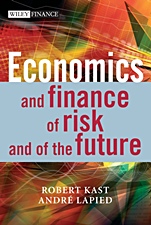
Economics and Finance of Risk and of the Future
ISBN 9780470015773
Autor: Robert Kast, André Lapied
Wydawca: Wiley
Dostępność: 3-6 tygodni
Cena: 579,60 zł
Przed złożeniem zamówienia prosimy o kontakt mailowy celem potwierdzenia ceny.
ISBN13: |
9780470015773 |
ISBN10: |
0470015772 |
Autor: |
Robert Kast, André Lapied |
Oprawa: |
Hardback |
Rok Wydania: |
2006-03-24 |
Ilość stron: |
242 |
Wymiary: |
250x181 |
Tematy: |
KF |
Human institutions are continuously threatened by both man–made and natural disasters. They provoke damages that may be hard to value and to compensate, and may also induce simultaneous defaults in industry and in insurance. When prevention means fail, economic and financial instruments become necessary to manage risks.
The scope of this book is to introduce new instruments based on the most recent developments in economics and finance theory. Public economics, decision theory, and arbitrage pricing in financial markets are all areas where these practical tools can be used. Applications are found for: public and private project management, insurable and non insurable risks, static and dynamic hedging of financial investments.
Traditional approaches to risk analysis do not question the relevance of some outdated assumptions. In contrast, this book screens classical tools and considers hypothesis that allow to answer, among others, the following questions:How to measure uncertainties when non–controversial probability distribution are not available?How to give a monetary value to non–tradable goods and assets?When can an individual valuation be implemented for a collective choice?How to use the powerful tools of finance to take into account irreversibilities and flexibilities so crucial to challenge huge risks?
Spis treści:
Acknowledgements.
General Introduction.
Financial assets.
Risks.
Uncertainty and precaution.
Problems: new methods and new instruments.
Presentation of the book.
PART I: INDIVIDUAL vs COLLECTIVE CHOICE.
Introduction to Part I.
1. Risks in a Public Project: The Millau Viaduct.
2. Individual Valuations and Economic Rationality.
2.1 Preferences on consequences and utilities of decisions.
2.2 Decisions, acts and contingent assets.
2.3 Criterion and individual valuation: averaging.
2.4 A simple decision
theoretic model.
2.5 A general criterion of individual valuation.
2.6 The two main criteria for decision–making in front of a known probability distribution: paradoxes and limitations.
3. Aggregation of Individual Choices.
3.1 Public choices.
3.2 Market aggregation of individual preferences.
4. Individual and Collective Risk Management Instruments.
4.1 Decision trees.
4.2 Optimisation under constraints: mathematical programming.
4.3 Risk and cost–benefit analysis.
Concluding comments on Part I.
PART II: RISK vs UNCERTAINTY.
Introduction to Part II.
5. Insurable and Uninsurable Risks.
5.1 Insurance of risks with a known probability distribution.
5.2 Insurance of risks with uncertainties.
5.3 Non–insurable risks.
6. Risk Economics.
6.1 Laws of large numbers and the principles of insurance.
6.2 Risk aversion and applications to the demand for insurance 1.
6.3 Background risk.
6.4 Risk measures: variance and Value at Risk.
6.5 Stochastic dominance.
6.6 Aversion to risk increases.
6.7 Asymmetric information: moral hazard and adverse selection.
7. Marketed Risks.
7.1 A general theory of risk measurement.
7.2 Applications to risk valuation.
8. Management Instruments for Risk and for Uncertainty.
8.1 Choosing optimal insurance.
8.2 Insurance claims securitisation.
8.3 Valuing controversial risks.
Concluding comments on Part II.
PART III: STATIC vs DYNAMIC.
Introduction to Part III.
9. Risk Businesses.
9.1 Lotteries and the gambling business.
9.2 Risks and investments.
9.3 Credit risk.
10. Valuation without Flexibilities.
10.1 The net present value.
10.2 Discounting.
10.3 Static models of financial market equilibrium pricing.
10.4 The value at risk.
11. Valuation with Options.
11.1 General theory of a dynamic measure of risks.
11.2 Applications
to risk valuation.
12. Static and Dynamic Risk Instruments.
12.1 Static risk management instruments.
12.2 Managing flexibilities.
Concluding comments on Part III.
General Conclusion.
1. How to deal with controversies.
2. Look for market valuation.
3. Measuring time.
References.
Index.
Nota biograficzna:
Professor ROBERT KAST has a research position at LAMETA–CNRS, University of Montpellier (France) and has published papers and books in decision theory and financial market theory.
ANDRÉ LAPIED is Professor of Economics at GREQAM, University Paul Cézanne in Aix–en–Provence (France) and has published papers and books in financial market theory and economic theory.
They work together in risk theory and have achieved several governmental investigations on applied problems. Some of them raise questions on risk management that are addressed in this book.
Okładka tylna:
Human institutions are continuously threatened by both man–made and natural disasters. They provoke damages that may be hard to value and to compensate, and may also induce simultaneous defaults in industry and in insurance. When prevention means fail, economic and financial instruments become necessary to manage risks.
The scope of this book is to introduce new instruments based on the most recent developments in economics and finance theory. Public economics, decision theory, and arbitrage pricing in financial markets are all areas where these practical tools can be used. Applications are found for: public and private project management, insurable and non insurable risks, static and dynamic hedging of financial investments.
Traditional approaches to risk analysis do not question the relevance of some outdated assumptions. In contrast, this book screens classical tools and considers hypothesis that allow to answer, among others, the following ques
tions:How to measure uncertainties when non–controversial probability distribution are not available?How to give a monetary value to non–tradable goods and assets?When can an individual valuation be implemented for a collective choice?How to use the powerful tools of finance to take into account irreversibilities and flexibilities so crucial to challenge huge risks?
Koszyk
Książek w koszyku: 0 szt.
Wartość zakupów: 0,00 zł
Informacje


Kontakt
Gambit
Centrum Oprogramowania
i Szkoleń Sp. z o.o.
Al. Pokoju 29b/22-24
31-564 Kraków
Siedziba Księgarni
ul. Kordylewskiego 1
31-542 Kraków
+48 12 410 5991
+48 12 410 5987
+48 12 410 5989
Subskrypcje
Administratorem danych osobowych jest firma Gambit COiS Sp. z o.o. Na podany adres będzie wysyłany wyłącznie biuletyn informacyjny.
Autoryzacja płatności

Informacje na temat autoryzacji płatności poprzez PayU.

© Copyright 2012: GAMBIT COiS Sp. z o.o. Wszelkie prawa zastrzeżone.
Projekt i wykonanie: Alchemia Studio Reklamy