


Wydawcy
Katalog tematyczny
- Archeologia (109)
- Ekonomia, finanse, business (13704)
- Filozofia (1445)
- Historia (3040)
- Języki i językoznawstwo (2356)
- Lifestyle, hobby i rozrywka (475)
- Medycyna (9704)
- Nauki humanistyczne (4)
- Nauki o Ziemi i środowisku (2638)
- Nauki ścisłe (20412)
- Nauki społeczne (8486)
- Nauki techniczne (13450)
- Budownictwo lądowe (1045)
- Chemia przemysłowa (2258)
- Elektronika i telekomunikacja (3287)
- Energetyka (1122)
- Inne nauki stosowane (363)
- Inżynieria biochemiczna (507)
- Inżynieria transportu (232)
- Mechanika i materiały (3316)
- Nauka o środowisku (321)
- Rolnictwo (507)
- Technika, ogólnie (475)
- Prawo (1696)
- Publikacje informacyjne i interdyscyplinarne (1288)
- Religia i wierzenia (917)
- Technika komputerowa (4067)
- Zdrowie, relacje międzyludzkie i rozwój osobisty (657)





Informacje szczegółowe o książce
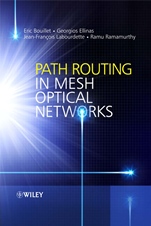
Path Routing in Mesh Optical Networks
ISBN 9780470015650
Autor: Eric Bouillet, Georgios Ellinas, Jean–Francois Labourdette, Ramu Ramamurthy
Wydawca: Wiley
Dostępność: 3-6 tygodni
Cena: 572,25 zł
Przed złożeniem zamówienia prosimy o kontakt mailowy celem potwierdzenia ceny.
ISBN13: |
9780470015650 |
ISBN10: |
0470015659 |
Autor: |
Eric Bouillet, Georgios Ellinas, Jean–Francois Labourdette, Ramu Ramamurthy |
Oprawa: |
Hardback |
Rok Wydania: |
2007-10-05 |
Ilość stron: |
304 |
Wymiary: |
249x174 |
Tematy: |
TJ |
Transport networks evolved from DCS (Digital Cross–connect Systems)–based mesh architectures, to SONET/SDH (Synchronous Optical Networking/Synchronous Digital Hierarchy) ring architectures in the 1990’s. In the past few years, technological advancements in optical transport switches have allowed service providers to support the same fast recovery in mesh networks previously available in ring networks while achieving better capacity efficiency and resulting in lower capital cost.
Optical transport networks today not only provide trunking capacity to higher–layer networks, such as inter–router connectivity in an IP–centric infrastructure, but also support efficient routing and fast failure recovery of high–bandwidth services. This is possible due to the emergence of optical network elements that have the intelligence required to efficiently control the network. Optical mesh networks will enable a variety of dynamic services such as bandwidth–on–demand, Just–In–Time bandwidth, bandwidth scheduling, bandwidth brokering, and optical virtual private networks that open up new opportunities for service providers and their customers alike.
Path Routing in Mesh Optical Networks combines both theoretical as well as practical aspects of routing and dimensioning for mesh optical networks. All authors have worked as technical leaders for the equipment vendor Tellium who implemented such capabilities in its product, and whose product was deployed in service provider networks.
Path Routing in Mesh Optical Networks
Presents an in–depth treatment of a specific class of optical networks, i.e. path–oriented mesh optical networks
Focuses on routing and recovery, dimensioning, performance analysis and availability in mesh optical networks.
Explains and analyses routing specifically associated with Dedicated Backup Path Protection (DBPP) and Shared
Backup Path Protection (SBPP) recovery architectures.
As most of the core backbone networks evolve to mesh topologies utilizing intelligent network elements for provisioning and recovery of services, Path Routing in MEsh Optical Networks will be an invaluable tool for both researchers and engineers in the industry who are responsible for designing, developing, deploying and maintaining mesh optical networks. It will also be a useful reference book for graduate students and university professors who are interested in optical networks or telecommunications networking.
With a foreword by Professor Wayne D. Grover, author of the book “Mesh–Based Survivable Networks”.
Spis treści:
List of Figures.
List of Tables.
Foreword.
Preface.
1 Optical Networking.
1.1 Evolution of Optical Network Architectures.
1.1.1 Transparent Networks.
1.1.2 Opaque Networks.
1.1.3 Translucent Networks.
1.2 Layered Network Architecture.
1.2.1 Optical Layer.
1.2.2 Logical Layer.
1.2.3 Service/Application Layer.
1.3 Multi–Tier Optical Layer.
1.3.1 One–Tier Network Architecture.
1.3.2 Two–Tier Network Architecture.
1.3.3 Network Scalability.
1.4 The Current State of Optical Networks.
1.5 Organization of the Book.
2 Recovery in Optical Networks.
2.1 Introduction.
2.2 Failure Recovery.
2.3 Fault Recovery Classifications.
2.4 Protection of Point–to–Point Systems.
2.4.1 (1 + 1) Protection.
2.4.2 (1 : 1) Protection.
2.4.3 (M :N) Protection.
2.5 Ring–Based Protection.
2.5.1 Failure Recovery in SONET Networks with Ring Topologies.
2.5.2 Ring–Based Failure Recovery in Optical Networks with Mesh Topologies.
2.6 Path–Based Protection.
2.6.1 Dedicated Backup Path Protection (DBPP) in Mesh Networks.
2.6.2 Shared Back Path Protection (SBPP) in Mesh Networks.
2.7 Link/Span–Based Protection.
2.8 Segment–Based Protection.
2.9 Island–Based Protection.
2.10 Mesh Network Restoration.
2.10.1 Centralized Restoration Techniques.
2.10.2 Distributed Restoration Techniques.
2.11 Multi–Layer Recovery.
2.12 Recovery Triggers and Signaling Mechanisms.
2.13 Conclusion.
3 Mesh Routing and Recovery Framework.
3.1 Introduction.
3.2 Mesh Protection and Recovery Techniques.
3.2.1 Link–Based Protection.
3.2.2 Path–Based Protection.
3.2.3 Segment–Based Protection.
3.3 Concept of Shared Risk Groups.
3.3.1 Shared Link Risk Groups.
3.3.2 Shared Node Risk Groups.
3.3.3 Shared Equipment Risk Groups.
3.4 Centralized vs Distributed Routing.
3.4.1 Centralized Routing.
3.4.2 Distributed Routing.
3.4.3 Centralized vs Distributed Routing Performance Results.
3.5 Conclusion.
4 Path Routing and Protection.
4.1 Introduction.
4.2 Routing in Path–Protected Mesh Networks.
4.3 Protection in Path–Protected Mesh Networks.
4.3.1 Dedicated Backup Path–Protected Lightpaths.
4.3.2 Shared Backup Path–Protected Lightpaths.
4.3.3 Preemptible Lightpaths.
4.3.4 Diverse Unprotected Lightpaths with Dual–Homing.
4.3.5 Multiple Simultaneous Backup Path–Protected Lightpaths.
4.3.6 Relaxing the Protection Guarantees.
4.3.7 Impact of Multi–Port Card Diversity Constraints.
4.4 Experiments and Capacity Performance Results.
4.4.1 Performance Results for Path–Based Protection Techniques.
4.4.2 Experiments with Multi–Port Card Diversity.
4.5 Recovery Time Analysis.
4.6 Recovery Time and Capacity Trade–Offs.
4.7 Conclusion.
5 Path Routing – Part 1: Complexity.
5.1 Introduction.
5.2 Network Topology Abstraction.
5.2.1 Service Definition.
5.2.2 Operational Models: Online vs Offline Routing.
5.3 Shortest–Path Routing
.
5.3.1 Dijkstra’s Algorithm.
5.3.2 Dijkstra’s Algorithm Generalization to K–Shortest Paths.
5.3.3 Shortest–Path Routing with Constraints.
5.4 Diverse–Path Routing.
5.4.1 SRG Types.
5.4.2 Diverse–Path Routing with Default SRGs.
5.4.3 Diverse–Path Routing with Fork SRGs.
5.4.4 Diverse–Path Routing with General SRGs.
5.5 Shared Backup Path Protection Routing.
5.5.1 Protection Guarantees and Rules of Sharing.
5.5.2 Complexity of Shared Backup Path Protection Routing.
5.6 Routing ILP.
5.6.1 ILP Description.
5.6.2 Implementation Experience.
5.7 Conclusion.
5.8 Appendix.
5.8.1 Complexity of Diverse–Path Routing with General SRGs.
5.8.2 Complexity of SBPP Routing.
6 Path Routing – Part 2: Heuristics.
6.1 Introduction.
6.1.1 Operational Models: Centralized vs Distributed Routing.
6.1.2 Topology Modeling Example.
6.2 Motivating Problems.
6.2.1 Heuristic Techniques.
6.3 K–Shortest Path Routing.
6.3.1 Yen’s K–Shortest Path Algorithm.
6.3.2 Constrained Shortest–Path Routing.
6.4 Diverse–Path Routing.
6.4.1 Best–Effort Path Diversity.
6.5 Shared Backup Path Protection Routing.
6.5.1 Sharing–Independent Routing Heuristic.
6.5.2 Sharing–Dependent Routing Heuristic.
6.6 Routing Preemptible Services.
6.7 General Constrained Routing Framework.
6.7.1 Implementation Experience.
6.8 Conclusion.
7 Enhanced Routing Model for SBPP Services.
7.1 Introduction.
7.2 Routing Metric.
7.3 Routing Algorithm.
7.4 Experiments.
7.4.1 Effect of .
7.4.2 Effect of α.
7.5 Conclusion.
8 Controlling Sharing for SBPP Services.
8.1 Introduction.
8.2 Express Links.
8.2.1 Routing with Express Links.
8.2.2 Analysis and Results.
8.2.3 Express Links–Conclusion.
8.3 Limiting Sharing.
8.
Koszyk
Książek w koszyku: 0 szt.
Wartość zakupów: 0,00 zł
Informacje


Kontakt
Gambit
Centrum Oprogramowania
i Szkoleń Sp. z o.o.
Al. Pokoju 29b/22-24
31-564 Kraków
Siedziba Księgarni
ul. Kordylewskiego 1
31-542 Kraków
+48 12 410 5991
+48 12 410 5987
+48 12 410 5989
Subskrypcje
Administratorem danych osobowych jest firma Gambit COiS Sp. z o.o. Na podany adres będzie wysyłany wyłącznie biuletyn informacyjny.
Autoryzacja płatności

Informacje na temat autoryzacji płatności poprzez PayU.

© Copyright 2012: GAMBIT COiS Sp. z o.o. Wszelkie prawa zastrzeżone.
Projekt i wykonanie: Alchemia Studio Reklamy