


Wydawcy
Katalog tematyczny
- Archeologia (109)
- Ekonomia, finanse, business (13704)
- Filozofia (1445)
- Historia (3040)
- Języki i językoznawstwo (2356)
- Lifestyle, hobby i rozrywka (475)
- Medycyna (9704)
- Nauki humanistyczne (4)
- Nauki o Ziemi i środowisku (2638)
- Nauki ścisłe (20412)
- Nauki społeczne (8486)
- Edukacja (229)
- Kryminologia, opieka spełeczna (284)
- Obronność (10)
- Polityka (1389)
- Psychologia (777)
- Socjologia (410)
- Społeczeństwo i kultura (187)
- Nauki techniczne (13450)
- Prawo (1696)
- Publikacje informacyjne i interdyscyplinarne (1288)
- Religia i wierzenia (917)
- Technika komputerowa (4067)
- Zdrowie, relacje międzyludzkie i rozwój osobisty (657)





Informacje szczegółowe o książce
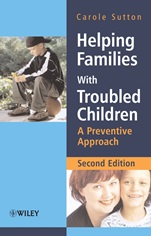
Helping Families with Troubled Children: A Preventive Approach
ISBN 9780470015506
Autor: Carole Sutton
Wydawca: Wiley
Dostępność: 3-6 tygodni
Cena: 290,85 zł
Przed złożeniem zamówienia prosimy o kontakt mailowy celem potwierdzenia ceny.
ISBN13: |
9780470015506 |
ISBN10: |
0470015500 |
Autor: |
Carole Sutton |
Oprawa: |
Paperback |
Rok Wydania: |
2006-04-07 |
Numer Wydania: |
2nd Edition |
Ilość stron: |
338 |
Wymiary: |
229x155 |
Tematy: |
JC |
The growing incidence of mental health problems and offending in adolescents suggests that preventive work with parents remains a critical area. This suggestion has been confirmed by longitudinal research that shows, for example, that children whose mothers are stressed in pregnancy are in danger of developing hyperactivity.
In Helping Families with Troubled Children, Carole Sutton stresses the importance of working with families before difficult behaviour becomes entrenched and resistant to intervention. This preventive work should take place from pregnancy onwards.
Drawing on social learning theory and cognitive behavioural principles, Sutton provides a structured approach to intervention (ASPIRE – Assessment, Planning, Implementation, Review and Evaluation). This approach will guide practitioners to work supportively with parents.
This second edition has been updated with the latest research findings in a number of areas of children’s difficulties. There are specific chapters on sleep problems, anxiety and depression, eating problems, wetting and soiling, serious behaviour problems and ADHD.
Spis treści:
List of Tables and Figures.
About the Author.
Acknowledgements.
Introduction.
So the grounds for concern are still serious.
The beginnings of a focus upon prevention.
Some common themes emerging from the research.
Dissemination of the necessary skills.
PART I: SOME GENERAL PRINCIPLES FOR HELPING FAMILIES.
1. Research Concerning Troubled Children.
The needs of children.
The nature of children’s difficulties.
The origins of some of the difficulties: risk and protective factors.
The effectiveness of interventions to help children.
2. Social Learning/Cognitive–Behavioural Theory.
Ways of thinking about human beings.
A range of perspectives on human beings.
Exploring principles of
cognitive–behavioural theory.
Making use of principles of cognitive–behavioural theory.
Summary of some key principles of cognitive–behavioural theory.
3. Engaging and Supporting Parents and Families.
Children within a statutory and organisational context.
How can we best support families?.
Developing awareness of cultural issues.
Developing a positive focus.
Practice issues: the importance of structure.
Interagency work.
Methods of giving help: evidence from research.
4. ASPIRE – Assessment.
ASPIRE: a process for practice.
What is assessment?.
The steps of assessment – and beyond.
5. ASPIRE – Planning, Implementation, Review and Evaluation.
The stage of planning – with parents or caregivers.
Implementing the plan.
Reviewing and evaluating the plan.
PART II: HELPING FAMILIES WITH SPECIFIC DIFFICULTIES.
6. Helping Families with Children who are Anxious or Depressed.
Definition of emotional disorders.
Prevalence of emotional difficulties in children.
Research into children and anxiety.
Helping families with anxious children.
Research into children and depression.
Helping families with depressed children.
7. Helping Families with Children’s Sleeping Problems.
Definition of sleeping disorder.
Prevalence of sleeping/waking difficulties.
Research into the origins of bedtime and waking.
problems.
Research into the management of bedtime and sleep.
problems.
Helping families whose children have bedtime/waking.
problems.
8. Helping Families with Children with Eating Problems.
Problems of definition.
Prevalence of eating/feeding problems.
Research into the origins of feeding/eating problems.
Research into the management of eating difficulties.
Helping families with children with eating difficulties.
9. Helping Families with Children wi
th Serious Behaviour Problems.
Difficulties of arriving at definitions.
Prevalence of and continuities in conduct disorders.
Research into the origins of conduct disorders.
Research into intervention in conduct disorders.
Helping parents with children with serious behaviour.
problems.
10. Helping Families with Children with Attention Deficit Hyperactivity Disorder.
Difficulties of arriving at definitions and diagnoses.
Prevalence of ADHD.
Research into ADHD.
Research concerning the management of ADHD.
Helping parents with children with features of ADHD.
11. Helping Families Whose Childen Wet or Soil.
Enuresis/bed–wetting: definition and prevalence.
Research concerning the origins of bed–wetting.
Research concerning the management of bed–wetting.
Help for families with children who wet the bed.
Encopresis/soiling.
Research into the origins of soiling.
Research into the management of soiling.
Help for families with children who soil.
12. Parent Education and Training: Values and Research.
The value base of the work: ethical issues.
Support for families in a multicultural society.
The content and process of effective programmes of parent training.
Content and characteristics of effective parent education programmes.
The process an practicalities of parent training.
Devising agreements to support practice.
Maintaining the improvement.
Concluding remarks.
Appendix 1: Form for assessment of child behaviour difficulty.
Appendix 2: Form for recording ‘life events’ for the family and child.
Appendix 3: Form for obtaining ratings on the Life Events Scale.
Appendix 4: Form for compiling summary of information relevant to assessment.
Appendix 5: Form for noting A–B–C sequences.
Appendix 6: Form for charting behaviours.
Appendix 7: Form for ei
ght–week charting of positive and negative behaviours.
Appendix 8: Form for planning with parents.
Appendix 9: Parenting positively: some notes for parents.
Appendix 10: Weekly sleep chart.
Appendix 11: Guidelines for Good Practice of Behavioural and Cognitive Psychotherapy.
Appendix 12: Form for framing an agreement between a worker and a client.
Appendix 13: Form for framing an agreement in one–to–one or family work.
References.
Index.
Nota biograficzna:
Carole Sutton is Associate Director of the Unit for Parenting Studies at De Montfort University. She originally worked as a social worker in the fields of health, mental health and children and families, where her experiences as a practitioner and as a parent led to an interest in preventive work to support young families. She studied for a degree in psychology and then for a doctorate in parent education, working with Professor Martin Herbert. She is a chartered psychologist. This book has grown out of her subsequent experiences of teaching and training professional workers, health visitors, social workers in field and residential settings, psychologists, family therapists, teachers and doctors and supporting parents in helping their troubled children.
Okładka tylna:
The growing incidence of mental health problems and offending in adolescents suggests that preventive work with parents remains a critical area. This suggestion has been confirmed by longitudinal research that shows, for example, that children whose mothers are stressed in pregnancy are in danger of developing hyperactivity.
In Helping Families with Troubled Children, Carole Sutton stresses the importance of working with families before difficult behaviour becomes entrenched and resistant to intervention. This preventive work should take place f
Koszyk
Książek w koszyku: 0 szt.
Wartość zakupów: 0,00 zł
Informacje


Kontakt
Gambit
Centrum Oprogramowania
i Szkoleń Sp. z o.o.
Al. Pokoju 29b/22-24
31-564 Kraków
Siedziba Księgarni
ul. Kordylewskiego 1
31-542 Kraków
+48 12 410 5991
+48 12 410 5987
+48 12 410 5989
Subskrypcje
Administratorem danych osobowych jest firma Gambit COiS Sp. z o.o. Na podany adres będzie wysyłany wyłącznie biuletyn informacyjny.
Autoryzacja płatności

Informacje na temat autoryzacji płatności poprzez PayU.

© Copyright 2012: GAMBIT COiS Sp. z o.o. Wszelkie prawa zastrzeżone.
Projekt i wykonanie: Alchemia Studio Reklamy