


Wydawcy
Katalog tematyczny
- Archeologia (109)
- Ekonomia, finanse, business (13704)
- Filozofia (1445)
- Historia (3040)
- Języki i językoznawstwo (2356)
- Lifestyle, hobby i rozrywka (475)
- Medycyna (9704)
- Nauki humanistyczne (4)
- Nauki o Ziemi i środowisku (2638)
- Nauki ścisłe (20412)
- Nauki społeczne (8486)
- Nauki techniczne (13450)
- Prawo (1696)
- Publikacje informacyjne i interdyscyplinarne (1288)
- Religia i wierzenia (917)
- Technika komputerowa (4067)
- Zdrowie, relacje międzyludzkie i rozwój osobisty (657)





Informacje szczegółowe o książce
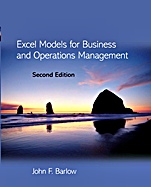
Excel Models for Business and Operations Management
ISBN 9780470015094
Autor: John Barlow
Wydawca: Wiley
Dostępność: 3-6 tygodni
Cena: 319,20 zł
Przed złożeniem zamówienia prosimy o kontakt mailowy celem potwierdzenia ceny.
ISBN13: |
9780470015094 |
ISBN10: |
0470015098 |
Autor: |
John Barlow |
Oprawa: |
Paperback |
Rok Wydania: |
2005-04-22 |
Numer Wydania: |
2nd Edition |
Ilość stron: |
432 |
Wymiary: |
234x190 |
Tematy: |
KM |
Excel Models for Business and Operations Management, Second Edition, adopts a structured approach to management decision–making by integrating the activities of a manufacturing organization. The text is entirely assignment–based and uses Microsoft’s Excel software to develop over eighty models. Everyday examples from finance, marketing and operations management form the basis of the book’s ‘hands–on’ development models. As in the previous edition, the emphasis is on the practical implementation of real–world models rather than traditional theoretical concepts. The book’s learn–by–example approach helps to develop both analytical and mathematical skills by focusing on the formulation and building of business models.
New features in the second edition includeFinance models in a new chapter on investment analysis modelsJob sequencing including a VBA routine for Johnson’s RuleMultiplicative Holt–Winter’s modelAll models and reference notes updated to the latest version of Excel
Excel Models for Business and Operations Management is ideally suited to intermediate and advanced undergraduate courses, as well as MBA courses, in business studies, finance, accounting, information technology, and operations management. It should be of interest to managers and analysts who want to develop their model–building skills.
Spis treści:
Preface.
1. A systems view of business.
Overview.
A systems view of business operations.
A manufacturing business model.
Finance and cost accounting.
The marketing function.
The production function.
Management decision–making.
References and further reading.
2. Model–building tools.
Overview.
Modelling characteristics.
Risk and uncertainty in decision–making.
Linear programming (LP).
Using Excel’s ‘Anal
ysis ToolPak’.
Statistical methods.
Decision analysis.
Simulation.
Excel functions used in model–building.
Exercises.
References and further reading.
PART 1: BUSINESS MODELS.
3. Financial models.
Overview.
Financial statements.
Ratio analysis.
Net present value (NPV).
Investment appraisal.
Portfolio management.
Capital budgeting using decision trees.
Cash flow analysis.
Investment financing: a simulation model.
Financial planning.
Excel add–ins: small business financial manager.
Excel functions used in model–building.
Exercises.
References and further reading.
4. Investment Analysis Models.
Overview.
Risk Preference Attitudes.
Utility Theory.
Portfolio theory – the Markowitz model.
Portfolio analysis – the efficient frontier.
Single index model (SIM).
Using SIM to derive the covariance matrix.
Capital asset pricing model (CAPM).
Bond valuation.
Duration and bond volatility.
Black–Scholes option pricing model.
Excel functions used in model–building.
Exercises.
References and further reading.
5. Worksheet applications in cost accounting.
Overview.
Cost–volume–profit analysis.
Depreciation.
Equipment replacement.
Statistical replacement analysis.
Simulation model for replacement/repairs.
Comparison between simulation and statistical results.
Budgeting.
Job costing.
The learning curve.
Checking the accuracy of learning curves.
Excel functions used in model–building.
Exercises.
References and further reading.
6. Marketing models.
Overview.
Organising and presenting data.
Correlation analysis and linear regression.
Forecasting – time series and exponential smoothing.
Forecasting – exponential smoothing.
Salesforce models.
Goal programming.
Excel functions used in model–build
ing.
Exercises.
References and further reading.
7. Purchase order processing.
Overview.
Creating a simple macro.
Purchase order processing.
Creating the title screen.
Products and suppliers worksheets.
Creating the purchase order form.
Creating the database and its associated macros.
Macros for transferring data into the database.
Adding macros to buttons.
Amending purchase orders.
Printing purchase orders.
Protecting the POP database application.
Excel functions used in model–building.
Exercises.
References and further reading.
PART 2: MODELS FOR OPERATIONS MANAGEMENT.
8. Statistical applications in quality control.
Overview.
Probability distributions.
Acceptance sampling.
Estimation – drawing conclusions from samples.
Hypothesis testing – checking out a claim!
Analysis of variance (ANOVA).
Statistical process control.
Excel functions used in model–building.
Exercises.
References and further reading.
9. Inventory control models.
Overview.
Glossary of inventory terms.
Characteristics of inventory models.
Deterministic models.
Production order quantity model.
Inventory models with constraints.
Probabilistic models.
Inventory controls: a simulation approach.
Material requirements planning (MRP).
Lot–sizing methods.
Just–in–time (JIT) approach to inventory management.
Excel functions used in model–building.
Exercises.
References and further reading.
10. Models for production operations.
Overview.
Logistics models.
Other network flow applications.
Production planning and scheduling.
Queuing models.
Excel functions used in model–building.
Exercises.
References and further reading.
11. Project management.
Overview.
Project management techniques.
The project network.
Critical path method (CPM).
Simula
tion model for project management.
Exercises.
References and further reading.
Appendix: Excel refresher notes.
Basic Excel commands.
Drawing graphs with ChartWizard.
Object linking and embedding (OLE).
Nota biograficzna:
Dr Barlow holds degrees in mathematics, computer science, and mechanical engineering. As well as extensive teaching experience – previously at the Universities of Cape Town, South Africa and Wollongong, Australia – he has held various positions in computer consultancy and the petroleum industry. He has published numerous papers in the areas of computer applications and systems management.
Okładka tylna:
Excel Models for Business and Operations Management, Second Edition, adopts a structured approach to management decision–making by integrating the activities of a manufacturing organization. The text is entirely assignment–based and uses Microsoft’s Excel software to develop over eighty models. Everyday examples from finance, marketing and operations management form the basis of the book’s ‘hands–on’ development models. As in the previous edition, the emphasis is on the practical implementation of real–world models rather than traditional theoretical concepts. The book’s learn–by–example approach helps to develop both analytical and mathematical skills by focusing on the formulation and building of business models.
New features in the second edition includeFinance models in a new chapter on investment analysis modelsJob sequencing including a VBA routine for Johnson’s RuleMultiplicative Holt–Winter’s modelAll models and reference notes updated to the latest version of Excel
Excel Models for Business and Operations Management is ideally suited to intermediate and advanced undergraduate courses, as well as MBA courses, in
Koszyk
Książek w koszyku: 0 szt.
Wartość zakupów: 0,00 zł
Informacje


Kontakt
Gambit
Centrum Oprogramowania
i Szkoleń Sp. z o.o.
Al. Pokoju 29b/22-24
31-564 Kraków
Siedziba Księgarni
ul. Kordylewskiego 1
31-542 Kraków
+48 12 410 5991
+48 12 410 5987
+48 12 410 5989
Subskrypcje
Administratorem danych osobowych jest firma Gambit COiS Sp. z o.o. Na podany adres będzie wysyłany wyłącznie biuletyn informacyjny.
Autoryzacja płatności

Informacje na temat autoryzacji płatności poprzez PayU.

© Copyright 2012: GAMBIT COiS Sp. z o.o. Wszelkie prawa zastrzeżone.
Projekt i wykonanie: Alchemia Studio Reklamy