


Wydawcy
Katalog tematyczny
- Archeologia (109)
- Ekonomia, finanse, business (13704)
- Filozofia (1445)
- Historia (3040)
- Języki i językoznawstwo (2356)
- Lifestyle, hobby i rozrywka (475)
- Medycyna (9704)
- Nauki humanistyczne (4)
- Nauki o Ziemi i środowisku (2638)
- Nauki ścisłe (20412)
- Nauki społeczne (8486)
- Nauki techniczne (13450)
- Prawo (1696)
- Publikacje informacyjne i interdyscyplinarne (1288)
- Religia i wierzenia (917)
- Technika komputerowa (4067)
- Zdrowie, relacje międzyludzkie i rozwój osobisty (657)





Informacje szczegółowe o książce
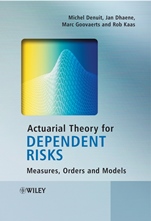
Actuarial Theory for Dependent Risks: Measures, Orders and Models
ISBN 9780470014929
Autor: Michel Denuit, Jan Dhaene, Marc Goovaerts, Rob Kaas
Wydawca: Wiley
Dostępność: 3-6 tygodni
Cena: 575,40 zł
Przed złożeniem zamówienia prosimy o kontakt mailowy celem potwierdzenia ceny.
ISBN13: |
9780470014929 |
ISBN10: |
047001492X |
Autor: |
Michel Denuit, Jan Dhaene, Marc Goovaerts, Rob Kaas |
Oprawa: |
Hardback |
Rok Wydania: |
2005-07-08 |
Ilość stron: |
458 |
Wymiary: |
251x168 |
Tematy: |
KF |
The increasing complexity of insurance and reinsurance products has seen a growing interest amongst actuaries in the modelling of dependent risks. For efficient risk management, actuaries need to be able to answer fundamental questions such as: Is the correlation structure dangerous? And, if yes, to what extent? Therefore tools to quantify, compare, and model the strength of dependence between different risks are vital. Combining coverage of stochastic order and risk measure theories with the basics of risk management and stochastic dependence, this book provides an essential guide to managing modern financial risk.Describes how to model risks in incomplete markets, emphasising insurance risks.Explains how to measure and compare the danger of risks, model their interactions, and measure the strength of their association.Examines the type of dependence induced by GLM–based credibility models, the bounds on functions of dependent risks, and probabilistic distances between actuarial models.Detailed presentation of risk measures, stochastic orderings, copula models, dependence concepts and dependence orderings.Includes numerous exercises allowing a cementing of the concepts by all levels of readers.Solutions to tasks as well as further examples and exercises can be found on a supporting website.
An invaluable reference for both academics and practitioners alike, Actuarial Theory for Dependent Risks will appeal to all those eager to master the up–to–date modelling tools for dependent risks. The inclusion of exercises and practical examples makes the book suitable for advanced courses on risk management in incomplete markets. Traders looking for practical advice on insurance markets will also find much of interest.
Spis treści:
Foreword.
Preface.
PART I: THE CONCEPT OF RISKS.
1. Modelling Risks.
1.1 Introduction.
1.2 The Probabilitsic Description of Risks.
1.3 In
depenance for Events and Conditional Probabilities.
1.4 Random Variables and Vectors.
1.5 Distribution Functions.
1.6 Mathematical Expectation.
1.7 Transforms.
1.8 Conditional Ditsributions.
1.9 Comonotonicity.
1.10 Mutual Exclusivity.
1.11 Exercises.
2. Measuring Risk.
2.1 Introduction.
2.2 Risk Measures.
2.3 Value–at–Risk.
2.4 Tail Value–at–Risk.
2.5 Risk MEasures Based on Expected Utility Theory.
2.6 Risk Measures Based on Distorted Expectation Theory.
2.7 Exercises.
2.8 Appendix: Convexity and Concavity.
3. Comparing Risks.
3.1 Introduction.
3.2 Stochastic Order Relations.
3.3 Stochastic Dominance.
3.4 Convex and Stop–Loss Orders.
3.5 Exercises.
PART II: DEPENDANCE BETWEEN RISKS.
4. Modelling Dependence.
4.1 Introduction.
4.2 Sklar′s Representation Theorem.
4.3 Families of Bivariate Copulas.
4.4 Properties of Copulas.
4.5 The Archimedean Family of Cpoulas.
4.6 Simulation from Given Marginals and Copula.
4.7 Multivariate Copulas.
4.8 Loss–Alae Modelling with Archimedean Copulas: A Case Study.
4.9 Exercises.
5. Measuring Depenence.
5.1 Introduction.
5.2 Concordance Measures.
5.3 Dependence Structures.
5.4 Exercises.
6. Comparing Depe6.1 Introduction.
6.2 Comparing in the Bivariate Case Using the Correlation Order.
6.3 Comparing Dependence in the Multivariate Case Using the Supermodular Order.
6.4 Positive Orthant Depenedence Order.
6.5 Exercises.
PART III: APPLICATIONS TO INSURANCE MATHEMATICS.
7. Depenedence in Credibility Models Based on Generalized Linear Models.
7.1 Introduction.
7.2 Poisson Static Credibility for Claim Frequencies.
7.3 More Results for the Static Credibility Model.
7.4 More Results for the Dynamic Credibility Models.
7.5 On the Depenedence Induced By Bonus–Malus Scales.
7.6 Credibility Theory and Time Series for Non–Normal Da
ta.
7.7 Exercises.
8. Stochastic Bounds on Functions of Dependent Risks.
8.1 Introduction.
8.2 Comparing Risks with Fixed Depoenedence Structure.
8.3 Stop–Loss Bounds on Functions of Dependent Risks.
8.4 Stochastic Bounds on Functions of Dependent Risks.
8.5 Some Financial Applications.
8.6 Exercises.
9. Integral Orderings and Probability Metrics.
9.1 Introduction.
9.2 Integral Stochastic Oredrings.
9.3 Integral Probability Metrics.
9.4 Total–Variation Distance.
9.5 Kolmogorov Distance.
9.6 Wasserstein Distance.
9.7 Stop–Loss Distance.
9.8 Integrated Stop–Loss Distance.
9.9 Distance Between the Individual and Collective Models in Risk Theory.
9.10 Compound Poisson Approximation for a Portfolio of Dependent Risks.
9.11 Exercises.
References.
Index.
Nota biograficzna:
Michel Denuit – Michel Denuit is Professor of Statistics and Actuarial Science at the Université catholique de Louvain, Belgium. His major fields of research are risk theory and stochastic inequalities. He (co–)authored numerous articles appeared in applied and theoretical journals and served as member of the editorial board for several journals (including Insurance: Mathematics and Economics). He is a section editor on Wiley’s Encyclopedia of Actuarial Science.
Jan Dhaene, Faculty of Economics and Applied Economics KULeuven, Belgium.
Marc Goovaerts, Professor of Actuarial Science (Non–life Insurance) at University of Amsterdam (The Netherlands) and Catholique University of Leuven (Belgium)
Rob Kaas, Professor of Actuarial Science (Actuarial Statistics), U. Amsterdam, The Netherlands.
Okładka tylna:
The increasing complexity of insurance and reinsurance products has seen a growing interest amongst actuaries in the modelling of dependent risks. For efficient risk management, actuaries need to be able to answer fu
ndamental questions such as: Is the correlation structure dangerous? And, if yes, to what extent? Therefore tools to quantify, compare, and model the strength of dependence between different risks are vital. Combining coverage of stochastic order and risk measure theories with the basics of risk management and stochastic dependence, this book provides an essential guide to managing modern financial risk.Describes how to model risks in incomplete markets, emphasising insurance risks.Explains how to measure and compare the danger of risks, model their interactions, and measure the strength of their association.Examines the type of dependence induced by GLM–based credibility models, the bounds on functions of dependent risks, and probabilistic distances between actuarial models.Detailed presentation of risk measures, stochastic orderings, copula models, dependence concepts and dependence orderings.Includes numerous exercises allowing a cementing of the concepts by all levels of readers.Solutions to tasks as well as further examples and exercises can be found on a supporting website.
An invaluable reference for both academics and practitioners alike, Actuarial Theory for Dependent Risks will appeal to all those eager to master the up–to–date modelling tools for dependent risks. The inclusion of exercises and practical examples makes the book suitable for advanced courses on risk management in incomplete markets. Traders looking for practical advice on insurance markets will also find much of interest.
Koszyk
Książek w koszyku: 0 szt.
Wartość zakupów: 0,00 zł
Informacje


Kontakt
Gambit
Centrum Oprogramowania
i Szkoleń Sp. z o.o.
Al. Pokoju 29b/22-24
31-564 Kraków
Siedziba Księgarni
ul. Kordylewskiego 1
31-542 Kraków
+48 12 410 5991
+48 12 410 5987
+48 12 410 5989
Subskrypcje
Administratorem danych osobowych jest firma Gambit COiS Sp. z o.o. Na podany adres będzie wysyłany wyłącznie biuletyn informacyjny.
Autoryzacja płatności

Informacje na temat autoryzacji płatności poprzez PayU.

© Copyright 2012: GAMBIT COiS Sp. z o.o. Wszelkie prawa zastrzeżone.
Projekt i wykonanie: Alchemia Studio Reklamy