


Wydawcy
Katalog tematyczny
- Archeologia (109)
- Ekonomia, finanse, business (13704)
- Filozofia (1445)
- Historia (3040)
- Języki i językoznawstwo (2356)
- Lifestyle, hobby i rozrywka (475)
- Medycyna (9704)
- Nauki humanistyczne (4)
- Nauki o Ziemi i środowisku (2638)
- Nauki ścisłe (20412)
- Astronomia (294)
- Biologia (5119)
- Chemia (6540)
- Chemia analityczna (361)
- Chemia fizyczna (346)
- Chemia nieorganiczna (137)
- Chemia organiczna (535)
- Krystalografia (27)
- Minerologia (46)
- Fizyka (3309)
- Matematyka (4574)
- Nauki ścisłe, ogólnie (503)
- Nauki społeczne (8486)
- Nauki techniczne (13450)
- Prawo (1696)
- Publikacje informacyjne i interdyscyplinarne (1288)
- Religia i wierzenia (917)
- Technika komputerowa (4067)
- Zdrowie, relacje międzyludzkie i rozwój osobisty (657)





Informacje szczegółowe o książce
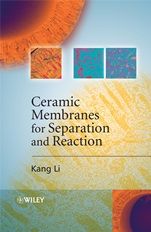
Ceramic Membranes for Separation and Reaction
ISBN 9780470014400
Autor: Kang Li
Wydawca: Wiley
Dostępność: 3-6 tygodni
Cena: 858,90 zł
Przed złożeniem zamówienia prosimy o kontakt mailowy celem potwierdzenia ceny.
ISBN13: |
9780470014400 |
ISBN10: |
0470014407 |
Autor: |
Kang Li |
Oprawa: |
Hardback |
Rok Wydania: |
2007-03-30 |
Ilość stron: |
316 |
Wymiary: |
252x170 |
Tematy: |
PN |
Ceramic membranes have been developed for similar process applications to polymeric membranes applications, including ultrafiltration, desalination, gas separation, pervaporation, and biochemical reactions. They are used especially where high alkaline (or acid) feed solution or high temperature operation precludes the use of existing polymeric membranes. In general, a ceramic membrane can be described as a permselective barrier or a fine sieve. Ceramic membranes are usually composite ones consisting of several layers of one or more different ceramic materials. They generally have a macroporous support, one or two mesoporous intermediate layers and a microporous (or a dense) top layer. The bottom layer provides mechanical support, while the middle layers bridge the pore size differences between the support layer and the top layer where the actual separation takes place. Commonly used materials for ceramic membranes are Al2O3, TiO2, ZrO2 and SiO2 or a combination of these materials.
This book is a single–authored guide to the developing area of ceramic membranes. It starts by documenting established procedures of ceramic membrane preparation and characterization. The book then focuses on gas separation, the processes involved with the transport and separation of gases in porous ceramic membranes, ceramic membrane modules for gas treatments, the transport of oxygen and hydrogen in dense ceramic membranes, and ceramic hollow fiber membranes for oxygen enrichment. The final chapter covers ceramic membrane reactors. Chapters provide key examples to illustrate membrane synthesis, characterization and applications in industry. The theoretical principles, advantages and disadvantages of using ceramic membranes under the various conditions are discussed where applicable.
The book is aimed at industrial and academic researchers and process developers working on membrane technology and development. Industries for which this book is applicable include: pharmaceutica
l, food and beverage, biomedical applications (tissue development), waste and wastewater treatment, petrochemicals and energy conversion. It is also relevant to upper–level undergraduates and Masters students taking modules on membrane science, as well as PhD candidates within departments of chemical and process development who would use this book as a source of reference.
Spis treści:
Chapter 1.
Ceramic Membranes and Membrane Processes.
1.1 Introduction.
1.2 Membrane Processes.
1.2.1 Gas separation.
1.2.2 Pervaporation.
1.2.3 Reverse osmosis and nanofiltration.
1.2.4 Ultrafiltration and microfiltration.
1.2.5. Dialysis.
1.2.6 Electrodialysis.
1.2.7 Membrane contactor.
1.2.8 Membrane reactors.
References.
Chapter 2.
Preparation of Ceramic Membranes.
2.1 Introduction.
2.2 Slip casting.
2.3 Tape casting.
2.4 Pressing.
2.5 Extrusion.
2.6 Sol–gel process.
2.7 Dip–coating.
2.8 Chemical vapour deposition (CVD).
2.9 Preparation of hollow fibre ceramic membranes.
2.9.1 Preparation of spinning suspension.
2.9.2 Spinning of ceramic hollow fibre precursors.
2.9.3 Sintering.
2.9.4 Example 1: Preparation of porous Al2O3 hollow fibre membranes.
2.9.5 Example 2: Preparation of TiO2/Al2O3 composite hollow fibre membranes.
2.9.6 Example 3: Preparation of dense perovskite hollow fibre membranes.
Appendix 2.1: Surface forces.
References.
Chapter 3.
Characterisation of Ceramic Membranes.
3.1 Introduction.
3.2 Morphology of membrane surfaces and cross sections.
3.3 Porous ceramic membranes.
3.3.1 Gas adsorption/desorption isotherms.
3.3.2 Permporometry.
3.3.3 Mercury porosimetry.
3.3.4 Thermoporometry.
3.3.5 Liquid displacement techniques.
(a) Bubble point method.
(b) Liquid displacement method.
3.3.6 Permeation method.
(a) Liquid permeation.
(b)
Gas permeation.
3.3.7 Measurements of solute rejection.
3.4 Dense ceramic membranes.
3.4.1 Leakage test.
3.4.2 Permeation measurements.
3.4.3 XRD.
3.4.4 Mechanical strength.
Notation.
References.
Chapter 4.
Transport and Separation of Gases in Porous Ceramic Membranes.
4.1 Introduction.
4.2 Performance indicators of gas separation membranes.
4.3 Ceramic membranes for gas separation.
4.4 Transport Mechanisms.
4.4.1 Knudsen and slip flow.
4.4.2 Viscous flow.
4.4.3 Surface flow.
4.4.4 Capillary condensation.
4.4.5 Configurational or micropore diffusion.
4.4.6 Simultaneous occurrence of different mechanism.
4.5 Modification of porous ceramic membranes for gas separation.
4.6 Resistance model for gas transport in composite membranes.
4.6.1 Effect of support layers.
4.6.2 Effect of non–zeolitic pores.
4.6.3 Effect of coating.
4.7 System design.
4.7.1 Operating Schemes.
(a) Perfect mixing.
(b) Cross flow.
(c ) Parallel plug flow.
4.7.2 Design equations for membrane processes in gas separation.
(a) Perfect mixing.
(b) Cross flow.
(c) Cocurrent flow.
(d) Countercurrent flow.
Notation.
References.
Chapter 5.
Ceramic Hollow Fibre Membrane Contactors for Treatment of Gases/Vapours.
5.1 Introduction.
5.2 General review.
5.3 Operating modes and mass transfer coefficients.
5.3.1 Nonwetted mode.
5.3.2 Wetted mode.
5.3.3 Mass transfer coefficients determined from experiments.
5.4 Mass transfer in hollow fibre contactors.
5.4.1 Mass transfer in hollow fibre lumen.
5.4.2 Mass transfer across membrane.
5.4.3 Mass transfer in shell side of a contactor.
5.4.4 Nonwetted, wetted, and partially wetted conditions in a hollow fibre contactor.
5.5 Effect of chemical reaction.
5.5.1 Instantaneous reaction.
5.5.2 Fast reaction.
5.6 Design equations.
Notation.
References.
Appendix A.
Chapter 6.
Mixed Conducting Cera
mic Membranes for Oxygen Separation.
6.1 Introduction.
6.2 Fundamentals of mixed conducting ceramic materials.
6.2.1 Structure of peroviskite–type of materials.
6.2.2 Doping strategies.
6.2.3 Properties of materials.
6.3 Current status in oxygen permeable membranes.
6.3.1 Pervoskite–type oxides.
Sr(Co,Fe)O3–d (SCFO).
La(Co,Fe)O3–d (LCFO).
LaGaO3(LGO).
6.3.2 Non–perovskite–type oxides.
6.3.3 Summary of ceramic oxygen permeable materials.
6.4 Dual phase membranes.
6.5 Oxygen transport.
6.5.1 Transport mechanism.
6.5.2 Transport equations.
6.5.3 Transport analysis.
6.6 Air separation.
6.6.1 Design equations.
Cocurrent flow.
Countercurrent flow.
6.6.2 Performance analysis.
Effect of operating pressures and temperatures.
Effect of flow patterns.
Effect of feed flow rate.
Effect of membrane area.
Comparison with experimental data.
Production of oxygen using hollow fibre modules.
6.7 Further development–challenges and prospects.
Notation.
References.
Chapter 7.
Mixed Conducting Ceramic Membranes for Hydrogen Permeation.
7.1 Introduction.
7.2 Proton and electron (hole) conducting materials and membranes.
7.2.1 Pervoskite–type oxides.
7.2.2 Non–pervoskite–type oxides.
7.3 Dual phase membranes.
7.4 Proton transport.
7.4.1 Transport mechanism.
7.4.2 Transport equations for mixed proton–hole conducting membranes.
7.4.3 Transport analysis.
Effect of membrane thickness.
Effect of temperature.
Effect of partial pressure of oxygen.
Comparison with experimental data.
7.5 Applications of proton conducting ceramic membranes.
7.5.1 Hydrogen production.
7.5.2 Dehydrogenation reactions.
Notation.
References.
Chapter 8.
Ceramic Membrane Reactors.
8.1 Introduction.
8.2 Membranes as product separators.
8.2.1 Microporous membrane re
Koszyk
Książek w koszyku: 0 szt.
Wartość zakupów: 0,00 zł
Informacje


Kontakt
Gambit
Centrum Oprogramowania
i Szkoleń Sp. z o.o.
Al. Pokoju 29b/22-24
31-564 Kraków
Siedziba Księgarni
ul. Kordylewskiego 1
31-542 Kraków
+48 12 410 5991
+48 12 410 5987
+48 12 410 5989
Subskrypcje
Administratorem danych osobowych jest firma Gambit COiS Sp. z o.o. Na podany adres będzie wysyłany wyłącznie biuletyn informacyjny.
Autoryzacja płatności

Informacje na temat autoryzacji płatności poprzez PayU.

© Copyright 2012: GAMBIT COiS Sp. z o.o. Wszelkie prawa zastrzeżone.
Projekt i wykonanie: Alchemia Studio Reklamy