


Wydawcy
Katalog tematyczny
- Archeologia (109)
- Ekonomia, finanse, business (13704)
- Filozofia (1445)
- Historia (3040)
- Języki i językoznawstwo (2356)
- Lifestyle, hobby i rozrywka (475)
- Medycyna (9704)
- Chirurgia (272)
- Inne gałęzie medycyny (1871)
- Medycyna kliniczna (4187)
- Choroby wewnętrzne (514)
- Dermatologia (51)
- Diagnostyka medyczna (3)
- Endokrynologia (144)
- Gastroenterologia (27)
- Geriatria (50)
- Ginekologia i położnictwo (134)
- Hematologia (46)
- Hepatologia (10)
- Kardiologia (71)
- Laryngologia (12)
- Nefrologia (10)
- Neurologia (500)
- Oftalmologia (50)
- Pediatria (33)
- Pulmunologia (32)
- Reumatologia (14)
- Terapia genowa (1)
- Układ mięśniowo-szkieletowy (1)
- Urologia (14)
- Medycyna niekonwencjonalna (14)
- Medycyna przedkliniczna (269)
- Medycyna, ogólnie (1740)
- Medyczne służby pomocnicze (745)
- Studia medyczne (16)
- Weterynaria (548)
- Nauki humanistyczne (4)
- Nauki o Ziemi i środowisku (2638)
- Nauki ścisłe (20412)
- Nauki społeczne (8486)
- Nauki techniczne (13450)
- Prawo (1696)
- Publikacje informacyjne i interdyscyplinarne (1288)
- Religia i wierzenia (917)
- Technika komputerowa (4067)
- Zdrowie, relacje międzyludzkie i rozwój osobisty (657)





Informacje szczegółowe o książce
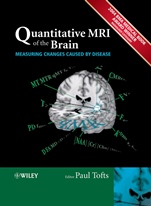
Quantitative MRI of the Brain: Measuring Changes Caused by Disease
ISBN 9780470014295
Autor: Paul Tofts
Wydawca: Wiley
Dostępność: 3-6 tygodni
Cena: 718,20 zł
Przed złożeniem zamówienia prosimy o kontakt mailowy celem potwierdzenia ceny.
ISBN13: |
9780470014295 |
ISBN10: |
0470014296 |
Autor: |
Paul Tofts |
Oprawa: |
Paperback |
Rok Wydania: |
2004-12-24 |
Ilość stron: |
650 |
Wymiary: |
252x190 |
Tematy: |
MJ |
The MRI machine is undergoing change in how it is used. Used conventionally, it produces images, which are viewed qualitatively by radiologists. Unusually dark, light, large or small areas are noted, and subtle changes cannot be detected. In its new use,that of a scientific instrument making measurements in the human brain, a myriad of physical and biological quantities can be measured for each small voxel of brain, of dimensions typically between 1–3 mm.
The book opens with a section on concepts which explores the principles of good practice in quantification, including quality assurance, MR data collection, and analysis aspects. Current limits are discussed in detail, and solutions proposed. A chapter on each of the major physical quantities follows (including proton density, T1, T2, diffusion, magnetisation transfer, spectroscopy, functional MRI and arterial spin labelling). The physical principles behind each quantity are given followed by their biological significance, practical techniques for measuring the quantity imperfections that can arise in the measuring process, and an extensive survey of clinical applications of that quantity. The pathological correlations with the MR quantities are discussed.
This is an indispensable ‘how to’ manual of quantitative MR, essential for anyone who wants to use the gamut of modern quantitative methods to measure the effects of neurological disease, its progression, and its response to treatment. It will appeal to research–minded radiologists, neurologists and MRI physicists who are considering undertaking quantitative work, as well as those already in the field.
Professor Paul Tofts has worked on the physical aspects of quantitative brain imaging since the early days of clinical NMR. He was the first to measure in–vivo concentrations of metabolites, and to use dynamic imaging to measure blood–brain barrier permeability and extra–cellular space in multi
ple sclerosis.
"Paul Tofts has succeeded brilliantly in capturing the essence of what needs to become the future of radiology" – from the Foreword by Robert I Grossmann, M.D., Louis Marx Professor and Chairman, Professor of Radiology, Neurosurgery, Neurology, Physiology and Neuroscience, New York University School of Medicine
Spis treści:
Contributors.
Reviewers.
Foreward.
Introduction.
SECTION A: THE MEASUREMENT PROCESS.
1. Concepts: Measurement and MR (Paul S. Tofts).
2. The Measurement Process: MR Data Collection and Image Analysis (Paul S. Tofts).
3. QA: Quality Assurance, Accuracy, Precision and Phantoms (Paul S. Tofts).
SECTION B: WINDOWS INTO THE BRAIN; MEASURING MR PARAMETERS.
4. PD: Proton Density of Tissue Water (Paul Tofts).
5. T1: the Longitudinal Relaxation Time (Penny A. Gowland and Valerie L. Stevenson).
6. T2: the Transverse Relaxation Time (Philip A. Boulby and Fergus J. Rugg–Gunn).
7. D: the Diffusion of Water (Claudia A.M. Wheeler–Kingshott, Gareth J. Barker, Stefan C.A. Steens and Mark A. van Buchem).
8. MT: Magnetisation Transfer (Paul S. Tofts, Stefan C.A. Steens and Mark A. van Buchem).
9. Spectroscopy: 1H Metabolite Concentrations (Paul S. Tofts and Adam D. Waldman).
10. T1–w DCE–MRI: T1–weighted Dynamic Contrast–enhance d MRI (Geoff J.M. Parker and Anwar Padhani).
11. T2– and T2∗–w DCE–MRI: Blood Perfusion and Volume Estimation using Bolus Tracking (Richard P. Kennan and H. Rolf Ja¨ger).
12. Functional MRI (Peter Jezzard and Nick F. Ramsay).
13. ASL: Blood Perfusion Measurements using Arterial Spin Labelling (Laura M. Parkes, John A. Detre).
SECTION C: THE BIOLOGY.
14. Biology: The Significance of MR Parameters in Multiple Sclerosis (Bruno Brochet, Klaus G. Petry and Vincent Do
usset).
SECTION D: ANALYSING IMAGES.
15. Spatial Registration of Images (John Ashburner and Catriona D. Good).
16. Volume and Atrophy (Geoff J.M. Parker and Declan T. Chard).
17. Shape and Texture (William R. Crum).
18. Histograms: Measuring Subtle Diffuse Disease (Paul S. Tofts, Gerard R. Davies and Jamshid Dehmeshki ).
SECTION E: WHERE ARE WE GOING?
19. The Future of qMRI: Conclusions and Speculation (Paul S. Tofts).
Appendix 1: Greek Alphabet for Scientific Use.
Index.
Nota biograficzna:
Professor Paul Tofts has worked on the physical aspects of quantitative brain imaging since the early days of clinical NMR. He was the first to measure in–vivo concentrations of metabolites, and to use dynamic imaging to measure blood–brain barrier permeability and extra–cellular space in multiple sclerosis.
Okładka tylna:
The MRI machine is undergoing change in how it is used. Used conventionally, it produces images, which are viewed qualitatively by radiologists. Unusually dark, light, large or small areas are noted, and subtle changes cannot be detected. In its new use,that of a scientific instrument making measurements in the human brain, a myriad of physical and biological quantities can be measured for each small voxel of brain, of dimensions typically between 1–3 mm.
The book opens with a section on concepts which explores the principles of good practice in quantification, including quality assurance, MR data collection, and analysis aspects. Current limits are discussed in detail, and solutions proposed. A chapter on each of the major physical quantities follows (including proton density, T1, T2, diffusion, magnetisation transfer, spectroscopy, functional MRI and arterial spin labelling). The physical principles behind each quantity are given followed by their biological significance, practical techniques for measuring the quantity imperfections that can arise in t
he measuring process, and an extensive survey of clinical applications of that quantity. The pathological correlations with the MR quantities are discussed.
This is an indispensable ‘how to’ manual of quantitative MR, essential for anyone who wants to use the gamut of modern quantitative methods to measure the effects of neurological disease, its progression, and its response to treatment. It will appeal to research–minded radiologists, neurologists and MRI physicists who are considering undertaking quantitative work, as well as those already in the field.
Professor Paul Tofts has worked on the physical aspects of quantitative brain imaging since the early days of clinical NMR. He was the first to measure in–vivo concentrations of metabolites, and to use dynamic imaging to measure blood–brain barrier permeability and extra–cellular space in multiple sclerosis.
"Paul Tofts has succeeded brilliantly in capturing the essence of what needs to become the future of radiology" – from the Foreword by Robert I Grossmann, M.D., Louis Marx Professor and Chairman, Professor of Radiology, Neurosurgery, Neurology, Physiology and Neuroscience, New York University School of Medicine
Koszyk
Książek w koszyku: 0 szt.
Wartość zakupów: 0,00 zł
Informacje


Kontakt
Gambit
Centrum Oprogramowania
i Szkoleń Sp. z o.o.
Al. Pokoju 29b/22-24
31-564 Kraków
Siedziba Księgarni
ul. Kordylewskiego 1
31-542 Kraków
+48 12 410 5991
+48 12 410 5987
+48 12 410 5989
Subskrypcje
Administratorem danych osobowych jest firma Gambit COiS Sp. z o.o. Na podany adres będzie wysyłany wyłącznie biuletyn informacyjny.
Autoryzacja płatności

Informacje na temat autoryzacji płatności poprzez PayU.

© Copyright 2012: GAMBIT COiS Sp. z o.o. Wszelkie prawa zastrzeżone.
Projekt i wykonanie: Alchemia Studio Reklamy