


Wydawcy
Katalog tematyczny
- Archeologia (109)
- Ekonomia, finanse, business (13704)
- Filozofia (1445)
- Historia (3040)
- Języki i językoznawstwo (2356)
- Lifestyle, hobby i rozrywka (475)
- Medycyna (9704)
- Nauki humanistyczne (4)
- Nauki o Ziemi i środowisku (2638)
- Nauki ścisłe (20412)
- Astronomia (294)
- Biologia (5119)
- Chemia (6540)
- Fizyka (3309)
- Elektryczność i magnetyzm (90)
- Fizyka atomowa i molekularna (110)
- Fizyka cząstek elementarnych (36)
- Fizyka jądra atomowego (36)
- Fizyka kwantowa (210)
- Fizyka matematyczna (121)
- Fizyka relatywistyczna (36)
- Fizyka statystyczna (51)
- Fizyka stosowana (498)
- Mechanika klasyczna (186)
- Optyka i światło (133)
- Stany materii (202)
- Matematyka (4574)
- Nauki ścisłe, ogólnie (503)
- Nauki społeczne (8486)
- Nauki techniczne (13450)
- Prawo (1696)
- Publikacje informacyjne i interdyscyplinarne (1288)
- Religia i wierzenia (917)
- Technika komputerowa (4067)
- Zdrowie, relacje międzyludzkie i rozwój osobisty (657)





Informacje szczegółowe o książce
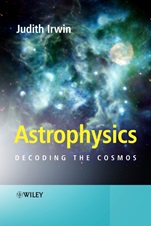
Astrophysics: Decoding the Cosmos
ISBN 9780470013052
Autor: Judith Ann Irwin
Wydawca: Wiley
Dostępność: 3-6 tygodni
Cena: 904,05 zł
Przed złożeniem zamówienia prosimy o kontakt mailowy celem potwierdzenia ceny.
ISBN13: |
9780470013052 |
ISBN10: |
0470013052 |
Autor: |
Judith Ann Irwin |
Oprawa: |
Hardback |
Rok Wydania: |
2007-04-20 |
Ilość stron: |
446 |
Wymiary: |
248x168 |
Tematy: |
PH |
Astrophysics: Decoding the Cosmos is an accessible introduction to the key principles and theories underlying astrophysics.
This text takes a close look at the radiation and particles that we receive from astronomical objects, providing a thorough understanding of what this tells us, drawing the information together using examples to illustrate the process of astrophysics. Chapters dedicated to objects showing complex processes are written in an accessible manner and pull relevant background information together to put the subject firmly into context.
The intention of the author is that the book will be a ‘tool chest’ for undergraduate astronomers wanting to know the how of astrophysics. Students will gain a thorough grasp of the key principles, ensuring that this often–difficult subject becomes more accessible.
Spis treści:
Preface.
Acknowledgments.
Introduction.
Appendix: dimensions, units and equations.
PART I THE SIGNAL OBSERVED.
1 Defining the signal.
1.1 The power of light – luminosity and spectral power.
1.2 Light through a surface – flux and flux density.
1.3 The brightness of light – intensity and specific intensity.
1.4 Light from all angles – energy density and mean intensity.
1.5 How light pushes – radiation pressure.
1.6 The human perception of light – magnitudes.
1.7 Light aligned – polarization.
Problems.
2 Measuring the signal.
2.1 Spectral filters and the panchromatic universe.
2.2 Catching the signal – the telescope.
2.3 The Corrupted signal – the atmosphere.
2.4 Processing the signal.
2.5 Analysing the signal.
2.6 Visualizing the signal.
Problems.
Appendix: refraction in the Earth’s atmosphere.
PART II MATTER AND RADIATION ESSENTIALS.
3 Matter essentials.
3.1 The Big Bang.
3.2 Dark and light matter.
3.3 Abun
dances of the elements.
3.4 The gaseous universe.
3.5 The dusty Universe.
3.6 Cosmic rays.
Problems.
Appendix: the electron/proton ratio in cosmic rays.
4 Radiation essentials.
4.1 Black body radiation.
4.2 Grey bodies and planetary temperatures.
Problems.
Appendix: derivation of the Planck function.
4.A.1 The statistical weight.
4.A.2 The mean energy per state.
4.A.3 The specific energy density and specific intensity.
PART III THE SIGNAL PERTURBED.
5 The interaction of light with matter.
5.1 The photon redirected – scattering.
5.2 The photon lost – absorption.
5.3 The wavefront redirected – refraction.
5.4 Quantifying opacity and transparency.
5.5 The opacity of dust – extinction.
Problems.
6 The signal transferred.
6.1 Types of energy transfer.
6.2 The equation of transfer.
6.3 Solutions to the equation of transfer.
6.4 Implications of the LTE solution.
Problems.
7 The interaction of light with space.
7.1 Space and time.
7.2 Redshifts and blueshifts.
7.3 Gravitational refraction.
7.4 Time variability and source size.
Problems.
PART IV THE SIGNAL EMITTED.
8 Continuum emission.
8.1 Characteristics of continuum emission – thermal and non–thermal.
8.2 Bremsstrahlung (free–free) emission.
8.3 Free–bound (recombination) emission.
8.4 Two–photon emission.
8.5 Synchrotron (and cyclotron) radiation.
8.5.4 Synchrotron sources – spurs, bubbles, jets, lobes and relics.
8.6 Inverse Compton radiation.
Problems.
9 Line emission.
9.1 The richness of the spectrum – radio waves to gamma rays.
9.2 The line strengths, thermalization, and the critical gas density.
9.3 Line broadening.
9.4 Probing physical conditions via electronic transitions.
9.5 Probing physical conditions via molecular transitions.
Problems.
PART V THE SIGNAL DECODED.
10 Forensic astronomy.
10.1 Complex spectra.
10.2 Case studies – the active, the young, and the old.
10.3 The messenger and the message.
Problems.
Appendix A: Mathematical and geometrical relations.
A.1 Taylor series.
A.2 Binomial expansion.
A.3 Exponential expansion.
A.4 Convolution.
A.5 Properties of the ellipse.
Appendix B: Astronomical geometry.
B.1 One–dimensional and two–dimensional angles.
B.2 Solid angle and the spherical coordinate system.
Appendix C: The hydrogen atom.
C.1 The hydrogen spectrum and principal quantum number.
C.2 Quantum numbers, degeneracy, and statistical weight.
C.3 Fine structure and the Zeeman effect.
C.4 The l 21 cm line of neutral hydrogen.
Appendix D: Scattering processes.
D.1 Elastic, or coherent scattering.
D.1.1 Scattering from free electrons – Thomson scattering.
D.1.2 Scattering from bound electrons I: the oscillator model.
D.1.3 Scattering from bound electrons II: quantum mechanics.
D.1.4 Scattering from bound electrons III: resonance scattering and the natural line shape.
D.1.5 Scattering from bound electrons IV: Rayleigh scattering.
D.2 Inelastic scattering – Compton scattering from free electrons.
D.3 Scattering by dust.
Appendix E: Plasmas, the plasma frequency, and plasma waves.
Appendix F: The Hubble relation and the expanding Universe.
F.1 Kinematics of the Universe.
F.2 Dynamics of the Universe.
F.3 Kinematics, dynamics and high redshifts.
Appendix G: Tables and Figures.
References.
Index.
Nota biograficzna:
Dr Judith Ann Irwin, Department of Physics, Queen’s University, Kingston Ontario, Canada.
Koszyk
Książek w koszyku: 0 szt.
Wartość zakupów: 0,00 zł
Informacje


Kontakt
Gambit
Centrum Oprogramowania
i Szkoleń Sp. z o.o.
Al. Pokoju 29b/22-24
31-564 Kraków
Siedziba Księgarni
ul. Kordylewskiego 1
31-542 Kraków
+48 12 410 5991
+48 12 410 5987
+48 12 410 5989
Subskrypcje
Administratorem danych osobowych jest firma Gambit COiS Sp. z o.o. Na podany adres będzie wysyłany wyłącznie biuletyn informacyjny.
Autoryzacja płatności

Informacje na temat autoryzacji płatności poprzez PayU.

© Copyright 2012: GAMBIT COiS Sp. z o.o. Wszelkie prawa zastrzeżone.
Projekt i wykonanie: Alchemia Studio Reklamy