


Wydawcy
Katalog tematyczny
- Archeologia (109)
- Ekonomia, finanse, business (13704)
- Filozofia (1445)
- Historia (3040)
- Języki i językoznawstwo (2356)
- Lifestyle, hobby i rozrywka (475)
- Medycyna (9704)
- Nauki humanistyczne (4)
- Nauki o Ziemi i środowisku (2638)
- Nauki ścisłe (20412)
- Nauki społeczne (8486)
- Nauki techniczne (13450)
- Prawo (1696)
- Publikacje informacyjne i interdyscyplinarne (1288)
- Religia i wierzenia (917)
- Technika komputerowa (4067)
- Zdrowie, relacje międzyludzkie i rozwój osobisty (657)





Informacje szczegółowe o książce
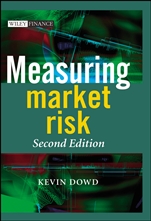
Measuring Market Risk
ISBN 9780470013038
Autor: Kevin Dowd
Wydawca: Wiley
Dostępność: 3-6 tygodni
Cena: 406,35 zł
Przed złożeniem zamówienia prosimy o kontakt mailowy celem potwierdzenia ceny.
ISBN13: |
9780470013038 |
ISBN10: |
0470013036 |
Autor: |
Kevin Dowd |
Oprawa: |
Hardback |
Rok Wydania: |
2005-05-27 |
Numer Wydania: |
2nd Edition |
Ilość stron: |
410 |
Wymiary: |
244x168 |
Tematy: |
KF |
The second edition of Measuring Market Risk provides an extensive treatment of the state of the art in market risk measurement. The book covers all aspects of modern market risk measurement, and in doing so emphasises new developments in the subject such as coherent and spectral risk measures, the uses of copulas, new applications of stochastic methods, and new developments in backtesting.
The topics covered include: the rise of VaR as a risk measure; different measures of financial risk (including coherent and distortion risk measures); non–parametric approaches (including the bootstrap, order statistics, non–parametric density estimation, and principal components and factor analysis); parametric approaches (including copulas and extreme–value approaches); the theory and applications of stochastic methods; the forecasting of volatilities and correlations; liquidity risk; options risk measurement; risk decomposition; mapping; stress–testing; backtesting; and model risk.
Measuring Market Risk is written in a clear and accessible style, and includes many worked examples of market risk measurement problems. It also comes with a CD–ROM containing a set of Excel workbooks and an extensive set of MATLAB risk measurement functions.
Spis treści:
Preface to the Second Edition
Acknowledgements
1 The Rise of Value at Risk
1.1 The emergence of financial risk management
1.2 Market risk management
1.3 Risk management before VaR
1.4 Value at risk
Appendix 1: Types of Market Risk
2 Measures of Financial Risk
2.1 The Mean–Variance framework for measuring financial risk
2.2 Value at risk
2.3 Coherent risk measures
2.4 Conclusions
Appendix 1: Probability Functions
Appendix 2: Regulatory Uses of VaR
3 Estimating Market Risk Measures: An Introduction and Overview
3.1 Data
3.2 Estimating historical simula
tion VaR
3.3 Estimating parametric VaR
3.4 Estimating coherent risk measures
3.5 Estimating the standard errors of risk measure estimators
3.6 Overview
Appendix 1: Preliminary Data Analysis
Appendix 2: Numerical Integration Methods
4 Non–parametric Approaches
4.1 Compiling historical simulation data
4.2 Estimation of historical simulation VaR and ES
4.3 Estimating confidence intervals for historical simulation VaR and ES
4.4 Weighted historical simulation
4.5 Advantages and disadvantages of non–parametric methods
4.6 Conclusions
Appendix 1: Estimating Risk Measures with Order Statistics
Appendix 2: The Bootstrap
Appendix 3: Non–parametric Density Estimation
Appendix 4: Principal Components Analysis and Factor Analysis
5 Forecasting Volatilities, Covariances and Correlations
5.1 Forecasting volatilities
5.2 Forecasting covariances and correlations
5.3 Forecasting covariance matrices
Appendix 1: Modelling Dependence: Correlations and Copulas
6 Parametric Approaches (I)
6.1 Conditional vs unconditional distributions
6.2 Normal VaR and ES
6.3 The t–distribution
6.4 The lognormal distribution
6.5 Miscellaneous parametric approaches
6.6 The multivariate normal variance–covariance approach
6.7 Non–normal variance–covariance approaches
6.8 Handling multivariate return distributions with copulas
6.9 Conclusions
Appendix 1: Forecasting longer–term Risk Measures
7 Parametric Approaches (II): Extreme Value
7.1 Generalised extreme–value theory
7.2 The peaks–over–threshold approach: the generalised pareto distribution
7.3 Refinements to EV approaches
7.4 Conclusions
8 Monte Carlo Simulation Methods
8.1 Uses of monte carlo simulation
8.2 Monte carlo simulation with a single risk factor
8.3 Monte
carlo simulation with multiple risk factors
8.4 Variance–reduction methods
8.5 Advantages and disadvantages of monte carlo simulation
8.6 Conclusions
9 Applications of Stochastic Risk Measurement Methods
9.1 Selecting stochastic processes
9.2 Dealing with multivariate stochastic processes
9.3 Dynamic risks
9.4 Fixed–income risks
9.5 Credit–related risks
9.6 Insurance risks
9.7 Measuring pensions risks
9.8 Conclusions
10 Estimating Options Risk Measures
10.1 Analytical and algorithmic solutions m for options VaR
10.2 Simulation approaches
10.3 Delta–gamma and related approaches
10.4 Conclusions
11 Incremental and Component Risks
11.1 Incremental VaR
11.2 Component VaR
11.3 Decomposition of coherent risk measures
12 Mapping Positions to Risk Factors
12.1 Selecting core instruments
12.2 Mapping positions and VaR estimation
13 Stress Testing
13.1 Benefits and difficulties of stress testing
13.2 Scenario analysis
13.3 Mechanical stress testing
13.4 Conclusions
14 Estimating Liquidity Risks
14.1 Liquidity and liquidity risks
14.2 Estimating liquidity–adjusted VaR
14.3 Estimating liquidity at risk (LaR)
14.4 Estimating liquidity in crises
15 Backtesting Market Risk Models
15.1 Preliminary data issues
15.2 Backtests based on frequency tests
15.3 Backtests based on tests of distribution equality
15.4 Comparing alternative models
15.5 Backtesting with alternative positions and data
15.6 Assessing the precision of backtest results
15.7 Summary and conclusions
Appendix 1: Testing Whether Two Distributions are Different
16 Model Risk
16.1 Models and model risk
16.2 Sources of model risk
16.3 Quantifying model risk
16.4 Managing model risk
16.5 Conclusions
Bibliography
Author Index
Subject Index
Ok&
#322;adka tylna:
The second edition of Measuring Market Risk provides an extensive treatment of the state of the art in market risk measurement. The book covers all aspects of modern market risk measurement, and in doing so emphasises new developments in the subject such as coherent and spectral risk measures, the uses of copulas, new applications of stochastic methods, and new developments in backtesting.
The topics covered include: the rise of VaR as a risk measure; different measures of financial risk (including coherent and distortion risk measures); non–parametric approaches (including the bootstrap, order statistics, non–parametric density estimation, and principal components and factor analysis); parametric approaches (including copulas and extreme–value approaches); the theory and applications of stochastic methods; the forecasting of volatilities and correlations; liquidity risk; options risk measurement; risk decomposition; mapping; stress–testing; backtesting; and model risk.
Measuring Market Risk is written in a clear and accessible style, and includes many worked examples of market risk measurement problems. It also comes with a CD–ROM containing a set of Excel workbooks and an extensive set of MATLAB risk measurement functions.
Koszyk
Książek w koszyku: 0 szt.
Wartość zakupów: 0,00 zł
Informacje


Kontakt
Gambit
Centrum Oprogramowania
i Szkoleń Sp. z o.o.
Al. Pokoju 29b/22-24
31-564 Kraków
Siedziba Księgarni
ul. Kordylewskiego 1
31-542 Kraków
+48 12 410 5991
+48 12 410 5987
+48 12 410 5989
Subskrypcje
Administratorem danych osobowych jest firma Gambit COiS Sp. z o.o. Na podany adres będzie wysyłany wyłącznie biuletyn informacyjny.
Autoryzacja płatności

Informacje na temat autoryzacji płatności poprzez PayU.

© Copyright 2012: GAMBIT COiS Sp. z o.o. Wszelkie prawa zastrzeżone.
Projekt i wykonanie: Alchemia Studio Reklamy