


Wydawcy
Katalog tematyczny
- Archeologia (109)
- Ekonomia, finanse, business (13704)
- Filozofia (1445)
- Historia (3040)
- Języki i językoznawstwo (2356)
- Lifestyle, hobby i rozrywka (475)
- Medycyna (9704)
- Nauki humanistyczne (4)
- Nauki o Ziemi i środowisku (2638)
- Nauki ścisłe (20412)
- Astronomia (294)
- Biologia (5119)
- Chemia (6540)
- Chemia analityczna (361)
- Chemia fizyczna (346)
- Chemia nieorganiczna (137)
- Chemia organiczna (535)
- Krystalografia (27)
- Minerologia (46)
- Fizyka (3309)
- Matematyka (4574)
- Nauki ścisłe, ogólnie (503)
- Nauki społeczne (8486)
- Nauki techniczne (13450)
- Prawo (1696)
- Publikacje informacyjne i interdyscyplinarne (1288)
- Religia i wierzenia (917)
- Technika komputerowa (4067)
- Zdrowie, relacje międzyludzkie i rozwój osobisty (657)





Informacje szczegółowe o książce
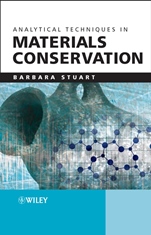
Analytical Techniques in Materials Conservation
ISBN 9780470012802
Autor: Barbara H. Stuart
Wydawca: Wiley
Dostępność: 3-6 tygodni
Cena: 943,95 zł
Przed złożeniem zamówienia prosimy o kontakt mailowy celem potwierdzenia ceny.
ISBN13: |
9780470012802 |
ISBN10: |
0470012803 |
Autor: |
Barbara H. Stuart |
Oprawa: |
Hardback |
Rok Wydania: |
2007-02-09 |
Ilość stron: |
444 |
Wymiary: |
237x166 |
Tematy: |
PN |
The use of scientific techniques in materials conservation has expanded considerably in recent decades and there is a great deal of interest in identifying the materials used in culturally important objects. Of importance is a clear understanding of the state and mechanisms of degradation of objects. Of importance is a clear understanding of the state and mechanisms of degradation of objects susceptible to deterioration with time and exposure to environmental factors. In addition, awareness of the state of materials at a molecular level can provide valuable information for conservators, enabling them to decide on a conservation procedure.
This book presents the extensive range of analytical techniques used by scientists that may be applied to heritage materials such as paintings, metals, sculptures, written material, natural materials, synthetic polymers, textiles, tone, ceramics and glass.
An introductory chapter describes the types and chemistry of materials encountered in conservation. Chapters 2 to 10 provide a straightforward background to each of the common analytical techniques:
Basic identification techniques Light examination and microscopy Molecular spectroscopy Atomic spectroscopy X–ray techniques Mass spectrometry Chromatography and electrophoresis Thermal and mechanical analysis Nuclear methodsAn explanation of how an instrument works is provided without the excessive technical detail that can be overwhelming for the first–time user. The nature and size of a sample required for each technique is given as this is an important consideration in conservation. Additionally, for each technique, examples of the application of the method to specific types of heritage materials are provided, with the relevant literature references.
This book will be a useful source of information for those with an interest in materials conservation. While it should prove an aid to those already working in this field, the book is also aimed at those entering the field who would like to know more about the analysis of heritage materials. An in–depth knowledge of chemistry, materials science or analytical chemistry is no assumed, so those without a strong background in these fields will be able to understand the scientific concepts presented.
1. Conservation materials.
1.1 Introduction.
1.2 Proteins.
1.3 Lipids.
1.4 Carbohydrates.
1.5 Natural resins.
1.6 Natural materials.
1.7 Synthetic polymers.
1.8 Dyes and pigments.
1.9 Textiles.
1.10 Paintings.
1.11 Written material.
1.12 Glass.
1.13 Ceramics.
1.14 Stone.
1.15 Metals.
2. Basic identification techniques.
2.1 Introduction.
2.2 Visual examination.
2.3 Chemical tests.
2.4 Density and specific gravity.
2.5 Solubility.
2.6 Heat tests.
3. Light examination and microscopy.
3.1 Introduction.
3.2 Infrared techniques.
3.3 Ultraviolet techniques.
3.4 Radiography.
3.5 Refractometry.
3.6 Optical microscopy.
3.7 Transmission electron microscopy.
3.8 Scanning electron microscopy.
3.9 Scanning probe microscopy.
4. Molecular spectroscopy.
4.1 Introduction.
4.2 Infrared spectroscopy.
4.3 Raman spectroscopy.
4.4 Ultraviolet–visible spectroscopy.
4.5 Photoluminescence spectroscopy.
4.6 Nuclear magnetic resonance spectroscopy.
4.7 Electron spin resonance spectroscopy.
4.8 Mössbauer spectroscopy.
5. Atomic spectroscopy.
5.1 Introduction.
5.2 Atomic absorption spectroscopy.
5.3 Atomic emission spectroscopy.
5.4 Laser induced breakdown spectroscopy.
6. X–ray techniques.
6.1 Introduction.
6.2 X–ray diffraction.
6.3 X–ray fluorescence spectroscopy.
6.4 Electron microprobe analysis.
6.5 Proton induced X–ray emission.
6.6 X–ray photoelectron spectroscopy and Auger spectroscopy.
7. Mass spectrometry.
7.1 Introduction.
7.2 Molecular mass spectrometry.
7.3 Secondary ion mass spectrometry.
7.4 Atomic mass spectrometry.
8. Chromatography and electrophoresis.
8.1 Introduction.
8.2 Paper chromatography.
8.3 Thin layer chromatography.
8.4 Gas chromatography.
8.5 High performance liquid chromatography.
8.6 Size exclusion chromatography.
8.7 Ion chromatography.
8.8 Capillary electrophoresis.
9. Thermal and mechanical analysis.
9.1 Introduction.
9.2 Thermogravimetric analysis.
9.3 Differential Scanning Calorimetry/Differential Thermal Analysis.
9.4 Tensile Testing.
9.5 Flexural Testing.
9.6 Thermal Mechanical Analysis.
9.7 Dynamic Mechanical Analysis.
9.8 Hardness.
10. Nuclear methods.
10.1 Introduction.
10.2 Radioisotopic dating.
10.3 Neutron activation analysis.
10.4 Luminescence.
10.5 Neutron diffraction.
Appendix Infrared spectra of polymers.
Index.
Barbara Stuart (BSc(Hons), MSc(Syd), PhD(Lond), DIC, MRSC, MRACI, Cchem)
After graduating with a BSc degree from the University of Sydney in Australia, Barbara Stuart worked as a tutor at this university. She also carried out research in the field of biophysical chemistry in the Department of Physical Chemistry and graduated with a MSc in 1990. The author moved to the UK to carry out doctoral studies in polymer engineering within the Department of Chemical Engineering and Chemical Technology at Imperial College (University of London). After obtaining her PhD in 1993, she took up a position as Lecturer in Physical Chemistry at the University of Greenwich in London. Barbara joined the staff at the University of Technology, Sydney, Australia in 1995, where she is currently a Senior Lecturer in the Department of Chemistry, Materials and Forensic Science. She is presently conducting research in the fields of polymer spectroscopy, materials conservation and forensic science. Barbara is the author of three other books published by John Wiley and Sons, "Modern Infrared Spectroscopy" and "Biological Applications of Infrared Spectroscopy", both in the ACOL series of open learning texts, and "Polymer Analysis" and Infrared Spectroscopy: Fundamentals and Applications in the current ANTS series of texts.
"Offers a unique source of useful up–to–date information about a vast variety of modern analytical techniques." ( Journal of Raman Spectroscopy, 2008)
"...An excellent starting point when mastering a specific technique..." (ABC, Monday 10th September 2007)
Koszyk
Książek w koszyku: 0 szt.
Wartość zakupów: 0,00 zł
Informacje


Kontakt
Gambit
Centrum Oprogramowania
i Szkoleń Sp. z o.o.
Al. Pokoju 29b/22-24
31-564 Kraków
Siedziba Księgarni
ul. Kordylewskiego 1
31-542 Kraków
+48 12 410 5991
+48 12 410 5987
+48 12 410 5989
Subskrypcje
Administratorem danych osobowych jest firma Gambit COiS Sp. z o.o. Na podany adres będzie wysyłany wyłącznie biuletyn informacyjny.
Autoryzacja płatności

Informacje na temat autoryzacji płatności poprzez PayU.

© Copyright 2012: GAMBIT COiS Sp. z o.o. Wszelkie prawa zastrzeżone.
Projekt i wykonanie: Alchemia Studio Reklamy