


Wydawcy
Katalog tematyczny
- Archeologia (109)
- Ekonomia, finanse, business (13704)
- Filozofia (1445)
- Historia (3040)
- Języki i językoznawstwo (2356)
- Lifestyle, hobby i rozrywka (475)
- Medycyna (9704)
- Nauki humanistyczne (4)
- Nauki o Ziemi i środowisku (2638)
- Nauki ścisłe (20412)
- Nauki społeczne (8486)
- Nauki techniczne (13450)
- Prawo (1696)
- Publikacje informacyjne i interdyscyplinarne (1288)
- Religia i wierzenia (917)
- Technika komputerowa (4067)
- Zdrowie, relacje międzyludzkie i rozwój osobisty (657)





Informacje szczegółowe o książce
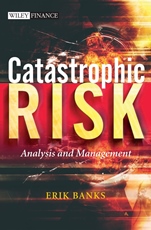
Catastrophic Risk: Analysis and Management
ISBN 9780470012369
Autor: Erik Banks
Wydawca: Wiley
Dostępność: 3-6 tygodni
Cena: 394,80 zł
Przed złożeniem zamówienia prosimy o kontakt mailowy celem potwierdzenia ceny.
ISBN13: |
9780470012369 |
ISBN10: |
0470012366 |
Autor: |
Erik Banks |
Oprawa: |
Hardback |
Rok Wydania: |
2005-03-18 |
Ilość stron: |
194 |
Wymiary: |
250x180 |
Tematy: |
KF |
Catastrophic risk is one of the most significant and challenging areas of corporate risk management. The onset of hurricane, earthquake, windstorm, terrorism, systemic financial dislocation, or “clash losses” can create billions of dollars of losses, financially damaging companies and regional/national economies. A single “supercat” event affecting a densely populated and economically productive area may be exceptionally devastating, causing losses in excess of $100 billion.
The possibility that these catastrophic events can occur means that the topic must be properly considered: at the corporate level directors must ensure sufficient resources and post–loss financing arrangements to avoid financial distress, and at the macro level regulators and intermediaries must ensure adequacy of risk mechanisms to absorb losses.
Catastrophic Risk is the first comprehensive volume to address the topic from a financial perspective. The book should be essential reading for corporate treasurers, CFOs and insurance/financial risk managers responsible for corporate risk management.
Spis treści:
Acknowledgments.
About the author.
PART I: IDENTIFICATION AND ANALYSIS OF CATASTROPHIC RISK.
1. Catastrophe and Risk.
1.1 Introduction.
1.2 The nature of catastrophe.
1.2.1 A definition.
1.2.2 Frequency.
1.2.3 Vulnerability.
1.2.4 Measuring severity.
1.3 The scope of impact.
1.4 Catastrophe and the risk management framework.
1.5 Overview of the book.
2. Risk Identification I: Perils.
2.1 Natural catastrophe.
2.1.1 Geophysical.
2.1.2 Meteorological/atmospheric.
2.1.3 Other natural disasters.
2.2 Man–made catastrophe.
2.2.1 Terrorism.
2.2.2 Industrial contamination.
2.2.3 Technological failure.
2.2.4 Financial dislocation.
2.3 Mega–catastrophe and clash loss.
3. Risk Identification II: Regional Vulnerability.
3.1 Spatial impact of natural catastrophes
.
3.1.1 Bermuda and the North American Atlantic Coast.
3.1.2 Florida.
3.1.3 North American West Coast.
3.1.4 US Great Plains/Midwest.
3.1.5 Caribbean.
3.1.6 Mexico.
3.1.7 Japan.
3.1.8 South Asia/Southeast Asia.
3.1.9 Middle East/Near East.
3.1.10 Europe.
3.2 Spatial impact of man–made catastrophes.
3.2.1 North America.
3.2.2 Europe.
3.2.3 Asia/Pacific.
3.3 Urban vulnerabilities.
4. Modeling Catastrophic Risk.
4.1 The development and use of models.
4.2 The goals of catastrophe modeling.
4.3 General model construction.
4.3.1 Phase one: Hazard/peril assessment.
4.3.2 Phase two: Vulnerability assessment.
4.3.3 Phase three: Contract assessment.
4.3.4 A general example.
4.3.5 Other perils.
4.4 Challenges.
4.4.1 Model characteristics and assumptions.
4.4.2 Model validation.
4.4.3 Tail risks.
4.4.4 Data quality and granularity.
PART II: MANAGEMENT OF CATASTROPHIC RISK.
5. Catastrophe and the Risk Management Framework.
5.1 Active risk management.
5.1.1 Enterprise value, liquidity, and solvency.
5.1.2 Loss control, loss financing, and risk reduction.
5.2 Risk monitoring.
5.3 Private and public sector efforts.
5.4 Sources of capital.
5.4.1 Insurers/reinsurers.
5.4.2 Investment funds.
5.4.3 Financial institutions.
5.5 Toward active risk management.
6. Catastrophe Insurance and Reinsurance.
6.1 Insurable risk and insurance.
6.1.1 Full insurance.
6.1.2 Partial insurance.
6.1.3 Captives.
6.2 Catastrophe insurance.
6.3 Reinsurance.
6.3.1 Facultative and treaty reinsurance.
6.3.2 Proportional and excess of loss agreements.
6.4 Catastrophe reinsurance.
6.5 Market cycles.
6.6 Internal risk management.
6.7 Challenges.
6.7.1 Pricing difficulties.
6.7.2 Earnings and capital volatility.
6.7.3 Concentrations.
6.7.4 Limits to insurability/uninsurable risks.
6.7.5 Lack of insurance/reinsurance penetration.
6
.7.6 Capacity constraints.
6.7.7 Contagion effects and systemic concerns.
7. Catastrophe Bonds and Contingent Capital.
7.1 Overview of securitization.
7.2 Catastrophe bonds.
7.2.1 Standard structures.
7.2.2 Innovations.
7.2.3 Market focus and direction.
7.3 Contingent capital.
7.3.1 Standard structures.
7.3.2 Contingent debt.
7.3.3 Contingent equity.
7.4 Challenges.
7.4.1 Structural flaws.
7.4.2 Regulatory differences.
8. Catastrophe Derivatives.
8.1 Overview of derivatives.
8.1.1 Exchange–traded derivatives.
8.1.2 OTC derivatives.
8.2 Exchange–traded catastrophe derivatives.
8.3 OTC Catastrophe derivatives.
8.3.1 Catastrophe reinsurance swaps.
8.3.2 Pure catastrophe swaps.
8.3.3 Synthetic OTC structures.
8.4 Challenges.
8.4.1 Index construction and basis risks.
8.4.2 Lack of contract transparency.
8.4.3 One–way markets.
8.4.4 Pricing difficulties.
8.4.5 Regulatory barriers.
9. Public Sector Management and Financing.
9.1 Forms of public sector involvement.
9.1.1 Ex ante loss control measures.
9.1.2 Insurance/reinsurance.
9.1.3 Ex post crisis management.
9.1.4 Financing and subsidies.
9.1.5 Financial regulation.
9.2 Challenges.
9.2.1 Voluntary versus mandatory measures.
9.2.2 Public and private sector responsibilities.
9.2.3 Lack of market access and capacity.
10. Outlook and Conclusions.
10.1 Loss control.
10.1.1 Loss control implementation.
10.1.2 Enforcing urban planning.
10.2 Quantification.
10.2.1 Modeling requirements.
10.2.2 Transparency.
10.2.3 Complexity of terrorism.
10.3 Loss financing.
10.3.1 Vulnerabilities and risk capacity.
10.3.2 Discriminatory funding and insurance.
10.4 Government participation.
10.4.1 Optimal government role.
10.4.2 Limited government resources.
10.4.3 Adverse incentives.
10.4.4 Market deregulation.
10.5 General management.
10.5
.1 Sub–optimal management.
10.5.2 Sustainability of solutions.
10.5.3 Preparing for the mega–catastrophe.
10.5.4 Amalgamated solutions.
10.5.5 Learning from past events.
Bibliography.
Index.
Nota biograficzna:
ERIK BANKS, an independent risk consultant, writer, and lecturer, has held senior risk management positions at several global financial institutions over the past 20 years, including Merrill Lynch, Citibank, and XL Capital. He is the author of 18 books on risk, derivatives, governance, and merchant banking, including the John Wiley titles Alternative Risk Transfer, Exchange–Traded Derivatives, The Simple Rules of Risk, and E–Finance.
Okładka tylna:
Catastrophic risk is one of the most significant and challenging areas of corporate risk management. The onset of hurricane, earthquake, windstorm, terrorism, systemic financial dislocation, or “clash losses” can create billions of dollars of losses, financially damaging companies and regional/national economies. A single “supercat” event affecting a densely populated and economically productive area may be exceptionally devastating, causing losses in excess of $100 billion.
The possibility that these catastrophic events can occur means that the topic must be properly considered: at the corporate level directors must ensure sufficient resources and post–loss financing arrangements to avoid financial distress, and at the macro level regulators and intermediaries must ensure adequacy of risk mechanisms to absorb losses.
Catastrophic Risk is the first comprehensive volume to address the topic from a financial perspective. The book should be essential reading for corporate treasurers, CFOs and insurance/financial risk managers responsible for corporate risk management.
Koszyk
Książek w koszyku: 0 szt.
Wartość zakupów: 0,00 zł
Informacje


Kontakt
Gambit
Centrum Oprogramowania
i Szkoleń Sp. z o.o.
Al. Pokoju 29b/22-24
31-564 Kraków
Siedziba Księgarni
ul. Kordylewskiego 1
31-542 Kraków
+48 12 410 5991
+48 12 410 5987
+48 12 410 5989
Subskrypcje
Administratorem danych osobowych jest firma Gambit COiS Sp. z o.o. Na podany adres będzie wysyłany wyłącznie biuletyn informacyjny.
Autoryzacja płatności

Informacje na temat autoryzacji płatności poprzez PayU.

© Copyright 2012: GAMBIT COiS Sp. z o.o. Wszelkie prawa zastrzeżone.
Projekt i wykonanie: Alchemia Studio Reklamy