


Wydawcy
Katalog tematyczny
- Archeologia (109)
- Ekonomia, finanse, business (13704)
- Filozofia (1445)
- Historia (3040)
- Języki i językoznawstwo (2356)
- Lifestyle, hobby i rozrywka (475)
- Medycyna (9704)
- Nauki humanistyczne (4)
- Nauki o Ziemi i środowisku (2638)
- Nauki ścisłe (20412)
- Nauki społeczne (8486)
- Nauki techniczne (13450)
- Budownictwo lądowe (1045)
- Chemia przemysłowa (2258)
- Elektronika i telekomunikacja (3287)
- Energetyka (1122)
- Inne nauki stosowane (363)
- Inżynieria biochemiczna (507)
- Inżynieria transportu (232)
- Mechanika i materiały (3316)
- Nauka o środowisku (321)
- Rolnictwo (507)
- Technika, ogólnie (475)
- Prawo (1696)
- Publikacje informacyjne i interdyscyplinarne (1288)
- Religia i wierzenia (917)
- Technika komputerowa (4067)
- Zdrowie, relacje międzyludzkie i rozwój osobisty (657)





Informacje szczegółowe o książce
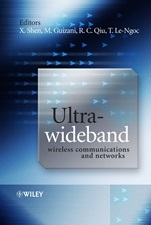
Ultra–Wideband Wireless Communications and Networks
ISBN 9780470011447
Autor: Xuemin Shen, Mohsen Guizani, Robert Caiming Qiu, Tho Le–Ngoc
Wydawca: Wiley
Dostępność: 3-6 tygodni
Cena: 622,65 zł
Przed złożeniem zamówienia prosimy o kontakt mailowy celem potwierdzenia ceny.
ISBN13: |
9780470011447 |
ISBN10: |
0470011440 |
Autor: |
Xuemin Shen, Mohsen Guizani, Robert Caiming Qiu, Tho Le–Ngoc |
Oprawa: |
Hardback |
Rok Wydania: |
2006-02-24 |
Ilość stron: |
322 |
Wymiary: |
250x172 |
Tematy: |
TJ |
Ultra–wideband (UWB) technology has great potential for applications in wireless communications, radar and location. It has many benefits due to its ultra–wideband nature, which include high data rate, less path loss and better immunity to multipath propagation, availability of low–cost transceivers, low transmit power and low interference. Despite R&D results so far demonstrating that UWB radio is a promising solution for high–rate short–range wireless communications, further extensive investigation is necessary towards developing effective and efficient UWB communication systems and UWB technology.
Ultra–wideband Wireless Communications and Networks explores both the fundamental aspects and the more advanced topics of networks and applications. Challenges and up–to–date technical progress in the field are presented, with timely reporting of results from cutting–edge research and state–of–the–art technology in UWB wireless communications.Unique focus on UWB wireless communications rather than previously covered UWB radar aspects.Topics include: radio propagation and large scale variations, pulse propagation and channel modelling, MIMO (Multiple Input – Multiple Output) RF subsystems and ad hoc networks.Features a wealth of tables, illustrations and photographs.
This book is aimed at professionals wishing to enhance their knowledge of UWB wireless communications systems for short range communications. It will also appeal to senior undergraduate and graduate students who require information on the key topics in this area.
Spis treści:
List of Contributors.
Preface.
1 Introduction (Robert Caiming Qiu, Xuemin (Sherman) Shen, Mohsen Guizani and Tho Le–Ngoc).
1.1 Fundamentals.
1.2 Issues Unique to UWB.
1.3 Emerging Technologies.
References.
2 Modulation and Signal Detection in
UWB (Uzoma A. Onunkwo and Ye (Geoffrey) Li).
2.1 Overview.
2.2 Single–Carrier–Based Modulation.
2.3 OFDM–Based Modulation.
2.4 Conclusion and Further Reading.
References.
3 UWB Pulse Propagation and Detection (Robert Caiming Qiu).
3.1 Introduction.
3.2 UWB Pulse Propagation.
3.3 UWB Pulse Signal Detection.
References.
4 Timing Synchronization for UWB Impulse Radios (Zhi Tian and Georgios B. Giannakis).
4.1 Introduction.
4.2 Signal Model.
4.3 Signal Detection and Symbol–Level Acquisition.
4.4 SAT and MAT: Templates with and without Timing.
4.5 Coarse Synchronization Using Symbol–Rate Samples.
4.6 Synchronization with Flexible Timing Resolution.
4.7 Timing Acquisition for Ad Hoc Multiple Access.
4.8 Demodulation and BER Sensitivity to Mistiming.
4.9 Concluding Summary.
References.
5 Error Performance of Pulsed Ultrawideband Systems in Indoor Environments (Huaping Liu).
5.1 Introduction.
5.2 System Model.
5.3 Error Performance in Indoor Environments.
References.
6 Mixed–Signal Ultrawideband Communications Receivers (Sebastian Hoyos and Brian M. Sadler).
6.1 Introduction.
6.2 Analog–to–Digital Conversion via Signal Expansion.
6.3 Mixed–Signal Communication Receivers Based on A/D Conversion via Signal Expansion.
6.4 Analog–to–Digital Conversion in the Frequency Domain.
6.5 Frequency–Domain Mixed–Signal Receivers.
6.6 Conclusions.
References.
7 Trends in Ultrawideband Transceiver Design (Zhengyuan Xu).
7.1 Introduction.
7.2 Status of UWB Transceiver Design.
7.3 Digital UWB Receivers.
7.4 Analog/Digital UWB Transceivers.
7.5 Conclusions.
Acknowledgments.
References.
8 UWB MAC and Ad Hoc Networks ( Zihua Guo and Richard Yao).
8.1 Introduction.
8.2 QoS Scheduling in PNC.
8.3 Power Management in IEEE 802.15.3.8.4 Adaptive Dly–ACK.
8.5 Ad Hoc Networks.
8.6 Summary.
References.
9 Radio Resource Management for Ultra–Wideband Communications (Xuemin (Sherman) Shen, Weihua Zhuang, Hai Jiang and Jun Cai).
9.1 Introduction.
9.2 Radio Resource Management.
9.3 Multiple Access.
9.4 Overhead Reduction.
9.5 Power/Rate Allocation.
9.6 Conclusions.
References.
10 Pulsed UWB Interference to Narrowband Receivers (Jay E. Padgett).
10.1 Introduction.
10.2 Pulsed UWB Signal Model.
10.3 Narrowband Receiver Model.
10.4 Equivalent Receiver Model and Response to a Pulse.
10.5 Response to a Pulse Sequence.
10.6 Simulating the Response to a Pulse Sequence.
10.7 General Properties of the IF Output.
10.8 Power Spectral Density.
10.9 Discrete PDF PSD Example: Equally Spaced, Equally Likely Time Offsets .
10.10 Continuous PDF PSD Examples.
10.11 Comparison of PSD and Simulation Results.
10.12 Statistical Properties of the Output Envelope.
10.13 Summary.
References.
11 Digital–Carrier Spreading Codes for Baseband UWB Multiaccess (Liuqing Yang and Georgios B. Giannakis).
11.1 Introduction.
11.2 Digital–Carrier Multiband User Codes.
11.3 Low Duty–Cycle Access in the Presence of NBI.
11.4 Improved Rate Access in the Presence of Multipath.
11.5 Multiuser Interference Mitigation.
11.6 Summary.
References.
12 Localization ( Kegen Yu, Harri Saarnisaari, Jean–Philippe Montillet, Alberto Rabbachin, Ian Oppermann and Giuseppe Thadeu Freitas de Abreu).
12.1 Introduction.
12.2 Time–of–Arrival Estimation.
12.3 Location and Tracking.
12.4 Location in Distributed Architectures.
12.5 Theoretical Positioning Accuracy.
12.6 Conclusions.
Acknowledgment.
References.
Index.
Nota biograficzna:
Professor Xuemin Shen works in the Department of Electrical and Computer Engineerin
g at the University of Waterloo, Canada. His research interests are Wireless/Internet interworking, Resource and mobility management, Voice over mobile IP, WiFi, WAP, Bluetooth, UWB wireless applications, ad hoc wireless networks.
Dr. Mohsen Guizani is Professor and Chair of the Department of Computer Science at Western Michigan university. Dr. Guizani′s research interests include Computer Networks, Wireless Communications and Computing, Design and Analysis of Computer Systems, and Optical Networking. He is the founder and Editor–In–Chief of Wireless Communications and Mobile Computing Journal, published by John Wiley.
Professor Robert Caiming works in the Center for Manufacturing Research/Electrical and Computer Engineering Department at Tennessee Technological University, USA. His research interests include Wireless communications and systems (3G, 4G, UWB), Radar/communications signal processing and Time–domain Electromagnetics.
Professor Tho Le–Ngoc works in the Department of Electrical and Computer Engineering at McGill University. His research interests include Broadband Communications: Advanced Transmission, Multiple–Access and Dynamic Capacity Allocation Techniques.
Okładka tylna:
Ultra–wideband (UWB) technology has great potential for applications in wireless communications, radar and location. It has many benefits due to its ultra–wideband nature, which include high data rate, less path loss and better immunity to multipath propagation, availability of low–cost transceivers, low transmit power and low interference. Despite R&D results so far demonstrating that UWB radio is a promising solution for high–rate short–range wireless communications, further extensive investigation is necessary towards developing effective and efficient UWB communication systems and UWB technology.
Ultra–wideband Wireless Communications and Net
Koszyk
Książek w koszyku: 0 szt.
Wartość zakupów: 0,00 zł
Informacje


Kontakt
Gambit
Centrum Oprogramowania
i Szkoleń Sp. z o.o.
Al. Pokoju 29b/22-24
31-564 Kraków
Siedziba Księgarni
ul. Kordylewskiego 1
31-542 Kraków
+48 12 410 5991
+48 12 410 5987
+48 12 410 5989
Subskrypcje
Administratorem danych osobowych jest firma Gambit COiS Sp. z o.o. Na podany adres będzie wysyłany wyłącznie biuletyn informacyjny.
Autoryzacja płatności

Informacje na temat autoryzacji płatności poprzez PayU.

© Copyright 2012: GAMBIT COiS Sp. z o.o. Wszelkie prawa zastrzeżone.
Projekt i wykonanie: Alchemia Studio Reklamy