


Wydawcy
Katalog tematyczny
- Archeologia (109)
- Ekonomia, finanse, business (13704)
- Filozofia (1445)
- Historia (3040)
- Języki i językoznawstwo (2356)
- Lifestyle, hobby i rozrywka (475)
- Medycyna (9704)
- Nauki humanistyczne (4)
- Nauki o Ziemi i środowisku (2638)
- Nauki ścisłe (20412)
- Nauki społeczne (8486)
- Nauki techniczne (13450)
- Budownictwo lądowe (1045)
- Chemia przemysłowa (2258)
- Elektronika i telekomunikacja (3287)
- Energetyka (1122)
- Inne nauki stosowane (363)
- Inżynieria biochemiczna (507)
- Inżynieria transportu (232)
- Mechanika i materiały (3316)
- Nauka o środowisku (321)
- Rolnictwo (507)
- Technika, ogólnie (475)
- Prawo (1696)
- Publikacje informacyjne i interdyscyplinarne (1288)
- Religia i wierzenia (917)
- Technika komputerowa (4067)
- Zdrowie, relacje międzyludzkie i rozwój osobisty (657)





Informacje szczegółowe o książce
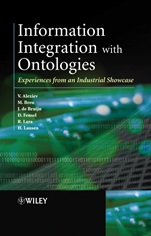
Information Integration with Ontologies: Experiences from an Industrial Showcase
ISBN 9780470010488
Autor: Vladimir Alexiev, Michael Breu, Jos de Bruijn, Dieter Fensel, Ruben Lara, Holger Lausen
Wydawca: Wiley
Dostępność: 3-6 tygodni
Cena: 639,45 zł
Przed złożeniem zamówienia prosimy o kontakt mailowy celem potwierdzenia ceny.
ISBN13: |
9780470010488 |
ISBN10: |
0470010487 |
Autor: |
Vladimir Alexiev, Michael Breu, Jos de Bruijn, Dieter Fensel, Ruben Lara, Holger Lausen |
Oprawa: |
Hardback |
Rok Wydania: |
2005-02-25 |
Ilość stron: |
196 |
Wymiary: |
253x176 |
Tematy: |
TJ |
Obtaining competitive advantage depends more than ever on optimizing information assets. Disparate information, spread over various sources in different formats and with inconsistent semantics, is a major obstacle that prevents corporations from disseminating and exchanging information with a view to maximizing efficiency and profitability.
This valuable resource provides a detailed insight into how ontology technology can be used to achieve optimum performance levels in the management of disparate information. Through practical experience this real–world approach focuses on the realization of information grids, based on ontologies, and their application in an industrial setting.Presents theory–based practical advice on integrating heterogeneous data sources using ontology technologiesIncludes the best practice examples and methodologies employed gleaned from the implementation of COG (Corporate Ontology Grid)Compares and contrasts data models and ontologies, illustrating these with real–world applicationsIncludes a comprehensive section on ontology querying and generating transformations via an ontological grid
Information Integration with Ontologies will be of interest to IT technicians needing advice and examples on the successful integration of heterogeneous information and the application of ontology technology. It will also appeal to technical decision makers involved in real–world applications.
Spis treści:
Foreword.
Acknowledgements.
List of Figures.
1 Introduction.
1.1 Finding a Way Out of the Dilemma.
1.2 The Background to this Book.
1.3 The Structure of the Book.
1.3.1 Data modelling and ontologies.
1.3.2 Information integrationwith relational databases and XML.
1.3.3 The show case.
1.3.4 Semantic information integration.
1.3.5 Data source queries.
1.3.6 Generating transformations.
1.3.7 Best Practices and Methodologies.2 Data Modelling and Ontologies.
2.1 The Information Integration Problem.
2.1.1 How databases view the world.
2.1.2 How ontologies view the world.
2.1.3 Comparison.
2.2 Semantic Information Management.
2.2.1 Principles.
2.2.2 The methodology.
2.3 Conclusions.
3 Information Integration with Relational Databases and XML.
3.1 Introduction.
3.1.1 Areas of data integration.
3.1.2 Business drivers of data integration.
3.1.3 Scope of this chapter.
3.2 Relational Database Integration.
3.2.1 Integration considerations.
3.2.2 Integration approaches/degrees.
3.2.3 Data centralization, sharing and federation.
3.2.4 Integration characteristics.
3.3 XML–based Integration.
3.3.1 XML tools.
3.3.2 XML and objects.
3.3.3 XML and databases.
3.3.4 XML transformations.
3.3.5 XML, eCommerce and Web services.
3.4 Conclusions.
3.4.1 Summary.
3.4.2 Variety in data integration.
4 The Show Case.
4.1 Data Sources.
4.2 Identifying Overlaps between the Data Sources.
4.3 Current Ways of Dealing with Heterogeneity.
5 Semantic Information Integration.
5.1 Approaches in Information Integration.
5.2 Mapping Heterogeneous Data Sources.
5.2.1 The Unicorn Workbench.
5.2.2 Ontology construction and rationalization in the COG project.
5.3 Other Methods and Tools.
5.3.1 The MOMIS approach.
5.3.2 InfoSleuth.
5.3.3 OBSERVER.
5.3.4 Ontology mapping in the KRAFT project.
5.3.5 PROMPT.
5.3.6 Chimæra.
5.3.7 ONION.
5.3.8 Other ontology merging methods.
5.4 Comparison of the Methods.
5.4.1 Comparison criteria.
5.4.2 Comparing the methodologies for semantic schema integration.
5.5 Conclusions and Future Work.
5.5.1 Limitations of the Unicorn Workbench and future work.
6 Data Source Queries.
6.1 Querying Disparate Data Sources Using the Unicorn Workbench.
6.1.1 Queries in the Unicorn Workbench.
6.1.2 Transfor
ming conceptual queries into database queries.
6.1.3 Limitations of the current approach.
6.2 Querying Disparate Data Sources.
6.2.1 The querying architecture in the COG project.
6.2.2 Querying in the COG showcase.
6.2.3 Overcoming the limitations of the Unicorn Workbench.
6.3 Related Work.
6.3.1 Ontology query languages.
6.4 Conclusions.
7 Generating Transformations.
7.1 Information Transformation in the COG Project.
7.1.1 Generating transformations with the Unicorn Workbench.
7.1.2 Automatic generation of transformations in the COG project.
7.2 Other Information Transformation Approaches.
7.2.1 Approaches that perform instance transformation.
7.2.2 Approaches that do not perform instance transformation.
7.3 Conclusions, Limitations and Extensions.
8 Best Practices and Methodologies Employed.
8.1 Best Practices.
8.1.1 Selective mapping.
8.1.2 Domain vs application modelling.
8.1.3 Global–as–view vs local–as–view.
8.2 Lessons Learned.
8.2.1 Quality of global model depends on local models.
8.2.2 Refinement of ontological concepts.
8.2.3 Automation is hard to achieve in real–life situations.
8.2.4 Queries vs transformations.
8.3 Conclusions.
9 Conclusion.
References.
Glossary.
Index.
Nota biograficzna:
The book is authored by members of the Digital Enterprise Research Institute (DERI) headed by Professor Dieter Fensel.
Professor Fensel is the scientific director of DERI at the National University of Ireland, Galway, based on a large grant acquired from Science Foundation Ireland (SFI). His current research interests include Ontologies, semantic web, web services, knowledge management, enterprise application integration, and electronic commerce. He is a major scientific player in the area of the semantic web and has authored and co–edited 9 books, and more than 150 publications in journals and c
onferences. He is associate editor of the Knowledge and Information Systems: An International Journal (KAIS), IEEE Intelligent Systems, the Electronic Transactions on Artificial Intelligence (ETAI), Web Intelligence and Agent Systems (WIAS), Elsevier′s Journal on Web Semantics: Science, Services and Agents on the World Wide Web and the Lecture Notes in Computer Science (LNCS) subline entitled "Semantics in Data Management".
Okładka tylna:
Obtaining competitive advantage depends more than ever on optimizing information assets. Disparate information, spread over various sources in different formats and with inconsistent semantics, is a major obstacle that prevents corporations from disseminating and exchanging information with a view to maximizing efficiency and profitability.
This valuable resource provides a detailed insight into how ontology technology can be used to achieve optimum performance levels in the management of disparate information. Through practical experience this real–world approach focuses on the realization of information grids, based on ontologies, and their application in an industrial setting.Presents theory–based practical advice on integrating heterogeneous data sources using ontology technologiesIncludes the best practice examples and methodologies employed gleaned from the implementation of COG (Corporate Ontology Grid)Compares and contrasts data models and ontologies, illustrating these with real–world applicationsIncludes a comprehensive section on ontology querying and generating transformations via an ontological grid
Information Integration with Ontologies will be of interest to IT technicians needing advice and examples on the successful integration of heterogeneous information and the application of ontology technology. It will also appeal to technical decision makers involved in real–world applications.
Koszyk
Książek w koszyku: 0 szt.
Wartość zakupów: 0,00 zł
Informacje


Kontakt
Gambit
Centrum Oprogramowania
i Szkoleń Sp. z o.o.
Al. Pokoju 29b/22-24
31-564 Kraków
Siedziba Księgarni
ul. Kordylewskiego 1
31-542 Kraków
+48 12 410 5991
+48 12 410 5987
+48 12 410 5989
Subskrypcje
Administratorem danych osobowych jest firma Gambit COiS Sp. z o.o. Na podany adres będzie wysyłany wyłącznie biuletyn informacyjny.
Autoryzacja płatności

Informacje na temat autoryzacji płatności poprzez PayU.

© Copyright 2012: GAMBIT COiS Sp. z o.o. Wszelkie prawa zastrzeżone.
Projekt i wykonanie: Alchemia Studio Reklamy