


Wydawcy
Katalog tematyczny
- Archeologia (109)
- Ekonomia, finanse, business (13704)
- Filozofia (1445)
- Historia (3040)
- Języki i językoznawstwo (2356)
- Lifestyle, hobby i rozrywka (475)
- Medycyna (9704)
- Nauki humanistyczne (4)
- Nauki o Ziemi i środowisku (2638)
- Nauki ścisłe (20412)
- Nauki społeczne (8486)
- Nauki techniczne (13450)
- Budownictwo lądowe (1045)
- Chemia przemysłowa (2258)
- Elektronika i telekomunikacja (3287)
- Energetyka (1122)
- Inne nauki stosowane (363)
- Inżynieria biochemiczna (507)
- Inżynieria transportu (232)
- Mechanika i materiały (3316)
- Nauka o środowisku (321)
- Rolnictwo (507)
- Technika, ogólnie (475)
- Prawo (1696)
- Publikacje informacyjne i interdyscyplinarne (1288)
- Religia i wierzenia (917)
- Technika komputerowa (4067)
- Zdrowie, relacje międzyludzkie i rozwój osobisty (657)





Informacje szczegółowe o książce
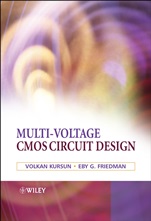
Multi–voltage CMOS Circuit Design
ISBN 9780470010235
Autor: Volkan Kursun, Eby G. Friedman
Wydawca: Wiley
Dostępność: 3-6 tygodni
Cena: 589,05 zł
Przed złożeniem zamówienia prosimy o kontakt mailowy celem potwierdzenia ceny.
ISBN13: |
9780470010235 |
ISBN10: |
0470010231 |
Autor: |
Volkan Kursun, Eby G. Friedman |
Oprawa: |
Hardback |
Rok Wydania: |
2006-08-11 |
Ilość stron: |
242 |
Wymiary: |
252x186 |
Tematy: |
TJ |
For more than four decades, the scaling of semiconductor process technologies has revolutionized electronics applications, with complementary metal–oxide–semiconductor (CMOS) technology dominating the semiconductor industry in recent years. The scaling of CMOS technology coupled with advanced in circuits structures and microarchitectures have significantly increased the performance of integrated circuits (ICs). The side–effects of these performance and functional enhancements have traditionally been increased design complexity, greater power consumption, and higher fabrication cost. Multi–voltage design now plays a crucial role in allowing the industry to meet the growing customer demand for high–performance ICs offering a wider variety of applications at a reduced cost.
Multi–voltage CMOS Circuit Design provides an in–depth analysis of several new techniques for designing low–power and high–speed ICs with particular emphasis on the approaches based on using multiple supply and threshold voltages. Starting with a detailed overview of the evolution of IC technologies, the authors go on to examine:the sources of power consumption in CMOS ICs;the mechanism that produce sub–threshold and gate oxide leakage currents;advanced supply and threshold voltage scaling techniques for lowering power consumption and enhancing reliability;energy–efficient monolithic DC–DC conversion techniques for low voltage applications such as microprocessors;in–depth evaluation of the potential of emerging multi–voltage circuit techniques for sustaining the scaling trends of CMOS technologies.
A valuable text for researches and electronic engineers working in the semiconductor technology industry, Multi–voltage CMOS Circuit Design is also a useful reference for graduate students taking courses on advanced topics in IC design.
Spis treści:
List of Tables.
List of Figures.
Preface.
1 Introduction.
1.1 Evolution of Integrated Circuits.
1.2 Outline of the Book.
2 Sources of Power Consumption in CMOS Integrated Circuits.
2.1 Dynamic Switching Power.
2.2 Leakage Power.
2.3 Short–Circuit Power.
2.4 Static DC Power.
3 Supply and Threshold Voltage Scaling Techniques.
3.1 Dynamic Supply Voltage Scaling.
3.2 Multiple Supply Voltage CMOS.
3.3 Threshold Voltage Scaling.
3.4 Multiple Supply and Threshold Voltage CMOS.
3.5 Dynamic Supply and Threshold Voltage Scaling.
3.6 Circuits with Multiple Voltage and Clock Domains.
3.7 Chapter Summary.
4 Low Voltage Power Supplies.
4.1 Linear DC–DC Converters.
4.2 Switched–Capacitor DC–DC Converters.
4.3 Switching DC–DC Converters.
4.4 Chapter Summary.
5 Analysis of Buck Converters for On–Chip Integration with a Dual Supply Voltage Microprocessor.
5.1 Circuit Model of a Buck Converter.
5.2 Efficiency Analysis of a Buck Converter.
5.3 Simulation Results.
5.4 Chapter Summary.
6 Low Voltage Swing Monolithic DC–DC Conversion.
6.1 Circuit Model of a Low Voltage Swing Buck Converter.
6.2 Low Voltage Swing Buck Converter Analysis.
6.3 Chapter Summary.
7 High Input Voltage Step–Down DC–DC Converters for Integration in a Low Voltage CMOS Process.
7.1 Cascode Bridge Circuits.
7.2 High Input Voltage Monolithic Switching DC–DC Converters.
7.3 Chapter Summary.
8 Signal Transfer in Integrated Circuits with Multiple Supply Voltages.
8.1 A High Speed and Low Power Voltage Interface Circuit.
8.2 Voltage Interface Circuit Simulation Results.
8.3 Experimental Results.
8.4 Chapter Summary.
9 Domino Logic with Variable Threshold Voltage Keeper.
9.1 Standard Domino Logic Circuits.
9.2 Domino Logic with Variable Thresh
old Voltage Keeper.
9.3 Simulation Results.
9.4 Domino Logic with Forward and Reverse Body Biased Keeper.
9.5 Chapter Summary.
10 Subthreshold Leakage Current Characteristics of Dynamic Circuits.
10.1 State Dependent Subthreshold Leakage Current Characteristics.
10.2 Noise Immunity.
10.3 Power and Delay Characteristics in the Active Mode.
10.4 Dual Threshold Voltage CMOS Technology.
10.5 Chapter Summary.
11Sleep Switch Dual Threshold Voltage Domino Logic with Reduced Standby Leakage Current.
11.1 Previously Published Sleep Mode Circuit Techniques.
11.2 Dual Threshold Voltage Domino Logic Employing Sleep Switches.
11.3 Simulation Results.
11.4 Noise Immunity Compensation.
11.5 Chapter Summary.
12 Conclusions.
Bibliography.
Index.
About the Authors.
Nota biograficzna:
Dr Volkan Kursun, Department of Electrical & Computer Engineering, University of Rochester, Rochester, New York 14627–0231, USA
Professor Dr Eby Friedman, Department of Electrical & Computer Engineering , University of Rochester , Rochester, New York 14627–0231, USA
Okładka tylna:
For more than four decades, the scaling of semiconductor process technologies has revolutionized electronics applications, with complementary metal–oxide–semiconductor (CMOS) technology dominating the semiconductor industry in recent years. The scaling of CMOS technology coupled with advanced in circuits structures and microarchitectures have significantly increased the performance of integrated circuits (ICs). The side–effects of these performance and functional enhancements have traditionally been increased design complexity, greater power consumption, and higher fabrication cost. Multi–voltage design now plays a crucial role in allowing the industry to meet the growing customer demand for high–performance ICs offer
ing a wider variety of applications at a reduced cost.
Multi–voltage CMOS Circuit Design provides an in–depth analysis of several new techniques for designing low–power and high–speed ICs with particular emphasis on the approaches based on using multiple supply and threshold voltages. Starting with a detailed overview of the evolution of IC technologies, the authors go on to examine:the sources of power consumption in CMOS ICs;the mechanism that produce sub–threshold and gate oxide leakage currents;advanced supply and threshold voltage scaling techniques for lowering power consumption and enhancing reliability;energy–efficient monolithic DC–DC conversion techniques for low voltage applications such as microprocessors;in–depth evaluation of the potential of emerging multi–voltage circuit techniques for sustaining the scaling trends of CMOS technologies.
A valuable text for researches and electronic engineers working in the semiconductor technology industry, Multi–voltage CMOS Circuit Design is also a useful reference for graduate students taking courses on advanced topics in IC design.
Koszyk
Książek w koszyku: 0 szt.
Wartość zakupów: 0,00 zł
Informacje


Kontakt
Gambit
Centrum Oprogramowania
i Szkoleń Sp. z o.o.
Al. Pokoju 29b/22-24
31-564 Kraków
Siedziba Księgarni
ul. Kordylewskiego 1
31-542 Kraków
+48 12 410 5991
+48 12 410 5987
+48 12 410 5989
Subskrypcje
Administratorem danych osobowych jest firma Gambit COiS Sp. z o.o. Na podany adres będzie wysyłany wyłącznie biuletyn informacyjny.
Autoryzacja płatności

Informacje na temat autoryzacji płatności poprzez PayU.

© Copyright 2012: GAMBIT COiS Sp. z o.o. Wszelkie prawa zastrzeżone.
Projekt i wykonanie: Alchemia Studio Reklamy