


Wydawcy
Katalog tematyczny
- Archeologia (6)
- Ekonomia, finanse, business (87)
- Historia (5)
- Medycyna (1123)
- Nauki o Ziemi i środowisku (299)
- Nauki ścisłe (2368)
- Nauki społeczne (35)
- Nauki techniczne (950)
- Budownictwo lądowe (39)
- Chemia przemysłowa (95)
- Elektronika i telekomunikacja (237)
- Energetyka (134)
- Inne nauki stosowane (51)
- Inżynieria biochemiczna (13)
- Inżynieria transportu (68)
- Mechanika i materiały (222)
- Nauka o środowisku (14)
- Rolnictwo (16)
- Technika, ogólnie (61)
- Prawo (8)
- Publikacje informacyjne i interdyscyplinarne (36)
- Technika komputerowa (126)
- Zdrowie, relacje międzyludzkie i rozwój osobisty (2)





Informacje szczegółowe o książce
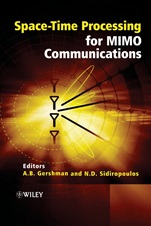
Space–Time Processing for MIMO Communications
ISBN 9780470010020
Autor: Alex Gershman, Nikos Sidiropoulos
Wydawca: Wiley
Dostępność: 3-6 tygodni
Cena: 751,80 zł
Przed złożeniem zamówienia prosimy o kontakt mailowy celem potwierdzenia ceny.
ISBN13: |
9780470010020 |
ISBN10: |
0470010029 |
Autor: |
Alex Gershman, Nikos Sidiropoulos |
Oprawa: |
Hardback |
Rok Wydania: |
2005-04-19 |
Ilość stron: |
388 |
Wymiary: |
253x177 |
Tematy: |
TJ |
Driven by the desire to boost the quality of service of wireless systems closer to that afforded by wireline systems, space–time processing for multiple–input multiple–output (MIMO) wireless communications research has drawn remarkable interest in recent years. Exciting theoretical advances have been complemented by rapid transition of research results to industry products and services, thus creating a vibrant new area.
Space–time processing is a broad area, owing in part to the underlying convergence of information theory, communications and signal processing research that brought it to fruition. This book presents a balanced and timely introduction to space–time processing for MIMO communications, including highlights of emerging trends, such as spatial multiplexing and joint transceiver optimization. Includes detailed coverage of wireless channel sounding, modelling, characterization and model validation.Provides state–of–the–art research results on space–time coding, including comprehensive tutorial coverage of orthogonal space–time block codes. Discusses important recent developments in spatial multiplexing, transmit beam–forming, pre–coding and joint transceiver design for the multi–user MIMO downlink using full or partial CSI.Illustrates all theory with numerous examples gleaned from cutting–edge research from around the globe.
This valuable resource will appeal to engineers, developers and consultants involved in the design and implementation of space–time processing for MIMO communications. Its accessible format, amply illustrated with real world case studies, contains relevant, detailed advice for postgraduate students and researchers specializing in this field.
Spis treści:
List of Contributors.
Preface.
Acknowledgements.
1 MIMO Wireless Channel Modeling
and Experimental Characterization (Michael A. Jensen and Jon W. Wallace).
1.1 Introduction.
1.2 MIMO Channel Measurement.
1.3 MIMO Channel Models.
1.4 The Impact of Antennas on MIMO Performance.
References.
2 Multidimensional Harmonic Retrieval with Applications in MIMO Wireless Channel Sounding (Xiangqian Liu, Nikos D. Sidiropoulos, and Tao Jiang).
2.1 Introduction.
2.2 Harmonic Retrieval Data Model.
2.3 Identifiability of Multidimensional Harmonic Retrieval.
2.4 Multidimensional Harmonic Retrieval Algorithms.
2.5 Numerical Examples.
2.6 Multidimensional Harmonic Retrieval for MIMO Channel Estimation.
2.7 Concluding Remarks.
References.
3 Certain Computations Involving Complex Gaussian Matrices with Applications to the Performance Analysis of MIMO Systems (Ming Kang, Lin Yang, and Mohamed–Slim Alouini).
3.1 Introduction.
3.2 Performance Measures of Multiple Antenna Systems.
3.3 SomeMathematical Preliminaries.
3.4 General Calculations with MIMO Applications.
3.5 Summary.
References.
4 Recent Advances in Orthogonal Space–Time Block Coding (Mohammad Gharavi–Alkhansari, Alex B. Gershman, and Shahram Shahbazpanahi).
4.1 Introduction.
4.2 Notations and Acronyms.
4.3 Mathematical Preliminaries.
4.4 MIMO System Model and OSTBC Background.8
4.5 Constellation Space Invariance and Equivalent Array–Processing–Type MIMO Model.
4.6 Coherent ML Decoding.
4.7 Exact Symbol Error Probability Analysis of Coherent ML Decoder.
4.8 Optimality Properties of OSTBCs.
4.9 Blind Decoding of OSTBCs.
4.10 Multiaccess MIMO Receivers for OSTBCs.
4.11 Conclusions.
References.
5 Trace–Orthogonal Full Diversity Cyclotomic Space–Time Codes (Jian–Kang Zhang, Jing Liu, and Kon Max Wong).
5.1 Introduction.
5.2 Channel Model with Linear Dispersion Codes.
5.3 Good Structures for
LD Codes: Trace Orthogonality.
5.4 Trace–orthogonal LD Codes.
5.5 Construction of Trace Orthogonal LD Codes.
5.6 Design of Full Diversity LD Codes.
5.7 Design of Full Diversity Linear Space–time Block Codes for N .
5.8 Design Examples and Simulations.
5.9 Conclusion.
References.
6 Linear and Dirty–Paper Techniques for the Multiuser MIMO Downlink (Christian B. Peel, Quentin H. Spencer, A. Lee Swindlehurst, Martin Haardt, and Bertrand M. Hochwald).
6.1 Introduction.
6.2 Background and Notation.
6.3 Single Antenna Receivers.
6.4 Multiple Antenna Receivers.
6.5 Open Problems.
6.6 Summary.
References.
7 Antenna Subset Selection in MIMO Communication Systems (Alexei Gorokhov, Dhananjay A. Gore, and Arogyaswami J. Paulraj).
7.1 Introduction.
7.2 SIMO/MISO Selection.
7.3 MIMO Selection.
7.4 Diversity and Multiplexing with MIMO Antenna Selection.
7.5 Receive Antenna Selection Algorithms.
7.6 Antenna Selection in MIMO Wireless LAN Systems.
7.7 Summary.
References.
8 Convex Optimization Theory Applied to Joint Transmitter–Receiver Design in MIMO Channels (Daniel P´erez Palomar, Antonio Pascual–Iserte, John M. Cioffi, and Miguel Angel Lagunas).
8.1 Introduction.
8.2 Convex Optimization Theory.
8.3 SystemModel and Preliminaries.
8.4 Beamforming Design for MIMO Channels: A Convex Optimization Approach.
8.5 An Application to Robust Transmitter Design in MIMO Channels.
8.6 Summary.
References.
9 MIMO Communications with Partial Channel State Information (Shengli Zhou and Georgios B. Giannakis).
9.1 Introduction.
9.2 Partial CSI Models.
9.3 Capacity–Optimal Designs.
9.4 Error Performance Oriented Designs.
9.5 Adaptive Modulation with Partial CSI.
9.6 Conclusions.
Appendix.
References.
Index.
Okładka tylna:
Driven
by the desire to boost the quality of service of wireless systems closer to that afforded by wireline systems, space–time processing for multiple–input multiple–output (MIMO) wireless communications research has drawn remarkable interest in recent years. Exciting theoretical advances have been complemented by rapid transition of research results to industry products and services, thus creating a vibrant new area.
Space–time processing is a broad area, owing in part to the underlying convergence of information theory, communications and signal processing research that brought it to fruition. This book presents a balanced and timely introduction to space–time processing for MIMO communications, including highlights of emerging trends, such as spatial multiplexing and joint transceiver optimization. Includes detailed coverage of wireless channel sounding, modelling, characterization and model validation.Provides state–of–the–art research results on space–time coding, including comprehensive tutorial coverage of orthogonal space–time block codes. Discusses important recent developments in spatial multiplexing, transmit beam–forming, pre–coding and joint transceiver design for the multi–user MIMO downlink using full or partial CSI.Illustrates all theory with numerous examples gleaned from cutting–edge research from around the globe.
This valuable resource will appeal to engineers, developers and consultants involved in the design and implementation of space–time processing for MIMO communications. Its accessible format, amply illustrated with real world case studies, contains relevant, detailed advice for postgraduate students and researchers specializing in this field.
Koszyk
Książek w koszyku: 0 szt.
Wartość zakupów: 0,00 zł
Informacje


Kontakt
Gambit
Centrum Oprogramowania
i Szkoleń Sp. z o.o.
Al. Pokoju 29b/22-24
31-564 Kraków
Siedziba Księgarni
ul. Kordylewskiego 1
31-542 Kraków
+48 12 410 5991
+48 12 410 5987
+48 12 410 5989
Subskrypcje
Administratorem danych osobowych jest firma Gambit COiS Sp. z o.o. Na podany adres będzie wysyłany wyłącznie biuletyn informacyjny.
Autoryzacja płatności

Informacje na temat autoryzacji płatności poprzez PayU.

© Copyright 2012: GAMBIT COiS Sp. z o.o. Wszelkie prawa zastrzeżone.
Projekt i wykonanie: Alchemia Studio Reklamy