


Wydawcy
Katalog tematyczny
- Archeologia (109)
- Ekonomia, finanse, business (13704)
- Filozofia (1445)
- Historia (3040)
- Języki i językoznawstwo (2356)
- Lifestyle, hobby i rozrywka (475)
- Medycyna (9704)
- Nauki humanistyczne (4)
- Nauki o Ziemi i środowisku (2638)
- Nauki ścisłe (20412)
- Astronomia (294)
- Biologia (5119)
- Chemia (6540)
- Fizyka (3309)
- Elektryczność i magnetyzm (90)
- Fizyka atomowa i molekularna (110)
- Fizyka cząstek elementarnych (36)
- Fizyka jądra atomowego (36)
- Fizyka kwantowa (210)
- Fizyka matematyczna (121)
- Fizyka relatywistyczna (36)
- Fizyka statystyczna (51)
- Fizyka stosowana (498)
- Mechanika klasyczna (186)
- Optyka i światło (133)
- Stany materii (202)
- Matematyka (4574)
- Nauki ścisłe, ogólnie (503)
- Nauki społeczne (8486)
- Nauki techniczne (13450)
- Prawo (1696)
- Publikacje informacyjne i interdyscyplinarne (1288)
- Religia i wierzenia (917)
- Technika komputerowa (4067)
- Zdrowie, relacje międzyludzkie i rozwój osobisty (657)





Informacje szczegółowe o książce
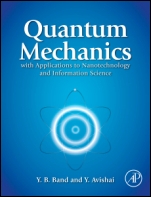
Quantum Mechanics with Applications to Nanotechnology and Information Science
ISBN 9780444537867
Autor: Band, Yehuda B.Avishai, Yshai
Wydawca: Elsevier
Dostępność: 3-6 tygodni
Cena: 498,75 zł
Przed złożeniem zamówienia prosimy o kontakt mailowy celem potwierdzenia ceny.
ISBN13: |
9780444537867 |
ISBN10: |
0444537864 |
Autor: |
Band, Yehuda B.Avishai, Yshai |
Oprawa: |
Hardback |
Rok Wydania: |
2012-11-27 |
Tematy: |
PHQ |
Quantum mechanics transcends and supplants classical mechanics at the atomic and subatomic levels. It provides the underlying framework for many subfields of physics, chemistry and materials science, including condensed matter physics, atomic physics, molecular physics, quantum chemistry, particle physics, and nuclear physics. It is the only way we can understand the structure of materials, from the semiconductors in our computers to the metal in our automobiles. It is also the scaffolding supporting much of nanoscience and nanotechnology. The purpose of this book is to present the fundamentals of quantum theory within a modern perspective, with emphasis on applications to nanoscience and nanotechnology, and information-technology. As the frontiers of science have advanced, the sort of curriculum adequate for students in the sciences and engineering twenty years ago is no longer satisfactory today. Hence, the emphasis on new topics that are not included in older reference texts, such as quantum information theory, decoherence and dissipation, and on applications to nanotechnology, including quantum dots, wires and wells.
This book provides a novel approach to Quantum Mechanics whilst also giving readers the requisite background and training for the scientists and engineers of the 21st Century who need to come to grips with quantum phenomenaThe fundamentals of quantum theory are provided within a modern perspective, with emphasis on applications to nanoscience and nanotechnology, and information-technologyOlder books on quantum mechanics do not contain the amalgam of ideas, concepts and tools necessary to prepare engineers and scientists to deal with the new facets of quantum mechanics and their application to quantum information science and nanotechnologyAs the frontiers of science have advanced, the sort of curriculum adequate for students in the sciences and engineering twenty years ago is no longer satisfactory todayThere are many excellent quantum mechanics books available, but none have the emphasis on nanotechnology and quantum information science that this book has
1 Introduction to Nanotechnology and Information-Technology
1.1 STM and AFM Microscopies
1.2 Molecular-Electronics
1.3 Quantum Dots, Wires and Wells, and Nanotubes
1.4 Bio-Nanotechnology
1.5 Information-Technology
2 The Formalism of Quantum Mechanics
2.1 Hilbert Space and Dirac Notation
2.2 The Postulates of Quantum Mechanics
2.2.1 The Measurement Problem
2.3 Hermitian and Anti-Hermitian operators
2.3.1 Compatible Operators and Degeneracy
2.3.2 Basis-State Expansions
2.4 The Uncertainty Principle
2.5 Mixed States: Density Matrix Formulation
2.5.1 Purity and von-Neumann Entropy
2.5.2 The Measurement Problem Revisited
2.6 Position and Momentum Representations
2.6.1 The Wigner Representation
2.7 Schrodinger and Heisenberg Representations
2.7.1 Interaction Representation
2.7.2 Harmonic Oscillator Raising and Lowering Operators
2.7.3 Coherent States and Squeezed States
2.8 The Correspondence Principle and the Classical Limit
2.9 Symmetry and Conservation Laws in Quantum Mechanics
2.9.1 Exchange Symmetry
2.9.2 Inversion Symmetry
2.9.3 Time-Reversal Symmetry
3 Angular Momentum and Spin
3.1 Angular Momentum in Quantum Mechanics
3.1.1 Angular Momentum Raising and Lowering Operators
3.1.2 Electron Spin: j = 1/2
3.1.3 Angular Momentum in Spherical Coordinates
3.1.4 Spherical Harmonics
3.2 Spin Angular Momentum
3.3 Spinors
3.3.1 Pauli Matrices
3.3.2 Rotation of Spinors
3.3.3 Spin-Orbitals
3.4 Electron in a Magnetic Field
3.4.1 Charged Particle in a Magnetic Field: Orbital Effects
3.4.2 Time-Reversal Properties of Spinors
3.5 Spin-Orbit Interaction
3.6 Hyperfine Interaction
3.6.1 Zeeman Splitting of Hyperfine States
3.7 Spin-Dipolar Interactions
3.8 Magnetic Resonance
3.8.1 The Rotating Wave Approximation
3.8.2 Spin Relaxation and The Bloch Equation
3.8.3 Chemical Shifts
3.8.4 Fourier Transform NMR
6 Quantum Information
6.1 Classical Information
6.1.1 Entropy and Information
6.1.2 Classical Bits and Gates
6.1.3 Classical Cryptography
6.1.4 Computational Complexity
6.2 Quantum Information and Processing
6.2.1 Qubits and Entanglement
6.2.2 Quantum Gates
6.2.3 No-Cloning Theorem
6.2.4 Dense Coding
6.2.5 Data Compression
6.2.6 Quantum Teleportation
6.2.7 Quantum Cryptography
6.2.8 Quantum Computing Despite Measurement
6.3 Quantum Computing
6.3.1 Deutsch and Deutsch-Jozsa Algorithms
6.3.2 The Grover Search Algorithm
6.3.3 Quantum Fourier Transform
6.3.4 Shor Factorization Algorithm
6.3.5 Quantum Simulation
6.4 Decoherence
6.5 Quantum Error Correction
6.6 Experimental Implementations
6.6.1 Ion Traps
6.6.2 Neutral Atoms in Optical Lattices
6.6.3 Cavity Based Quantum Computing
6.6.4 Nuclear Magnetic Resonance Systems
6.6.5 All-Optical Quantum Computers
6.6.6 Solid-State Qubits
6.7 The EPR Paradox
6.8 Bell’s Inequalities
7 Quantum Dynamics and Correlations
7.1 Two-Level Systems (Spin Systems)
7.1.1 Two-Level Dynamics (Spin Dynamics)
7.1.2 The Bloch Sphere Picture
7.1.3 Coupling to a Bath: Decoherence
7.1.4 Adiabatic limit: The Steady-State Approximation
7.1.5 Two or More Correlated Spins
7.1.6 N-Two-Level System Bloch Sphere
7.1.7 Ramsey Fringe Spectroscopy
7.2 Three-Level Systems
7.2.1 Two or More Three-Level Correlated Systems
7.2.2 Three-Level Dynamics
7.3 Continuous-Variable Systems
7.3.1 Wave Packet Dynamics
7.4 Time-Dependent Hamiltonians
7.5 Quantum Optimal Control Theory
8 Approximation Methods 371
8.1 Basis State Expansions
8.1.1 Time-Dependent Basis State Expansions
8.2 Semiclassical Approximations
8.2.1 The WKB Approximation
8.2.2 Semiclassical Expansion of Ehrenfest Theorem
8.2.3 Semiclassical Hamilton-Jacobi Expansion
8.3 Perturbation Theory
8.3.1 Non-degenerate Perturbation Theory
8.3.2 Perturbative Magnetic Field Effects
8.3.3 Perturbative Electric Field Effects
8.3.4 Degenerate Perturbation Theory
8.3.5 Time-Dependent Perturbation Theory
8.4 Dynamics in an Electromagnetic Field
8.4.1 Spontaneous and Stimulated Emission of Radiation
8.4.2 Electric Dipole and Multipole Radiation
8.4.3 Rayleigh, Raman and Brillouin Two-Photon Transitions
8.4.4 Decay Width
8.4.5 Doppler Shift
8.5 Exponential and Nonexponential Decay
8.6 The Variational Method
8.7 The Sudden Approximation
8.8 The Adiabatic Approximation
8.8.1 Chirped Pulse Adiabatic Passage
8.8.2 Stimulated Raman Adiabatic Passage
8.8.3 The Landau-Zener Problem
8.8.4 Generalized Displacements and Forces
8.8.5 Berry’s Phase
8.9 Linear Response and Susceptibilities
8.9.1 The Kubo Formula: Correlation Functions
8.9.2 Fluctuation-Dissipation Theorem
9 Identical Particles
9.1 Permutation Symmetry
9.1.1 The Symmetric Group
9.1.2 Young Tableaux
9.2 Exchange Symmetry
9.2.1 Symmetrization Postulate
9.3 Slater Determinants and Permanents
9.4 Simple Two-Electron States
9.5 Exchange Symmetry of Two Two-Level Systems
9.6 Exchange Symmetry of Many-Particle States
10 Electronic Properties of Solids
10.1 Free Electron Gas
10.1.1 Density of States in 2D and 1D systems
10.1.2 Fermi-Dirac Distribution Function
10.2 Elementary Theories of Conductivity
10.2.1 Drude Theory of Electron Conductivity
10.2.2 Thermal Conductivity of Metals
10.2.3 Sommerfeld Theory of Transport in Metals
10.3 Crystal Structure
10.3.1 Bravais Lattices and Crystal Systems
10.3.2 The Reciprocal Lattice
10.3.3 Quasicrystals
10.4 Electrons in a Periodic Potential
10.4.1 From Atomic Orbits to Band Structure
10.4.2 Band Structure and Electron Transport
10.4.3 Periodic Potential and Band Formation
10.4.4 Sinusoidal Potential: Mathieu Functions
10.4.5 Bloch Wave Functions and Energy Bands
10.4.6 Schr¬odinger Equation in Reciprocal Lattice Space
10.4.7 Tight-Binding Approximation
10.4.8 Wannier Functions
10.4.9 Electric Field Effects
10.5 Magnetic Field Effects
10.5.1 The Aharonov-Bohm Effect
10.5.2 Landau Levels
10.5.3 Periodic Potential and Magnetic Field
10.5.4 The Hall Effect and Magnetoresistance
10.5.5 de Haas-van Alphen and Shubnikov-de Haas Effects
10.5.6 The Quantum Hall Effect
10.5.7 Paramagnetism and Diamagnetism
10.6 Semiconductors
10.6.1 Semiconductor Band Structure
10.6.2 Density of Charge Carriers
10.6.3 Donor and Acceptor Impurities
10.6.4 p-n Junctions
10.6.5 Excitons
10.6.6 Low Energy Excitations
10.6.7 Spin-Orbit Coupling in Solid-State Physics
10.6.8 káp Perturbation Theory
10.6.9 Photon Induced Processes in Semiconductors
10.7 Insulators
10.7.1 On the Definition of the Gap
10.7.2 Nature of Band, Peirles and Anderson Insulators
10.7.3 Mott Insulators
10.8 Spintronics
11 Electronic Structure of Multi-Electron Systems
11.1 The Multi-Electron System Hamiltonian
11.2 Slater and Gaussian Type Atomic Orbitals
11.3 Term Symbols for Atoms
11.4 Two-Electron Systems
11.4.1 The Helium Atom
11.4.2 The Hartree Method: Helium
11.5 Hartree Approximation for Multi-Electron Systems
11.5.1 Koopmans’ Theorem
11.6 Hartree-Fock for Multi-electron Atoms
11.6.1 Hartree-Fock for Helium
11.7 Electronic Structure of Molecules
11.7.1 H+ Molecular Orbitals
11.7.2 The Hydrogen-Molecule
11.7.3 The H¬uckel Approximation
11.8 Hartree-Fock for Metals
11.9 Electron Correlation
11.9.1 Configuration Interaction
11.9.2 Moller-Plesset Many-Body Perturbation Theory
11.9.3 Coupled Cluster Method
11.10Multi-Electron Fine and Hyperfine Structure
12 Molecules
12.1 Molecular Orbitals and Group Theory
12.1.1 Character Tables and Mulliken Symbols
12.2 Diatomic Electronic States
12.2.1 Hund’s Coupling Cases
12.2.2 Hyperfine Interactions in Diatomic Molecules
12.3 The Born-Oppenheimer Approximation
12.3.1 Potential Energy Crossings and Pseudo-Crossings
12.3.2 Born-Oppenheimer Nuclear Derivative Coupling
12.3.3 The Hellman-Feynman Theorem
12.4 Rotational-Vibrational Structure
12.5 Electronic Optical Transition Selection Rules
12.6 The Franck-Condon Principle
13 Scattering Theory
13.1 Classical Scattering Theory
13.2 Quantum Treatment of Scattering
13.2.1 Time-Dependent Formulation
13.3 Stationary Scattering Theory
13.3.1 Cross-Sections
13.3.2 Two-Body Potential Scattering
13.3.3 From Wave Functions to Cross-Sections
13.3.4 Green’s Functions
13.4 Aspects of Formal Scattering Theory
13.4.1 The S Matrix and M¬oller Operators
13.5 Spherically Symmetric Potentials
13.5.1 Partial Wave Analysis
13.5.2 Phase Shift Analysis
13.5.3 Scattering from a Coulomb Potential
13.5.4 Scattering of Two Identical Particles
13.6 Resonance Scattering
13.6.1 Low Energy Cross-Sections: Influence of Bound-States
13.6.2 Resonance Cross-Sections
13.6.3 Feshbach Resonance
13.6.4 Fano Resonance
13.7 Approximation Methods
13.7.1 Born approximation
13.7.2 WKB Approximation
13.7.3 Variational Principle
13.7.4 Eikonal Approximation
13.8 Scattering of Particles with Internal Degrees of Freedom
13.8.1 Asymptotic States and Cross-Sections
13.8.2 The Multichannel S Matrix
13.8.3 Scattering from Two Potentials
13.8.4 Scattering of Particles with Spin
13.8.5 Inelastic Scattering and Scattering Reactions
13.8.6 Scattering from Identical Particles
13.9 Scattering in Low Dimensional Systems
13.9.1 Scattering in Two Dimensions
13.9.2 Scattering in One Dimension: The S matrix
13.9.3 Scattering in One Dimension: Anderson Localization
13.9.4 Scattering in Quasi-One-Dimensional Systems
13.9.5 The Landauer Conductance Formula
14 Many-Body Theory
14.1 Second Quantization
14.1.1 Construction of a basis
14.1.2 Mapping onto Fock Space
14.1.3 Creation and Annihilation operators
14.1.4 The Hamiltonian in Fock Space
14.1.5 Field Operators
14.1.6 Quantizing the Radiation Field: Photons
14.1.7 Quantizing Crystal Vibrations: Phonons
14.1.8 Systems with Two Kinds of Particles
14.2 Statistical Mechanics in Second Quantization
14.3 Mean-Field Theory
14.3.1 The Mean-Field Equations
14.3.2 The Hartree-Fock Approximation
14.4 Green’s Function
14.4.1 Representations
14.4.2 Green’s Functions in Many-Body Theory
14.4.3 Connection to Observables
14.4.4 The Spectral Function
14.4.5 Green’s Functions in Tunneling
14.5 Calculating Green’s Functions
14.5.1 Equations of Motion
14.5.2 Interaction Representation Expansion
14.5.3 Wick’s Theorem
14.5.4 Feynman Diagrams
14.5.5 Dyson Equation
14.5.6 Feynman Diagrams for Interacting Electrons
14.5.7 Higher Order Correlations
14.6 Imaginary Time Green’s Function
14.6.1 Matsubara Green’s function
14.7 Linear Response
14.8 Important Second Quantized Problems
14.8.1 Electrons and Phonons in a Crystal
14.8.2 Electrons and Photons
14.8.3 Anderson Impurity Model
14.8.4 The Kondo Effect
14.8.5 Spin Systems
14.8.6 Bose-Einstein Condensation
14.8.7 Landau Fermi Liquid Theory
14.8.8 Superconductivity and Superfluidity
15 Density Functional Theory
15.1 The Hohenberg-Kohn Theorems
15.2 The Thomas-Fermi Approximation
15.3 The Kohn-Sham Equations
15.3.1 Local Density Approximation
15.4 Spin DFT and Magnetic Systems
15.4.1 Spin DFT Local Density Approximation
15.5 Time-Dependent DFT
15.5.1 The Runge-Gross theorem
15.5.2 Time-Dependent Kohn-Sham equations
15.5.3 Adiabatic LDA Approximation
15.6 Temperature-Dependent DFT
15.6.1 Legendre Transforms and the Hohenberg-Kohn Theorem
15.6.2 The Finite T Kohn-Sham Equations
15.6.3 Finite T Bosonic Systems
15.6.4 The Grand Potential and the Free Energy
15.6.5 Solving the Effective non-interacting Reference System
16 Quantum Dots and Other Low-Dimensional Systems
16.1 Quantum Dots
16.1.1 Equilibrium Properties of Quantum Dots
16.1.2 Transport Properties of Quantum Dots
16.2 Quantum Wires
16.2.1 Nanotubes
16.3 Quantum Wells
16.3.1 Heterojunctions and Superlattices
16.4 Graphene
16.4.1 Charge Carriers in Graphene
16.4.2 Dirac Equation and its Relevance to Graphene
16.4.3 Tight Binding Model for Graphene
16.4.4 Continuum Theory
16.4.5 Landau Levels in Graphene
16.4.6 Potential Scattering in Graphene
16.5 Decoherence in Confined Systems
17 Decoherence and Dissipation
17.1 System-Bath Interactions
17.1.1 Decoherence Free Subspaces
17.2 Decohered and Dissipative Two-Level System
17.2.1 The Caldeira-Leggett Model
17.3 The Scattering Model of Decoherence and Localization
17.4 Master Equations
17.5 Quantum Fluctuations and Decoherence
17.6 Entanglement Decoherence
17.7 Weak Measurements and Non-Demolition Measurements
A Linear Algebra
A.1 Vector Spaces
A.1.1 Inner Product Spaces and Dirac Notation
A.2 Operators and Matrices
A.3 Determinants and Permanents
A.4 Antilinear and Antiunitary Operators
B Probability Theory
C Some Simple Ordinary Differential Equations
D Vector Analysis
D.1 Scalar and Vector Products
D.2 Differential Operators
D.3 Divergence and Stokes Theorems
D.4 Curvilinear Coordinates
E Fourier Analysis
E.1 Fourier Series
E.1.1 Fourier Series of Functions of a Discrete Variable
E.2 Fourier Integrals
E.3 Fourier Series and Integrals in Three Space Dimensions
E.3.1 3D Fourier Integrals
E.4 Fourier Integrals of Time-Dependent Functions
E.5 Convolution
E.6 Fourier Expansion of Operators
E.7 Fourier Transforms
E.8 FT for Solving Differential and Integral Equations
F Symmetry and Group Theory
F.1 Group Theory Axioms
F.2 Group Multiplication Tables
F.3 Examples of Groups
F.3.1 Point Groups
F.3.2 Space Groups
F.3.3 Continuous Groups
F.4 Some Properties of Groups
F.5 Group Representations
F.5.1 Irreducible Representations
F.5.2 Group Orthogonality Theorem
F.5.3 Characters and Character Tables
F.5.4 Constructing Irreducible Representations
F.6 Unitary Representations in Quantum States
F.7 SU(2), SU(1, 1), etc.
F.8 O(3), SO(3)
Koszyk
Książek w koszyku: 0 szt.
Wartość zakupów: 0,00 zł
Informacje


Kontakt
Gambit
Centrum Oprogramowania
i Szkoleń Sp. z o.o.
Al. Pokoju 29b/22-24
31-564 Kraków
Siedziba Księgarni
ul. Kordylewskiego 1
31-542 Kraków
+48 12 410 5991
+48 12 410 5987
+48 12 410 5989
Subskrypcje
Administratorem danych osobowych jest firma Gambit COiS Sp. z o.o. Na podany adres będzie wysyłany wyłącznie biuletyn informacyjny.
Autoryzacja płatności

Informacje na temat autoryzacji płatności poprzez PayU.

© Copyright 2012: GAMBIT COiS Sp. z o.o. Wszelkie prawa zastrzeżone.
Projekt i wykonanie: Alchemia Studio Reklamy