


Wydawcy
Katalog tematyczny
- Archeologia (109)
- Ekonomia, finanse, business (13704)
- Filozofia (1445)
- Historia (3040)
- Języki i językoznawstwo (2356)
- Lifestyle, hobby i rozrywka (475)
- Medycyna (9704)
- Chirurgia (272)
- Inne gałęzie medycyny (1871)
- Medycyna kliniczna (4187)
- Choroby wewnętrzne (514)
- Dermatologia (51)
- Diagnostyka medyczna (3)
- Endokrynologia (144)
- Gastroenterologia (27)
- Geriatria (50)
- Ginekologia i położnictwo (134)
- Hematologia (46)
- Hepatologia (10)
- Kardiologia (71)
- Laryngologia (12)
- Nefrologia (10)
- Neurologia (500)
- Oftalmologia (50)
- Pediatria (33)
- Pulmunologia (32)
- Reumatologia (14)
- Terapia genowa (1)
- Układ mięśniowo-szkieletowy (1)
- Urologia (14)
- Medycyna niekonwencjonalna (14)
- Medycyna przedkliniczna (269)
- Medycyna, ogólnie (1740)
- Medyczne służby pomocnicze (745)
- Studia medyczne (16)
- Weterynaria (548)
- Nauki humanistyczne (4)
- Nauki o Ziemi i środowisku (2638)
- Nauki ścisłe (20412)
- Nauki społeczne (8486)
- Nauki techniczne (13450)
- Prawo (1696)
- Publikacje informacyjne i interdyscyplinarne (1288)
- Religia i wierzenia (917)
- Technika komputerowa (4067)
- Zdrowie, relacje międzyludzkie i rozwój osobisty (657)





Informacje szczegółowe o książce
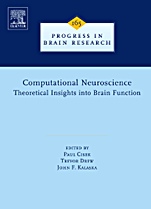
Computational Neuroscience: Theoretical Insights into Brain Function
ISBN 9780444528230
Autor: Cisek, PaulDrew, TrevorKalaska, John
Wydawca: Elsevier
Dostępność: 3-6 tygodni
Cena: 1 226,40 zł
Przed złożeniem zamówienia prosimy o kontakt mailowy celem potwierdzenia ceny.
ISBN13: |
9780444528230 |
ISBN10: |
0444528237 |
Autor: |
Cisek, PaulDrew, TrevorKalaska, John |
Oprawa: |
Hardback |
Rok Wydania: |
2007-10-29 |
Tematy: |
MJN |
Computational neuroscience is a relatively new but rapidly expanding area of research which is becoming increasingly influential in shaping the way scientists think about the brain. Computational approaches have been applied at all levels of analysis, from detailed models of single-channel function, transmembrane currents, single-cell electrical activity, and neural signaling to broad theories of sensory perception, memory, and cognition. This book provides a snapshot of this exciting new field by bringing together chapters on a diversity of topics from some of its most important contributors. This includes chapters on neural coding in single cells, in small networks, and across the entire cerebral cortex, visual processing from the retina to object recognition, neural processing of auditory, vestibular, and electromagnetic stimuli, pattern generation, voluntary movement and posture, motor learning, decision-making and cognition, and algorithms for pattern recognition. Each chapter provides a bridge between a body of data on neural function and a mathematical approach used to interpret and explain that data. These contributions demonstrate how computational approaches have become an essential tool which is integral in many aspects of brain science, from the interpretation of data to the design of new experiments, and to the growth of our understanding of neural function.
• Includes contributions by some of the most influential people in the field of computational neuroscience
• Demonstrates how computational approaches are being used today to interpret experimental data
• Covers a wide range of topics from single neurons, to neural systems, to abstract models of learning
The neuronal transfer function: contributions from voltage and time-dependent mechanisms
E.P. Cook, A.C. Wilhelm, J.A. Guest, Y. Liang, N.Y. Masse and C.M. Colbert (Montreal QC, Canada and Houston, TX, USA).
A simple growth model constructs critical avalanche networks
L.F. Abbott and R. Rohrkemper (New York, NY, USA and Zurich, Switzerland).
The dynamics of visual responses in the primary visual cortex
R. Shapley, M. Hawken and D. Xing (New York, NY, USA).
A quantitative theory of immediate visual recognition
T. Serre, G. Kreiman, M. Kouh, C. Cadieu, U. Knoblich and T. Poggio (Boston, MA, USA).
Attention in hierarchical models of object recognition
D.B. Walther and C. Koch (Urbana, IL, and Pasadena,CA, USA).
Towards a unified theory of neocortex: laminar cortical circuits for vision and cognition
S. Grossberg (Boston, MA, USA).
Real-time neural coding of memory
J.Z. Tsien (Boston, MA, USA).
Beyond timing in the auditory brainstem: intensity in the avian cochlear nucleus angularis
K.M. MacLeod and C.E. Carr (College Park, MD, USA).
Neural strategies for optimal processing of sensory signals
L. Maler (Ottawa, ON, Canada).
Coordinate transformations and sensory integration in the detection of spatial orientation and self-motion: from models to experiments
A.M. Green and D.E. Angelaki (Montreal, QC, Canada and St. Louis, MO, USA).
Sensorimotor optimization in higher dimensions
. Tweed (Toronto, ON,USA).
How tightly tuned are network parameters? Insight from computational and experimental studies in small rhythmic motor networks
E. Marder, A.-E. Tobin and R. Grashow (Waltham, MA, USA).
Spatial organization and state-dependent mechanisms for respiratory rhythm and pattern generation
I.A. Rybak, A.P.L. Abdala, S.N. Markin, J.F.R. Paton and J.C. Smith (Philadelphia, PA and Bethesda, MD, USA and Bristol, UK).
Modeling a vertebrate motor system – pattern generation, steering and control of body orientation
S. Grillner, A. Kozlov, P. Dario, C. Stefanini, A. Menciassi, A. Lansner, J. Hellgren Kotaleski (Stockholm, Sweden and Pontedera, Italy).
Modeling the mammalian locomotor CPG: insights from mistakes and perturbations
D.A. McCrea and I.A. Rybak (Winnipeg, MB, Canada and Philadelphia, PA, USA).
The neuromechanical tuning hypothesis
A. Prochazka and S. Yakovenko (Edmonton, AB and Montreal, QC, Canada).
Threshold position control and the principle of minimal interaction in motor actions
A.G. Feldman, V. Goussev, A. Sangole and M.F. Levin (Montreal and Laval, QC, Canada).
Modelling sensorimotor control of human upright stance
T. Mergner (Freiburg, Germany).
Dimensional reduction in sensorimotor systems: a framework for understanding muscle coordination of posture
L.H. Ting (Atlanta, GA, USA).
Primitives, premotor drives and pattern generation: a combined computational and neuroethological perspective
S. Giszter, V. Patil and C. Hart (Philadelphia, PA, USA).
A multi-level approach to understanding upper limb function
I. Kurtzer and S.H. Scott (Kingston, ON, Canada).
How is somatosensory information used to adapt to changes in the mechanical environment?
T.E. Milner, M.R. Hinder and D.W. Franklin (Burnaby, BC, Queensland, Australia and Kyoto, Japan).
Trial-by-trial motor adaptation: a window into elemental neural computation
K.A. Thoroughman, M.S. Fine and J.A. Taylor (Saint Louis, MO, USA).
Towards a computational neuropsychology of action
J.W. Krakauer and R. Shadmehr (New York, NY and Baltimore, MD, USA).
Motor control in a meta-network with attractor dynamics
N.I. Krouvhev and J.F. Kalaska (Montreal, WC, Canada).
Computing movement geometry – a step in sensory-motor transformations
D. Zipser and E. Torres (Pasadena, CA, USA).
Dynamics systems versus optimal control — a unifying view
S. Schaal, P. Mohajerian and A. Ijspeert (Los Angeles, CA, USA, Kyoto, Japan and Lausanne, Switzerland).
The place of ‘codes’ in nonlinear neurodynamics
W.J. Freeman (Berkeley, CA, USA).
From a representation of behaviour to the concept of cognitive syntax: a theoretical framework
T. Gisiger and M. Kerszberg (Paris, France).
A parallel framework for interactive behaviour
P. Cisek (Montreal, QC, Canada).
Statistical models for neural encoding, decoding, and optimal stimulus design
L. Paninski, J. Pillow and J. Lewi (New York, NY, USA and London, UK).
Probabilistic population codes and the exponential family of distributions
J. Beck, W. Ma, P.E. Latham and A. Pouget (Rochester, NY, USA and London, UK).
On the challenge of learning complex functions
Y. Bengio (Montreal, QC, Canada).
To recognize shapes, first learn to generate images
G.E. Hinton (Toronto, Canada).
Koszyk
Książek w koszyku: 0 szt.
Wartość zakupów: 0,00 zł
Informacje


Kontakt
Gambit
Centrum Oprogramowania
i Szkoleń Sp. z o.o.
Al. Pokoju 29b/22-24
31-564 Kraków
Siedziba Księgarni
ul. Kordylewskiego 1
31-542 Kraków
+48 12 410 5991
+48 12 410 5987
+48 12 410 5989
Subskrypcje
Administratorem danych osobowych jest firma Gambit COiS Sp. z o.o. Na podany adres będzie wysyłany wyłącznie biuletyn informacyjny.
Autoryzacja płatności

Informacje na temat autoryzacji płatności poprzez PayU.

© Copyright 2012: GAMBIT COiS Sp. z o.o. Wszelkie prawa zastrzeżone.
Projekt i wykonanie: Alchemia Studio Reklamy