


Wydawcy
Katalog tematyczny
- Archeologia (109)
- Ekonomia, finanse, business (13704)
- Filozofia (1445)
- Historia (3040)
- Języki i językoznawstwo (2356)
- Lifestyle, hobby i rozrywka (475)
- Medycyna (9704)
- Nauki humanistyczne (4)
- Nauki o Ziemi i środowisku (2638)
- Nauki ścisłe (20412)
- Nauki społeczne (8486)
- Nauki techniczne (13450)
- Prawo (1696)
- Publikacje informacyjne i interdyscyplinarne (1288)
- Religia i wierzenia (917)
- Technika komputerowa (4067)
- Zdrowie, relacje międzyludzkie i rozwój osobisty (657)





Informacje szczegółowe o książce
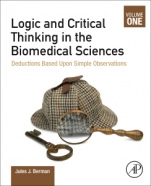
Logic and Critical Thinking in the Biomedical Sciences: Volume I: Deductions Based Upon Simple Observations
ISBN 9780128213643
Autor: Berman, Jules J.
Wydawca: Elsevier
Dostępność: 3-6 tygodni
Cena: 564,90 zł
Przed złożeniem zamówienia prosimy o kontakt mailowy celem potwierdzenia ceny.
ISBN13: |
9780128213643 |
Autor: |
Berman, Jules J. |
Oprawa: |
Paperback |
Rok Wydania: |
2020-07-04 |
Tematy: |
KNDH1 |
Science is not a collection of facts. Science is the process by which we draw inferences from facts. Volume I of Logic and Critical Thinking in the Biomedical Sciences invites readers to linger over a collection of common observations to see what inferences can be drawn, when one applies a bit of deductive logic. If we just think about what we observe, it is often possible to discover profound biomedical insights.
Volumes 1 and 2 of Logic and Critical Thinking in the Biomedical Sciences are written for biomedical scientists and college-level students engaged in any of the life sciences, including bioinformatics and related data sciences.
Provides a strong introduction to deductive methods that can be directly applied to the biomedical sciences
Using hundreds of examples, shows how creative scientists draw important inferences from observations that are often ignored by their peers
Discusses complex biological and medical concepts in a relaxed manner, intended to focus the reader’s attention on the deductive process, without dwelling excessively on details
1. Introduction to biomedical logic
Section 1.1. What is reasoning?
Section 1.2. What is proof?
Section 1.3. Fallacies
Section 1.4. Can several weak arguments substitute for one strong argument?
Glossary
References
2. Drawing inferences from photographs
Section 2.1. Thinking about what we see
Section 2.2. Looking at nuclei
Section 2.3. Deducing that the chloroplasts in plant cells are captured cyanobacteria
Section 2.4. Phylogenetic advances manifest themselves in the embryo
Section 2.5. All eutherian cell types are equivalent among classes of species
Section 2.6. Length of gestation in eutherian animals
Section 2.7. Inferring that there are many more than 200 cell types
Section 2.8. What we learn from looking at red blood cells
Section 2.9. What we learn from inclusion bodies
Glossary
References
3. Inferences drawn from organismal development
Section 3.1. Desmosomes, the essence of animals
Section 3.2. Ear ossicles missing from reptiles
Section 3.3. The wisdom of teeth
Section 3.4. The development of bones
Section 3.5. Unnecessary cerebellum
Section 3.6. Mammalian hair and the origin of basal cell carcinoma
Section 3.7. Inferences drawn from the shape of snake heads
Section 3.8. Depth of penetration of ultraviolet light
Section 3.9. Evolution is often a one-way road
Glossary
References
4. Inferences drawn from temporal sequences
Section 4.1. Paradoxes of creation
Section 4.2. A logical approach to bootstrapping paradoxes
Section 4.3. Inferences drawn from the sequence of clinical events preceding death
Section 4.4. When was aging invented?
Section 4.5. When does aging begin?
Section 4.6. Old age does not cause cancer
Section 4.7. What can we infer when we know the time at which a mutation occurred?
Glossary
References
5. Finding relationships among biological entities
Section 5.1. Defining relationships and similarities
Section 5.2. Ancestral genes
Section 5.3. The significance of gene sequence conservation
Section 5.4. Unexpected gene conservation
Section 5.5. Relationships between human diseases and orthodiseases
Section 5.6. Inferring the relationships between genetic diseases and their phenocopies
Section 5.7. The logic of treating disease pathways, not disease genes
Glossary
References
6. Drawing inferences from classifications and ontologies
Section 6.1. What is a classification?
Section 6.2. Ontologies
Section 6.3. Some paradoxes of classifications
Section 6.4. The classification of living organisms and the meaning of “species
Section 6.5. Speciation is the primary driver of evolution
Section 6.6. Classifications allow us to discover class-specific treatments of diseases
Glossary
References
7. Biomedical advances achieved by reducing class noise
Section 7.1. Significance of class noise
Section 7.2. Why fungi are definitely not plants?
Section 7.3. Naegleria fowleri is not an amoeba
Section 7.4. Clinical trials for staged cancers
Section 7.5. Psychiatric illnesses
Section 7.6. Cures for the most common and chronic diseases
Section 7.7. The mistake of overclassifying in an effort to avoid class blending
Glossary
References
8. How a little logic could have corrected long-held misbeliefs
Section 8.1. We should have known better
Section 8.2. An embryo is not a miniature baby
Section 8.3. The genome is a recipe book, not a blueprint
Section 8.4. Why our genome is full of junk
Section 8.5. Bacteria live in our stomachs
Section 8.6. We can abandon Koch’s postulates
Section 8.7. Diseases arise through a sequence of events that occur over time
Section 8.8. The egalitarian nature of logical analysis
Glossary 252
References 263
Koszyk
Książek w koszyku: 0 szt.
Wartość zakupów: 0,00 zł
Informacje


Kontakt
Gambit
Centrum Oprogramowania
i Szkoleń Sp. z o.o.
Al. Pokoju 29b/22-24
31-564 Kraków
Siedziba Księgarni
ul. Kordylewskiego 1
31-542 Kraków
+48 12 410 5991
+48 12 410 5987
+48 12 410 5989
Subskrypcje
Administratorem danych osobowych jest firma Gambit COiS Sp. z o.o. Na podany adres będzie wysyłany wyłącznie biuletyn informacyjny.
Autoryzacja płatności

Informacje na temat autoryzacji płatności poprzez PayU.

© Copyright 2012: GAMBIT COiS Sp. z o.o. Wszelkie prawa zastrzeżone.
Projekt i wykonanie: Alchemia Studio Reklamy