


Wydawcy
Katalog tematyczny
- Archeologia (109)
- Ekonomia, finanse, business (13704)
- Filozofia (1445)
- Historia (3040)
- Języki i językoznawstwo (2356)
- Lifestyle, hobby i rozrywka (475)
- Medycyna (9704)
- Nauki humanistyczne (4)
- Nauki o Ziemi i środowisku (2638)
- Nauki ścisłe (20412)
- Nauki społeczne (8486)
- Edukacja (229)
- Kryminologia, opieka spełeczna (284)
- Obronność (10)
- Polityka (1389)
- Psychologia (777)
- Socjologia (410)
- Społeczeństwo i kultura (187)
- Nauki techniczne (13450)
- Prawo (1696)
- Publikacje informacyjne i interdyscyplinarne (1288)
- Religia i wierzenia (917)
- Technika komputerowa (4067)
- Zdrowie, relacje międzyludzkie i rozwój osobisty (657)





Informacje szczegółowe o książce
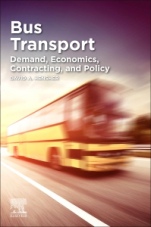
Bus Transport: Demand, Economics, Contracting, and Policy
ISBN 9780128201329
Autor: Hensher, David A.
Wydawca: Elsevier
Dostępność: 3-6 tygodni
Cena: 564,90 zł
Przed złożeniem zamówienia prosimy o kontakt mailowy celem potwierdzenia ceny.
ISBN13: |
9780128201329 |
Autor: |
Hensher, David A. |
Oprawa: |
Paperback |
Rok Wydania: |
2020-04-17 |
Tematy: |
JPQB |
Bus Transport: Demand, Economics, Contracting, and Policy examines in one source the most critical and current research themes of public transport relevant to regulators, planners, operators, researchers and educators. It highlights the wider economic impacts of public transport and compares energy usage across all public transport modes. The book examines the evolving debate on Mobility as a Service (MaaS) and includes discussion of such themes as; public image issues, performance measurement and monitoring, contract procurement and design models, travel choice and demand, and global public transport reform. The book reflects the leading perspectives on the preservation and health of the bus sector, intending to move public transport reform forward.
Compiles in one source up-to-date insights on important public transport themes, issues, and debates Examines a wide range of public transport topics in the multidisciplinary fields of economics, policy, operations, and planningBridges the gap between scientific research and policy implementation
1. Introduction and Overview
Part I: Reviews 2. Public service contracts in the bus sector 3. Disruptive technology and moving people 4. The influence of the Thredbo Series 5. Competition and ownership in land passenger transport: the Thredbo story
Part II: Contracting 6. Contracting regimes for bus services: what have we learnt in recent years? 7. Incompleteness and clarity in bus contracts 8. A simplified performance-linked value for money model for bus contract payments 9. Bus contract costs, user perceived service quality and performance assessment 10. Customer service quality and benchmarking in bus contracts 11. Are there cost efficiency gains through competitive tendering or negotiated performance-based contracts and benchmarking in the absence of an incumbent public monopolist? 12. Efficient contracting and incentive agreements between regulators and bus operators: the influence of risk preferences of contracting agents on contract choice 13. Using contracted assets to undertake non-contracted services to improve cost efficiency 14. Disruption costs in contract transitions
Part III: Bus Rapid Transit 15. Sustainable bus systems: moving towards a value for money and network-based approach and away from blind commitment 16. Ridership drivers of bus based transit systems 17. Performance contributors of bus rapid transit systems within the ITDP BRT standard 18. Review of bus rapid transit and branded bus services in Australia
Part IV: Image 19. Identifying resident preferences for bus and rail investments 20. Cultural contrasts of preferences for bus rapid transit and light rail transit
Part V: Elasticities 21. Assessing sources of variation in public transport elasticities: some warnings
Part VI: Crowding 22. A review of willingness to pay evidence on public transport crowding 23. A review of objective and subjective measures of crowding in public transport 24. The effects of passenger crowding on public transport demand and supply system 25. Multimodal transport pricing with extensions to non-motorised transport
Part VII: Transport Appraisal 26. Estimating the wider economic benefits of the Sydney North West Rail Link project 27. Clarifying the complementary contributions of cost benefit analysis and economic impact analysis in public transport investment 28. How well does BRT perform in contrast to LRT? An Australian case study
Part VIII: Energy 29. Can bus be cleaner and greener than rail?
Part IX: Social Exclusion 30. The roles of mobility and bridging social capital in reducing social exclusion in regional Australia
Part X: Mobility as a Service (MaaS) 31. Future bus transport contracts under mobility as a service regime 32. Potential uptake and willingness-to-pay for mobility as a service 33. Identifying broker/aggregator models for delivering mobility as a service 34. What might road congestion look like in the future under a collaborative and connected mobility model?
Koszyk
Książek w koszyku: 0 szt.
Wartość zakupów: 0,00 zł
Informacje


Kontakt
Gambit
Centrum Oprogramowania
i Szkoleń Sp. z o.o.
Al. Pokoju 29b/22-24
31-564 Kraków
Siedziba Księgarni
ul. Kordylewskiego 1
31-542 Kraków
+48 12 410 5991
+48 12 410 5987
+48 12 410 5989
Subskrypcje
Administratorem danych osobowych jest firma Gambit COiS Sp. z o.o. Na podany adres będzie wysyłany wyłącznie biuletyn informacyjny.
Autoryzacja płatności

Informacje na temat autoryzacji płatności poprzez PayU.

© Copyright 2012: GAMBIT COiS Sp. z o.o. Wszelkie prawa zastrzeżone.
Projekt i wykonanie: Alchemia Studio Reklamy