


Wydawcy
Katalog tematyczny
- Archeologia (109)
- Ekonomia, finanse, business (13704)
- Filozofia (1445)
- Historia (3040)
- Języki i językoznawstwo (2356)
- Lifestyle, hobby i rozrywka (475)
- Medycyna (9704)
- Nauki humanistyczne (4)
- Nauki o Ziemi i środowisku (2638)
- Nauki ścisłe (20412)
- Nauki społeczne (8486)
- Nauki techniczne (13450)
- Budownictwo lądowe (1045)
- Chemia przemysłowa (2258)
- Elektronika i telekomunikacja (3287)
- Energetyka (1122)
- Inne nauki stosowane (363)
- Inżynieria biochemiczna (507)
- Inżynieria transportu (232)
- Mechanika i materiały (3316)
- Nauka o środowisku (321)
- Rolnictwo (507)
- Technika, ogólnie (475)
- Prawo (1696)
- Publikacje informacyjne i interdyscyplinarne (1288)
- Religia i wierzenia (917)
- Technika komputerowa (4067)
- Zdrowie, relacje międzyludzkie i rozwój osobisty (657)





Informacje szczegółowe o książce
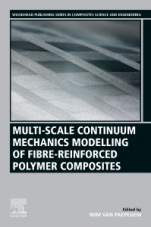
Multi-Scale Continuum Mechanics Modelling of Fibre-Reinforced Polymer Composites
ISBN 9780128189849
Autor: Van Paepegem, Wim
Wydawca: Elsevier
Dostępność: 3-6 tygodni
Cena: 1 486,80 zł
Przed złożeniem zamówienia prosimy o kontakt mailowy celem potwierdzenia ceny.
ISBN13: |
9780128189849 |
Autor: |
Van Paepegem, Wim |
Oprawa: |
Paperback |
Rok Wydania: |
2020-11-26 |
Tematy: |
TGM |
Multi-scale modelling of composites is a very relevant topic in composites science. This is illustrated by the numerous sessions in the recent European and International Conferences on Composite Materials, but also by the fast developments in multi-scale modelling software tools, developed by large industrial players such as Siemens (Virtual Material Characterization toolkit and MultiMechanics virtual testing software), MSC/e-Xstream (Digimat software), Simulia (micromechanics plug-in in Abaqus), HyperSizer (Multi-scale design of composites), Altair (Altair Multiscale Designer)
This book is intended to be an ideal reference on the latest advances in multi-scale modelling of fibre-reinforced polymer composites, that is accessible for both (young) researchers and end users of modelling software. We target three main groups:
This book aims at a complete introduction and overview of the state-of-the-art in multi-scale modelling of composites in three axes:
• ranging from prediction of homogenized elastic properties to nonlinear material behaviour
• ranging from geometrical models for random packing of unidirectional fibres over meso-scale geometries for textile composites to orientation tensors for short fibre composites
• ranging from damage modelling of unidirectionally reinforced composites over textile composites to short fibre-reinforced composites
The book covers the three most important scales in multi-scale modelling of composites: (i) micro-scale, (ii) meso-scale and (iii) macro-scale. The nano-scale and related atomistic and molecular modelling approaches are deliberately excluded, since the book wants to focus on continuum mechanics and there are already a lot of dedicated books about polymer nanocomposites.
A strong focus is put on physics-based damage modelling, in the sense that the chapters devote attention to modelling the different damage mechanisms (matrix cracking, fibre/matrix debonding, delamination, fibre fracture,…) in such a way that the underlying physics of the initiation and growth of these damage modes is respected.
The book also gives room to not only discuss the finite element based approaches for multi-scale modelling, but also much faster methods that are popular in industrial software, such as Mean Field Homogenization methods (based on Mori-Tanaka and Eshelby solutions) and variational methods (shear lag theory and more advanced theories).
Since the book targets a wide audience, the focus is put on the most common numerical approaches that are used in multi-scale modelling. Very specialized numerical methods like peridynamics modelling, Material Point Method, eXtended Finite Element Method (XFEM), isogeometric analysis, SPH (Smoothed Particle Hydrodynamics),… are excluded.
Outline of the book
The book is divided in three large parts, well balanced with each a similar number of chapters:
Part I deals with all "ingredients" to start with multi-scale modelling, limited to elastic property prediction. This typically includes: (i) setting up your geometrical model at micro- or meso-scale (definition of Representative Volume Element (RVE) or Repeating Unit Cell (RUC)), (ii) definition of periodic boundary conditions, (iii) homogenization of the elastic properties, starting from the elastic properties of the constituents, (iv) importance of statistical representation of geometry and stochastic nature of fibre architecture. This should bring all readers at the same level of principles and terminology for multi-scale modelling. Advanced users could eventually skip this first part.
Part II deals with nonlinear multi-scale modelling. We build further upon the ingredients from Part I, but now add all kinds of nonlinearities to the simulation at micro- or meso-scale (matrix cracking, delamination, fibre/matrix debonding, delamination, fibre failure, visco-elasto-plasticity-damage of the polymer matrix,…). Not only finite element based techniques are covered, but also much faster inclusion methods (Mori-Tanaka, Eshelby,…) and variational methods.
Part III deals with the laminate scale or macro-scale, where all these multi-scale modelling tools are applied for macro-scale ply-based modelling and virtual testing of laminates (in static loading, but also sometimes for prediction of fatigue, post-impact strength,…).
In all three parts, the main three types of fibre reinforcement are covered (unidirectionally reinforced composites, textile composites and short fibre composites).
The chapters are written by leading authorities from academia, and each chapter gives a self-contained overview of a specific topic, covering the state-of-the-art and future research challenges.
• all software users, R&D people and researchers that have some knowledge in general continuum mechanics modelling of composites, but have never worked in the field of multi-scale modelling,
• this book should also provide a strong theoretical background to the end users of commercial multi-scale modelling tools, and warn them for the pitfalls and difficulties in obtaining results with such software,
• for advanced users and researchers in multi-scale modelling, the book will still be of much value, because almost nobody will cover in his/her own research the complete field of knowledge that is described in this book.
Chapter 1- Multiscale Framework. Concept of Geometry, Materials, Load Conditions and Homogenization. - David Garoz Gómez
Chapter 2 - Micro-scale Representative Volume Element - Generation and Statistical Characterisation - António R. Melro and Riccardo Manno
Chapter 3 - Geometry modelling and elastic property prediction for short fiber composites - Jörg Hohe
Chapter 4 - Modelling approaches for constructing the geometry of textiles at the meso-scale level - Yordan Kyosev
Chapter 5 - Construction of Representative Unit Cells for FE analysis of Textile Composite Plies - R.D.B. Sevenois
Chapter 6 - Detailed comparison of analytical and FE-based homogenization approaches for fiber-reinforced composites - Sergey G. Abaimov, Iskander Akhatov, Stepan V. Lomov
Chapter 7 - Applications of Maxwell’s methodology to the prediction of the effective properties of composite materials - L.N. McCartney
Chapter 8 - Modelling nonlinear material response of polymer matrices used in fiber-reinforced composites - F. A. Gilabert
Chapter 9 - Modelling fibre/matrix interface debonding and matrix cracking in composite laminates - F. París, M.L. Velasco, E. Correa
Chapter 10 - Modeling Defect Severity for Failure Analysis of Composites - Ramesh Talreja
Chapter 11 – Micromechanical modelling of interlaminar damage propagation and migration - L.F. Varandas, G. Catalanotti, A. Arteiro, A.R. Melro and B.G. Falzon
Chapter 12 – Modelling the longitudinal failure of fibre-reinforced composites at micro-scale - G. Catalanotti, L.F. Varandas, A.R. Melro, T.A. Sebaey, M.A. Bessa and B.G. Falzon
Chapter 13 - Multi-scale modelling and experimental observation of transverse tow cracking and debonding in textile composites – Martin Hirsekorn
Chapter 14 – Experimental-Numerical Characterization of the Non-linear Microstructural Behavior of Fiber Reinforced Polymer Structures – Michael Schober, Kerstin Dittmann, Peter Gumbsch, Jörg Hohe
Chapter 15 - Virtual identification of macroscopic material laws from lower scales - David Garoz Gómez
Chapter 16 - Modeling Damage Evolution in Multidirectional Laminates: Micro to Macro – John Montesano and Farzad Sharifpour
Chapter 17 - Physics-based methodology for predicting ply cracking and laminate failure in symmetric composite laminates under multiaxial loading condition - M. Hajikazemi
Chapter 18 - Meso-scale modeling of delamination using the cohesive zone model approach - Laura Carreras, Gerard Guillamet, Adrià Quintanas-Corominas, Jordi Renart, Albert Turon
Chapter 19 – Stochastic Virtual Testing Laboratory for unidirectional composite coupons. From conventional to dispersed-plylaminates - Cläudio S. Lopes, David Garoz Gómez, Olben Falcó, Bas H. A. H. Tijs
Chapter 20 – Multiscale Modeling of Open-hole Composite Laminates and 3D Woven Composites – Deepak K. Patela, Anthony M. Waas
Chapter 21 - Multi-scale modelling of laminated composite structures with defects and features - Bassam El Said and Stephen R. Hallett
Chapter 22 - A Multi-Scale Damage-Based Strategy to Predict the Fatigue Damage Evolution and the Stiffness Loss in Composite Laminates - Marino Quaresimin, Paolo Andrea Carraro
Chapter 23 - Hybrid multi-scale modelling of fatigue and damage in short fibre reinforced composites - Atul JAIN
Koszyk
Książek w koszyku: 0 szt.
Wartość zakupów: 0,00 zł
Informacje


Kontakt
Gambit
Centrum Oprogramowania
i Szkoleń Sp. z o.o.
Al. Pokoju 29b/22-24
31-564 Kraków
Siedziba Księgarni
ul. Kordylewskiego 1
31-542 Kraków
+48 12 410 5991
+48 12 410 5987
+48 12 410 5989
Subskrypcje
Administratorem danych osobowych jest firma Gambit COiS Sp. z o.o. Na podany adres będzie wysyłany wyłącznie biuletyn informacyjny.
Autoryzacja płatności

Informacje na temat autoryzacji płatności poprzez PayU.

© Copyright 2012: GAMBIT COiS Sp. z o.o. Wszelkie prawa zastrzeżone.
Projekt i wykonanie: Alchemia Studio Reklamy