


Wydawcy
Katalog tematyczny
- Archeologia (109)
- Ekonomia, finanse, business (13704)
- Filozofia (1445)
- Historia (3040)
- Języki i językoznawstwo (2356)
- Lifestyle, hobby i rozrywka (475)
- Medycyna (9704)
- Nauki humanistyczne (4)
- Nauki o Ziemi i środowisku (2638)
- Nauki ścisłe (20412)
- Astronomia (294)
- Biologia (5119)
- Chemia (6540)
- Fizyka (3309)
- Elektryczność i magnetyzm (90)
- Fizyka atomowa i molekularna (110)
- Fizyka cząstek elementarnych (36)
- Fizyka jądra atomowego (36)
- Fizyka kwantowa (210)
- Fizyka matematyczna (121)
- Fizyka relatywistyczna (36)
- Fizyka statystyczna (51)
- Fizyka stosowana (498)
- Mechanika klasyczna (186)
- Optyka i światło (133)
- Stany materii (202)
- Matematyka (4574)
- Nauki ścisłe, ogólnie (503)
- Nauki społeczne (8486)
- Nauki techniczne (13450)
- Prawo (1696)
- Publikacje informacyjne i interdyscyplinarne (1288)
- Religia i wierzenia (917)
- Technika komputerowa (4067)
- Zdrowie, relacje międzyludzkie i rozwój osobisty (657)





Informacje szczegółowe o książce
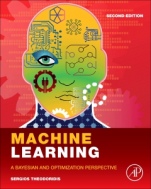
Machine Learning: A Bayesian and Optimization Perspective
ISBN 9780128188033
Autor: Theodoridis, Sergios
Wydawca: Elsevier
Dostępność: 3-6 tygodni
Cena: 479,85 zł
Przed złożeniem zamówienia prosimy o kontakt mailowy celem potwierdzenia ceny.
ISBN13: |
9780128188033 |
Autor: |
Theodoridis, Sergios |
Oprawa: |
Hardback |
Rok Wydania: |
2020-03-06 |
Tematy: |
PHK |
Machine Learning: A Bayesian and Optimization Perspective, 2nd edition, gives a unified perspective on machine learning by covering both pillars of supervised learning, namely regression and classification. The book starts with the basics, including mean square, least squares and maximum likelihood methods, ridge regression, Bayesian decision theory classification, logistic regression, and decision trees. It then progresses to more recent techniques, covering sparse modelling methods, learning in reproducing kernel Hilbert spaces and support vector machines, Bayesian inference with a focus on the EM algorithm and its approximate inference variational versions, Monte Carlo methods, probabilistic graphical models focusing on Bayesian networks, hidden Markov models and particle filtering. Dimensionality reduction and latent variables modelling are also considered in depth.
This palette of techniques concludes with an extended chapter on neural networks and deep learning architectures. The book also covers the fundamentals of statistical parameter estimation, Wiener and Kalman filtering, convexity and convex optimization, including a chapter on stochastic approximation and the gradient descent family of algorithms, presenting related online learning techniques as well as concepts and algorithmic versions for distributed optimization.
Focusing on the physical reasoning behind the mathematics, without sacrificing rigor, all the various methods and techniques are explained in depth, supported by examples and problems, giving an invaluable resource to the student and researcher for understanding and applying machine learning concepts. Most of the chapters include typical case studies and computer exercises, both in MATLAB and Python.
The chapters are written to be as self-contained as possible, making the text suitable for different courses: pattern recognition, statistical/adaptive signal processing, statistical/Bayesian learning, as well as courses on sparse modeling, deep learning, and probabilistic graphical models.
New to this edition:
Complete re-write of the chapter on Neural Networks and Deep Learning to reflect the latest advances since the 1st edition. The chapter, starting from the basic perceptron and feed-forward neural networks concepts, now presents an in depth treatment of deep networks, including recent optimization algorithms, batch normalization, regularization techniques such as the dropout method, convolutional neural networks, recurrent neural networks, attention mechanisms, adversarial examples and training, capsule networks and generative architectures, such as restricted Boltzman machines (RBMs), variational autoencoders and generative adversarial networks (GANs).
Expanded treatment of Bayesian learning to include nonparametric Bayesian methods, with a focus on the Chinese restaurant and the Indian buffet processes.
Presents the physical reasoning, mathematical modeling and algorithmic implementation of each methodUpdates on the latest trends, including sparsity, convex analysis and optimization, online distributed algorithms, learning in RKH spaces, Bayesian inference, graphical and hidden Markov models, particle filtering, deep learning, dictionary learning and latent variables modelingProvides case studies on a variety of topics, including protein folding prediction, optical character recognition, text authorship identification, fMRI data analysis, change point detection, hyperspectral image unmixing, target localization, and more
1. Introduction 2. Probability and stochastic Processes 3. Learning in parametric Modeling: Basic Concepts and Directions 4. Mean-Square Error Linear Estimation 5. Stochastic Gradient Descent: the LMS Algorithm and its Family 6. The Least-Squares Family 7. Classification: A Tour of the Classics 8. Parameter Learning: A Convex Analytic Path 9. Sparsity-Aware Learning: Concepts and Theoretical Foundations 10. Sparsity-Aware Learning: Algorithms and Applications 11. Learning in Reproducing Kernel Hilbert Spaces 12. Bayesian Learning: Inference and the EM Algorithm 13. Bayesian Learning: Approximate Inference and nonparametric Models 14. Montel Carlo Methods 15. Probabilistic Graphical Models: Part 1 16. Probabilistic Graphical Models: Part 2 17. Particle Filtering 18. Neural Networks and Deep Learning 19. Dimensionality Reduction and Latent Variables Modeling
Koszyk
Książek w koszyku: 0 szt.
Wartość zakupów: 0,00 zł
Informacje


Kontakt
Gambit
Centrum Oprogramowania
i Szkoleń Sp. z o.o.
Al. Pokoju 29b/22-24
31-564 Kraków
Siedziba Księgarni
ul. Kordylewskiego 1
31-542 Kraków
+48 12 410 5991
+48 12 410 5987
+48 12 410 5989
Subskrypcje
Administratorem danych osobowych jest firma Gambit COiS Sp. z o.o. Na podany adres będzie wysyłany wyłącznie biuletyn informacyjny.
Autoryzacja płatności

Informacje na temat autoryzacji płatności poprzez PayU.

© Copyright 2012: GAMBIT COiS Sp. z o.o. Wszelkie prawa zastrzeżone.
Projekt i wykonanie: Alchemia Studio Reklamy