


Wydawcy
Katalog tematyczny
- Archeologia (109)
- Ekonomia, finanse, business (13704)
- Filozofia (1445)
- Historia (3040)
- Języki i językoznawstwo (2356)
- Lifestyle, hobby i rozrywka (475)
- Medycyna (9704)
- Nauki humanistyczne (4)
- Nauki o Ziemi i środowisku (2638)
- Geografia (299)
- Nauki o Ziemi (1661)
- Geologia (414)
- Hydrologia (237)
- Meteorologia i klimatologia (114)
- Paleontologia (33)
- Wulkanologia i sejsmologia (44)
- Planowanie przestrzenne (53)
- Środowisko (607)
- Nauki ścisłe (20412)
- Nauki społeczne (8486)
- Nauki techniczne (13450)
- Prawo (1696)
- Publikacje informacyjne i interdyscyplinarne (1288)
- Religia i wierzenia (917)
- Technika komputerowa (4067)
- Zdrowie, relacje międzyludzkie i rozwój osobisty (657)





Informacje szczegółowe o książce
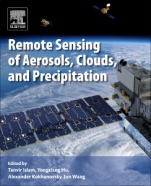
Remote Sensing of Aerosols, Clouds, and Precipitation
ISBN 9780128104378
Autor: Islam, TanvirHu, YongxiangKokhanovsky, Alexander A.Wang, Jun
Wydawca: Elsevier
Dostępność: 3-6 tygodni
Cena: 564,90 zł
Przed złożeniem zamówienia prosimy o kontakt mailowy celem potwierdzenia ceny.
ISBN13: |
9780128104378 |
Autor: |
Islam, TanvirHu, YongxiangKokhanovsky, Alexander A.Wang, Jun |
Oprawa: |
Paperback |
Rok Wydania: |
2017-10-18 |
Tematy: |
RBP |
Remote Sensing of Aerosols, Clouds, and Precipitation compiles recent advances in aerosol, cloud, and precipitation remote sensing from new satellite observations. The book examines a wide range of measurements from microwave (both active and passive), visible, and infrared portions of the spectrum. Contributors are experts conducting state-of-the-art research in atmospheric remote sensing using space, airborne, and ground-based datasets, focusing on supporting earth observation satellite missions for aerosol, cloud, and precipitation studies. A handy reference for scientists working in remote sensing, earth science, electromagnetics, climate physics, and space engineering. Valuable for operational forecasters, meteorologists, geospatial experts, modelers, and policymakers alike.
Author Biography: Dr. Tanvir Islam is presently with the NASA Jet Propulsion Laboratory, who leads on the thermal infrared spectroscopy and radiative transfer theory for the retrieval of earth surface properties and spectral emissivity information. Dr. Islam received the Ph.D. degree in remote sensing from the University of Bristol, Bristol, UK, in 2012. His Ph.D. research was focused on the remote sensing of precipitation through the use of radar polarimetry, especially, towards algorithm developments and data quality improvements. Following his Ph.D., he joined the University of Tokyo as a visiting scientist, more specifically, as part of the NASA/JAXA precipitation measurement missions (PMM) algorithm development team, which was supported by JAXA. During 2013-2015, he was with the NOAA/NESDIS/STAR, and worked on the development of satellite remote sensing algorithms, with an emphasis on microwave variational inversion techniques. He was the scientific algorithm developer for the NOAA's Microwave Integrated Retrieval System (MiRS), where he led a number of efforts to enhance the performance of geophysical retrievals, and extended the capability of the system to new passive microwave sensors. In 2015, he stayed at the University of Calgary as an invited visiting scientist to assist with remote sensing research of the sea ice and snow using scatterometry and synthetic aperture radar. Dr. Islam was the recipient of the Faculty of Engineering Commendation from the University of Bristol (nominated for a University Prize for his outstanding Ph.D. thesis), in 2012, the JAXA visiting fellowship award, in 2012, the CIRA postdoctoral fellowship award, in 2013, the Calgary visiting fellowship award, in 2015, and the Caltech postdoctoral scholar award, in 2015. He has served as a guest editor of the special issue on Microwave Remote Sensing, Physics and Chemistry of the Earth (Elsevier), and currently serving on the editorial board of Atmospheric Measurement Techniques (EGU), Acta Geophysica (Springer), ISPRS International Journal of Geo-Information (ISPRS), and Journal of Environmental & Engineering Geophysics (EEGS). He has published two books and more than 50 peer-reviewed papers in various remote sensing and earth sciences journals. His primary research interests include remote sensing in the thermal infrared and microwave portions of the spectrum, satellite retrieval algorithms, radiative transfer theory, data assimilation, cloud and precipitation system, mesoscale modeling, and artificial intelligence techniques in earth science applications. Dr. Yongxiang Hu is a senior research scientist in the Science Directorate, NASA Langley Research Center (LaRC), Hampton, Virginia, USA. He graduated with a BSc degree in Meteorology from Peking University in 1985, with a MSc degree from the National Satellite Meteorological Center of China in 1988, and with a PhD degree in atmospheric sciences from University of Alaska in 1994. His expertise is in radiative transfer, lidar remote sensing and climate modeling. Dr. Alexander A. Kokhanovsky received the M.S. degree in theoretical physics from the Belarussian State University, Minsk, Belarus, in 1983 and the Ph.D. degree in optical physics from the B. I. Stepanov Institute of Physics, National Academy of Sciences of Belarus, Minsk, in 1991. His Ph.D. work was focused on modeling light scattering properties of aerosol media, clouds, and foams. He is the Editor of Light Scattering Reviews and is one of Associate Editors of the Journal of Quantitative Spectroscopy and Radiative Transfer. He is the author of the books Light ScatteringMedia Optics: Problems and Solutions (Springer-Praxis, 1999, 2001, 2004), Polarization Optics of Random Media (Springer-Praxis, 2003), Cloud Optics (Springer, 2006), and Aerosol Optics (Springer-Praxis, 2008). He has published more than 100 papers in the field of environmental optics, radiative transfer, remote sensing, and light scattering. His research is directed toward the solution of various forward and inverse problems of atmospheric optics. Dr. Kokhanovsky is a member of the American Geophysical Union, European Geophysical Union, and Belarussian Physical Society. Jun Wang is a Professor in the University of Iowa, with joint appointments in the Department of Chemical and Biochemical Engineering, the Iowa Informatics Initiative, and the Center for Global and Regional Environmental Studies. Prior to joining University of Iowa, he worked in University of Nebraska - Lincoln first as Assistant Professor and then Associate Professor with university-selected Rosowski professorship. His current research focuses on the integration of satellite remote sensing and chemistry transport model to study air quality, wildfires, and aerosol-cloud interaction. He has authored ~90 peer-reviewed articles, and has been a science team member of several NASA missions (Aura, CLARREO, DSCOVR, Glory, NPP, Terra/Aqua, TEMPO, MAIA, etc.). He was a recipient of NASA Earth System Science Graduate Student Fellowship in 2004, NOAA Climate and Global Change Postdoctoral Fellowship in 2005, NASA New Investigator Award in 2008, and NASA's group achievement award for TEMPO satellite in 2013 and SNPP satellite in 2014. He also sits in "Atmospheric Environment" editorial advisory board as a section editor for its "New Directions" column. More about his research team's work can be found at: http://arroma.uiowa.edu
Section 1 - Remote sensing of aerosols Atmospheric aerosol models Polarimetric aerosol remote sensing Remote sensing of atmospheric aerosol using POLDER Aerosol remote sensing using multispectral imagers Aerosol remote sensing using MODIS Multiangular remote sensing of atmospheric aerosol: MISR experience Section 2 - Remote sensing of clouds Cloud remote sensing using MODIS Fog detection from a satellite Polarimetric remote sensing of terrestrial clouds Remote sensing of optically thick clouds: theory and applications Cloud top height determination from a satellite Section 3 - Remote sensing of precipitation Land surface emissivity impact on precipitation remote sensing Passive microwave remote sensing of precipitation Precipitation retrieval using ATMS and SAPHIR Global Precipitation Measurement (GPM) mission Satellite data assimilation for extreme precipitation events Section 4 - Remote sensing of aerosols-clouds-precipitation interaction Impact of aerosols on clouds and precipitation Aerosol-cloud-precipitation relationships from satellite measurements Cloud microphysics for satellite based precipitation retrieval Changes in precipitation and cloud patterns
Koszyk
Książek w koszyku: 0 szt.
Wartość zakupów: 0,00 zł
Informacje


Kontakt
Gambit
Centrum Oprogramowania
i Szkoleń Sp. z o.o.
Al. Pokoju 29b/22-24
31-564 Kraków
Siedziba Księgarni
ul. Kordylewskiego 1
31-542 Kraków
+48 12 410 5991
+48 12 410 5987
+48 12 410 5989
Subskrypcje
Administratorem danych osobowych jest firma Gambit COiS Sp. z o.o. Na podany adres będzie wysyłany wyłącznie biuletyn informacyjny.
Autoryzacja płatności

Informacje na temat autoryzacji płatności poprzez PayU.

© Copyright 2012: GAMBIT COiS Sp. z o.o. Wszelkie prawa zastrzeżone.
Projekt i wykonanie: Alchemia Studio Reklamy