


Wydawcy
Katalog tematyczny
- Archeologia (109)
- Ekonomia, finanse, business (13704)
- Filozofia (1445)
- Historia (3040)
- Języki i językoznawstwo (2356)
- Lifestyle, hobby i rozrywka (475)
- Medycyna (9704)
- Nauki humanistyczne (4)
- Nauki o Ziemi i środowisku (2638)
- Nauki ścisłe (20412)
- Nauki społeczne (8486)
- Nauki techniczne (13450)
- Budownictwo lądowe (1045)
- Chemia przemysłowa (2258)
- Elektronika i telekomunikacja (3287)
- Energetyka (1122)
- Inne nauki stosowane (363)
- Inżynieria biochemiczna (507)
- Inżynieria transportu (232)
- Mechanika i materiały (3316)
- Nauka o środowisku (321)
- Rolnictwo (507)
- Technika, ogólnie (475)
- Prawo (1696)
- Publikacje informacyjne i interdyscyplinarne (1288)
- Religia i wierzenia (917)
- Technika komputerowa (4067)
- Zdrowie, relacje międzyludzkie i rozwój osobisty (657)





Informacje szczegółowe o książce
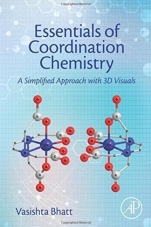
Essentials of Coordination Chemistry: A Simplified Approach with 3D Visuals
ISBN 9780128038956
Autor: Bhatt, Vasishta
Wydawca: Elsevier
Dostępność: 3-6 tygodni
Cena: 385,35 zł
Przed złożeniem zamówienia prosimy o kontakt mailowy celem potwierdzenia ceny.
ISBN13: |
9780128038956 |
Autor: |
Bhatt, Vasishta |
Oprawa: |
Paperback |
Rok Wydania: |
2015-11-12 |
Tematy: |
TDM |
Essentials of Coordination Chemistry: A Simplified Approach with 3D Visuals provides an accessible overview of this key, foundational topic in inorganic chemistry. Thoroughly illustrated within the book and supplemented by online 3D images and videos in full color, this valuable resource covers basic fundamentals before exploring more advanced topics of interest.
The work begins with an introduction to the structure, properties, and syntheses of ligands with metal centers, before discussing the variety of isomerism exhibited by coordination compounds, such as structural, geometrical and optical isomerism. As thermodynamics and kinetics provide a gateway to synthesis and reactivity of coordination compounds, the book then describes the determination of stability constants and composition of complexes. Building upon those principles, the resource then explains a wide variety of nucleophilic substitution reactions exhibited by both octahedral and square planar complexes. Finally, the book discusses metal carbonyls and nitrosyls, special classes of compounds that can stabilize zero or even negative formal oxidation states of metal ions. Highlighting preparations, properties, and structures, the text explores the unique type of Metal-Ligand bonding which enable many interesting applications of these compounds.
Thoughtfully organized for academic use, Essentials of Coordination Chemistry: A Simplified Approach with 3D Visuals encourages interactive learning. Advanced undergraduate and graduate students, as well as researchers requiring a full overview and visual understanding of coordination chemistry, will find this book invaluable.
Includes valuable visual content through 3D images and videos in full color, available onlineProvides a valuable introduction to the study of organic and inorganic ligands with metal centersDiscusses advanced topics including metal carbonyls and nitrosyls
- Dedication
- Preface
- Acknowledgements
- Chapter 1. Basic Coordination Chemistry
- 1. Introduction
- 2. Nomenclature
- 3. Theories of Bonding in Coordination Compounds
- 4. Geometries of Complexes with Different Coordination Numbers
- 5. Crystal Field Theory
- 6. Splitting of d-Orbitals in Fields of Different Geometry
- 7. Magnetism
- 8. Catalytic Properties
- 9. Exercises
- Chapter 2. Basic Concepts of Symmetry and Group Theory
- 1. Introduction
- 2. Symmetry Operations and Elements of Symmetry
- 3. Point Groups
- 4. Flow Chart for Determination of Molecular Point Groups
- 5. Exercises
- Chapter 3. Isomerism in Coordination Complexes
- 1. Introduction
- 2. Classification of Isomerism
- 3. Structural Isomerism
- 4. Stereo Isomerism or Space Isomerism
- 5. Experimental Separation and Identification of Isomers
- 6. Optical Isomerism or Mirror Image Isomerism
- 7. Maximum Number of Enantiomeric Pairs in Different Complexes
- 8. Resolution of Racemic Mixture
- 9. Exercises
- Chapter 4. Thermodynamics and Kinetics of Complex Formation
- 1. Introduction
- 2. Stability and Lability of Complexes
- 3. Steps Involved in Formation of a Complex MLn, Stepwise and Overall Stability Constants
- 4. Explanation of Lability and Inertness of Octahedral Complexes
- 5. Factors Affecting the Stability and Lability of Complexes
- 6. Bases for Detection of Complex Formation
- 7. Experimental Determination of Stability Constant and Composition of a Complex
- 8. Exercises
- Chapter 5. Reactions in Octahedral Complexes
- 1. Introduction
- 2. Potential Energy Curves Showing Energy Changes Involved in Endothermic and Exothermic Reactions
- 3. Mechanisms of Nucleophilic Substitution Reactions in Octahedral Complexes
- 4. Mechanisms Involved in Reactions Like Acid Hydrolysis and Base Hydrolysis of Six-Coordinated Co (III) Ammine Complexes
- 5. Anation Reaction
- 6. Substitution Reactions without M-L Bond Cleavage
- 7. Electron Transfer Reactions
- 8. Isomerization Reactions
- 9. Exercises
- Chapter 6. Reactions in Square Planar Complexes
- 1. Introduction
- 2. The Trans Effect and Its Applications
- 3. Theories for Explaining Trans Effect
- 4. Mechanism of Substitution Reactions
- 5. Factors Affecting the Rate of Substitution Reactions in Square Planar Complexes
- 6. Exercises
- Chapter 7. Basic Organometallic Chemistry
- 1. Introduction
- 2. Nature and Types of Metal-Carbon Bonding
- 3. Preparation of Metal-Carbon Bonds
- 4. Classification of Organometallic Compounds
- 5. Nomenclature
- 6. Fluxional Organometallic Compounds
- 7. Applications of Organometallic Compounds
- 8. Some Organometallic Compounds of Interest
- 9. Exercises
- Chapter 8. Metal Carbonyls
- 1. Introduction
- 2. Synthesis of Metal Carbonyls
- 3. Physical Properties
- 4. Chemical Properties
- 5. Bonding in Metallic Carbonyls
- 6. Infrared Spectroscopy
- 7. Classification of Metal Carbonyls
- 8. Mononuclear Carbonyls
- 9. Polynuclear Carbonyls
- 10. Structures of a Few Polynuclear Carbonyls
- 11. Effective Atomic Number (EAN) Rule
- 12. Catalytic Activity of Metallic Carbonyls
- 13. Exercises
- Chapter 9. Metal Nitrosyls
- 1. Introduction
- 2. Bonding in Metallic Nitrosyls
- 3. Infrared Spectroscopy
- 4. Classification of Nitrosyls
- 5. Synthesis of Metallic Nitrosyls
- 6. Individual Nitrosyls
- 7. Effective Atomic Number (EAN) Rule
- 8. Applications of Some Metallic Nitrosyls
- 9. Exercises
- Index
Koszyk
Książek w koszyku: 0 szt.
Wartość zakupów: 0,00 zł
Informacje


Kontakt
Gambit
Centrum Oprogramowania
i Szkoleń Sp. z o.o.
Al. Pokoju 29b/22-24
31-564 Kraków
Siedziba Księgarni
ul. Kordylewskiego 1
31-542 Kraków
+48 12 410 5991
+48 12 410 5987
+48 12 410 5989
Subskrypcje
Administratorem danych osobowych jest firma Gambit COiS Sp. z o.o. Na podany adres będzie wysyłany wyłącznie biuletyn informacyjny.
Autoryzacja płatności

Informacje na temat autoryzacji płatności poprzez PayU.

© Copyright 2012: GAMBIT COiS Sp. z o.o. Wszelkie prawa zastrzeżone.
Projekt i wykonanie: Alchemia Studio Reklamy