


Wydawcy
Katalog tematyczny
- Archeologia (109)
- Ekonomia, finanse, business (13704)
- Filozofia (1445)
- Historia (3040)
- Języki i językoznawstwo (2356)
- Lifestyle, hobby i rozrywka (475)
- Medycyna (9704)
- Nauki humanistyczne (4)
- Nauki o Ziemi i środowisku (2638)
- Nauki ścisłe (20412)
- Astronomia (294)
- Biologia (5119)
- Chemia (6540)
- Fizyka (3309)
- Elektryczność i magnetyzm (90)
- Fizyka atomowa i molekularna (110)
- Fizyka cząstek elementarnych (36)
- Fizyka jądra atomowego (36)
- Fizyka kwantowa (210)
- Fizyka matematyczna (121)
- Fizyka relatywistyczna (36)
- Fizyka statystyczna (51)
- Fizyka stosowana (498)
- Mechanika klasyczna (186)
- Optyka i światło (133)
- Stany materii (202)
- Matematyka (4574)
- Nauki ścisłe, ogólnie (503)
- Nauki społeczne (8486)
- Nauki techniczne (13450)
- Prawo (1696)
- Publikacje informacyjne i interdyscyplinarne (1288)
- Religia i wierzenia (917)
- Technika komputerowa (4067)
- Zdrowie, relacje międzyludzkie i rozwój osobisty (657)





Informacje szczegółowe o książce
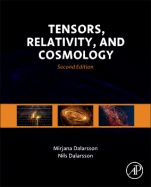
Tensors, Relativity, and Cosmology
ISBN 9780128033975
Autor: Dalarsson, MirjanaDalarsson, Nils
Wydawca: Elsevier
Dostępność: 3-6 tygodni
Cena: 564,90 zł
Przed złożeniem zamówienia prosimy o kontakt mailowy celem potwierdzenia ceny.
ISBN13: |
9780128033975 |
ISBN10: |
0128033975 |
Autor: |
Dalarsson, MirjanaDalarsson, Nils |
Oprawa: |
Paperback |
Rok Wydania: |
2015-06-29 |
Tematy: |
PHR |
Tensors, Relativity, and Cosmology, Second Edition, combines relativity, astrophysics, and cosmology in a single volume, providing a simplified introduction to each subject that is followed by detailed mathematical derivations.
The book includes a section on general relativity that gives the case for a curved space-time, presents the mathematical background (tensor calculus, Riemannian geometry), discusses the Einstein equation and its solutions (including black holes and Penrose processes), and considers the energy-momentum tensor for various solutions. In addition, a section on relativistic astrophysics discusses stellar contraction and collapse, neutron stars and their equations of state, black holes, and accretion onto collapsed objects, with a final section on cosmology discussing cosmological models, observational tests, and scenarios for the early universe.
This fully revised and updated second edition includes new material on relativistic effects, such as the behavior of clocks and measuring rods in motion, relativistic addition of velocities, and the twin paradox, as well as new material on gravitational waves, amongst other topics.
Clearly combines relativity, astrophysics, and cosmology in a single volumeExtensive introductions to each section are followed by relevant examples and numerous exercisesPresents topics of interest to those researching and studying tensor calculus, the theory of relativity, gravitation, cosmology, quantum cosmology, Robertson-Walker Metrics, curvature tensors, kinematics, black holes, and moreFully revised and updated with 80 pages of new material on relativistic effects, such as relativity of simultaneity and relativity of the concept of distance, amongst other topicsProvides an easy-to-understand approach to this advanced field of mathematics and modern physics by providing highly detailed derivations of all equations and results
Tensors, Relativity, and Cosmology, 2nd Edition
- Preface
- 1: Introduction
- Abstract
- Part 1: Tensor Algebra
- 2: Notation and Systems of Numbers
- Abstract
- 2.1 Introduction and Basic Concepts
- 2.2 Symmetric and Antisymmetric Systems
- 2.3 Operations with Systems
- 2.4 Summation Convention
- 2.5 Unit Symmetric and Antisymmetric Systems
- 3: Vector Spaces
- Abstract
- 3.1 Introduction and Basic Concepts
- 3.2 Definition of a Vector Space
- 3.3 The Euclidean Metric Space
- 3.4 The Riemannian Spaces
- 4: Definitions of Tensors
- Abstract
- 4.1 Transformations of Variables
- 4.2 Contravariant Vectors
- 4.3 Covariant Vectors
- 4.4 Invariants (Scalars)
- 4.5 Contravariant Tensors
- 4.6 Covariant Tensors
- 4.7 Mixed Tensors
- 4.8 Symmetry Properties of Tensors
- 4.9 Symmetric and Antisymmetric Parts of Tensors
- 4.10 Tensor Character of Systems
- 5: Relative Tensors
- Abstract
- 5.1 Introduction and Definitions
- 5.2 Unit Antisymmetric Tensors
- 5.3 Vector Product in Three Dimensions
- 5.4 Mixed Product in Three Dimensions
- 5.5 Orthogonal Coordinate Transformations
- 6: The Metric Tensor
- Abstract
- 6.1 Introduction and Definitions
- 6.2 Associated Vectors and Tensors
- 6.3 Arc Length of Curves: Unit Vectors
- 6.4 Angles between Vectors
- 6.5 Schwarz Inequality
- 6.6 Orthogonal and Physical Vector Coordinates
- 7: Tensors as Linear Operators
- Abstract
- 2: Notation and Systems of Numbers
- Part 2: Tensor Analysis
- 8: Tensor Derivatives
- Abstract
- 8.1 Differentials of Tensors
- 8.2 Covariant Derivatives
- 8.3 Properties of Covariant Derivatives
- 8.4 Absolute Derivatives of Tensors
- 9: Christoffel Symbols
- Abstract
- 9.1 Properties of Christoffel Symbols
- 9.2 Relation to the Metric Tensor
- 10: Differential Operators
- Abstract
- 10.1 The Hamiltonian ∇-Operator
- 10.2 Gradient of Scalars
- 10.3 Divergence of Vectors and Tensors
- 10.4 Curl of Vectors
- 10.5 Laplacian of Scalars and Tensors
- 10.6 Integral Theorems for Tensor Fields
- 11: Geodesic Lines
- Abstract
- 11.1 Lagrange Equations
- 11.2 Geodesic Equations
- 12: The Curvature Tensor
- Abstract
- 12.1 Definition of the Curvature Tensor
- 12.2 Properties of the Curvature Tensor
- 12.3 Commutator of Covariant Derivatives
- 12.4 Ricci Tensor and Scalar
- 12.5 Curvature Tensor Components
- 8: Tensor Derivatives
- Part 3: Special Theory of Relativity
- 13: Relativistic Kinematics
- Abstract
- 13.1 The Principle of Relativity
- 13.2 Invariance of the Speed of Light
- 13.3 The Interval between Events
- 13.4 Lorentz Transformations
- 13.5 Velocity and Acceleration Vectors
- 14: Relativistic Phenomena
- Abstract
- 14.1 Introduction
- 14.2 Time Dilatation
- 14.3 Length Contraction
- 14.4 Relativistic Addition of Velocities
- 14.5 The Twin Paradox
- 15: Relativistic Dynamics
- Abstract
- 15.1 Lagrange Equations
- 15.2 Energy-Momentum Vector
- 15.3 Angular Momentum Tensor
- 16: Electromagnetic Fields
- Abstract
- 16.1 Electromagnetic Field Tensor
- 16.2 Gauge Invariance
- 16.3 Lorentz Transformations and Invariants
- 17: Electromagnetic Field Equations
- Abstract
- 17.1 Electromagnetic Current Vector
- 17.2 Maxwell Equations
- 17.3 Electromagnetic Potentials
- 17.4 Energy-Momentum Tensor
- 13: Relativistic Kinematics
- Part 4: General Theory of Relativity
- 18: Gravitational Fields
- Abstract
- 18.1 Introduction
- 18.2 Time Intervals and Distances
- 18.3 Particle Dynamics
- 18.4 Electromagnetic Field Equations
- 19: Gravitational Field Equations
- Abstract
- 19.1 The Action Integral
- 19.2 Action for Matter Fields
- 19.3 Einstein Field Equations
- 20: Solutions of Field Equations
- Abstract
- 20.1 The Newton Law
- 20.2 The Schwarzschild Solution
- 21: Applications of the Schwarzschild Metric
- Abstract
- 21.1 The Perihelion Advance
- 21.2 The Black Holes
- 22: Gravitational Waves
- Abstract
- 22.1 Introduction
- 22.2 Linearized Einstein Field Equations
- 22.3 Plane-wave Solutions
- 22.4 Effects of Gravitational Waves on Particles
- 22.5 Generation of Gravitational Radiation
- 18: Gravitational Fields
- Part 5: Elements of Cosmology
- 23: The Robertson-Walker Metric
- Abstract
- 23.1 Introduction and Basic Observations
- 23.2 Metric Definition and Properties
- 23.3 The Hubble Law
- 23.4 The Cosmological Red Shifts
- 24: The Cosmic Dynamics
- Abstract
- 24.1 The Einstein Tensor
- 24.2 Friedmann Equations
- 25: Non-static Models of the Universe
- Abstract
- 25.1 Solutions of Friedmann Equations
- 25.2 Closed or Open Universe
- 25.3 Newtonian Cosmology
- 26: The Quantum Cosmology
- Abstract
- 26.1 Introduction
- 26.2 Wheeler-De Witt Equation
- 26.3 The Wave Function of the Universe
- 23: The Robertson-Walker Metric
- Bibliography
- Index
Koszyk
Książek w koszyku: 0 szt.
Wartość zakupów: 0,00 zł
Informacje


Kontakt
Gambit
Centrum Oprogramowania
i Szkoleń Sp. z o.o.
Al. Pokoju 29b/22-24
31-564 Kraków
Siedziba Księgarni
ul. Kordylewskiego 1
31-542 Kraków
+48 12 410 5991
+48 12 410 5987
+48 12 410 5989
Subskrypcje
Administratorem danych osobowych jest firma Gambit COiS Sp. z o.o. Na podany adres będzie wysyłany wyłącznie biuletyn informacyjny.
Autoryzacja płatności

Informacje na temat autoryzacji płatności poprzez PayU.

© Copyright 2012: GAMBIT COiS Sp. z o.o. Wszelkie prawa zastrzeżone.
Projekt i wykonanie: Alchemia Studio Reklamy