


Wydawcy
Katalog tematyczny
- Archeologia (109)
- Ekonomia, finanse, business (13704)
- Filozofia (1445)
- Historia (3040)
- Języki i językoznawstwo (2356)
- Lifestyle, hobby i rozrywka (475)
- Medycyna (9704)
- Nauki humanistyczne (4)
- Nauki o Ziemi i środowisku (2638)
- Nauki ścisłe (20412)
- Astronomia (294)
- Biologia (5119)
- Biochemia (575)
- Biologia człowieka (14)
- Biologia komórkowa (377)
- Biologia molekularna (398)
- Biologia rozwoju (130)
- Biologia, ogólnie (1277)
- Botanika (280)
- Hydrobiologia (92)
- Mikrobiologia (363)
- Mykologia (22)
- Zoologia (303)
- Chemia (6540)
- Fizyka (3309)
- Matematyka (4574)
- Nauki ścisłe, ogólnie (503)
- Nauki społeczne (8486)
- Nauki techniczne (13450)
- Prawo (1696)
- Publikacje informacyjne i interdyscyplinarne (1288)
- Religia i wierzenia (917)
- Technika komputerowa (4067)
- Zdrowie, relacje międzyludzkie i rozwój osobisty (657)





Informacje szczegółowe o książce
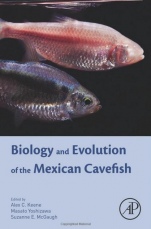
Biology and Evolution of the Mexican Cavefish
ISBN 9780128021484
Autor: Keene, AlexYoshizawa, MasatoMcGaugh, Suzanne
Wydawca: Elsevier
Dostępność: 3-6 tygodni
Cena: 404,25 zł
Przed złożeniem zamówienia prosimy o kontakt mailowy celem potwierdzenia ceny.
ISBN13: |
9780128021484 |
ISBN10: |
0128021489 |
Autor: |
Keene, AlexYoshizawa, MasatoMcGaugh, Suzanne |
Oprawa: |
Hardback |
Rok Wydania: |
2015-10-12 |
Tematy: |
PSP |
Biology and Evolution of the Mexican Cavefish features contributions by leading researchers in a comprehensive, unique work that examines a number of distinct areas of biology—evolution, development, ecology, and behavior—using the Mexican cavefish as a powerful model system to further understanding of basic biological processes such as eye degeneration, hearing, craniofacial development, sleep, and metabolic function.
These fish are currently being used to better understand a number of issues related to human health, including age-related blindness, sleep, obesity, mood-related disorders, and aging. The recent sequencing of the cavefish genome broadens the interest of this system to groups working with diverse biological systems, and has helped researchers identify genes that regulate sleep, eye degeneration, and metabolic function.
Mexican cavefish are particularly powerful for the study of biological processes because these fish evolved independently in twenty-nine caves in the Sierra de el Abra Region of Northeast Mexico. These fish have dramatic adaptations to the cave environment, and this can be used to identify genes involved in disease-related traits.
This scholarly text will be of interest to researchers and students throughout diverse areas of biology and ecology. It includes photographs of animals and behavior in laboratory and natural settings that will also increase interest and accessibility to non-experts.
Includes a mixture of images and illustrations such as the geographical distribution of cave pools and the developmental biology of the nervous systemFeatures a companion site with geographical maps Fills a notable gap in the literature on a topic of broad interest to the scientific communityPresents the recent sequencing of the cavefish genome as a groundbreaking development for researchers working with diverse biological systems
- Preface
- Introduction: The Emergence of the Mexican Cavefish as an Important Model System for Understanding Phenotypic Evolution
- Part I: Ecology and Evolution
- Chapter 1: Cave Exploration and Mapping in the Sierra de El Abra Region
- Abstract
- Acknowledgments
- Introduction
- Mapping and Cartography Methods
- Geographic Information Systems
- Cave Descriptions
- Gómez Farías Area (Sierra de Guatemala)
- Glossary of Mexican, Geographic, and Geologic Terms
- Chapter 2: Hydrogeology of Caves in the Sierra de El Abra Region
- Abstract
- Preface
- Current Surface Streams and Springs
- Current Underground Drainages
- Geology
- Age of the Caves
- Evolution of the Hydrogeology at the El Abra Region
- Discussion
- Conclusions
- Chapter 3: Cave Biodiversity and Ecology of the Sierra de El Abra Region
- Abstract
- Acknowledgments
- Introduction
- Biodiversity
- General Cave Ecology
- Ecology of Four Caves
- Conclusions
- Chapter 4: Phylogeny and Evolutionary History ofAstyanax mexicanus
- Abstract
- The Astyanax Genus
- Taxonomy of Troglobite Astyanax from the Huasteca Region
- Cave Invasion by Astyanax Lineages
- Chapter 1: Cave Exploration and Mapping in the Sierra de El Abra Region
- Part II: Genetic Diversity and Quantitative Genetics
- Chapter 5: Regressive Evolution: Testing Hypotheses of Selection and Drift
- Abstract
- Introduction
- Eyes and Pigmentation, Hypotheses and Their Tests
- Melanin Traits
- Conclusion
- Materials and Methods
- Chapter 6: Mapping the Genetic Basis of Troglomorphy in Astyanax: How Far We Have Come and Where Do We Go from Here?
- Abstract
- Introduction
- Part I: Quantitative Genetics and QTL Mapping in Astyanax
- Part II: Looking Forward: Remaining Questions and New Approaches
- Chapter 7: Selection Through Standing Genetic Variation
- Abstract
- De novo Versus Standing Genetic Variation
- Cryptic Genetic Variation and Canalization
- HSP90 as a Capacitor of Evolution
- HSP90 in Cavefish Evolution
- Is Eye Loss in Cavefish an Adaptive Trait
- Detecting Standing Genetic Variation
- Examples from Astyanax Mexicanus
- Gene Flow
- Open Questions
- Chapter 5: Regressive Evolution: Testing Hypotheses of Selection and Drift
- Part III: Morphology and Development
- Chapter 8: Pigment Regression and Albinism inAstyanax Cavefish
- Abstract
- Introduction
- Astyanax Pigmentation and Depigmentation
- Control of Melanogenesis
- Developmental Basis of Cavefish Depigmentation
- Genetic Basis of Cavefish Depigmentation
- Evolution of Cavefish Depigmentation
- Conclusions and Future Prospects
- Chapter 9: Molecular Mechanisms of Eye Degeneration in Cavefish
- Abstract
- Adult Cavefish Eye
- Eye Development
- Eye Degeneration
- Mechanisms of PCD in the Cavefish Lens
- Evolutionary Forces Why Cavefish Fish Have Lost Their Eye
- The Trend of Eye Degeneration
- Eye Degeneration in Other Cavefish Species
- Evolutionary Mechanisms: Neutral Mutation with Genetic Drift
- Evolutionary Mechanisms: Trade-off Hypothesis
- Evolutionary Mechanisms: Energy Conservation Hypothesis
- Why “Build and Destroy”?
- Chapter 10: The Evolution of the Cavefish Craniofacial Complex
- Abstract
- Acknowledgments
- Discovery, Characterization, and the Historical Relevance of Craniofacial Evolution in Cavefish
- Craniofacial Changes Across Independently Derived Cave Populations
- The Nature of Morphological Changes to the Craniofacial Complex in Cave-Dwelling Populations
- Mechanisms of Craniofacial Evolution in Cave-Dwelling Populations
- Coordinated Changes Between the Craniofacial Complex and Other Cave-Associated Traits
- Genetic Analyses of Craniofacial Evolution
- Conclusions
- Chapter 11: Evolution and Development of the Cavefish Oral Jaws: Adaptations for Feeding
- Abstract
- Acknowledgments
- Introduction
- Relationship Between the Constructive Traits of Teeth and Tastebud Expansion and Eye Loss
- Tooth-Tastebud Linkages
- Teeth-Eye Linkages
- Modularity and Adaptive Evolution
- Conclusion
- Chapter 12: Neural Development and Evolution inAstyanax mexicanus: Comparing Cavefish and Surface Fish Brains
- Abstract
- Acknowledgments
- Introduction
- Adult Brain Anatomy and Brain Networks
- A Special Case: Development and Degeneration of the Cavefish Visual System
- Early Embryonic Development: The Origin of Cavefish Differences?
- Larval Brain Development: Establishing Subtle Differences
- Sensory Systems
- Cavefish Brain Neurochemistry
- Conclusions and Perspectives
- Chapter 8: Pigment Regression and Albinism inAstyanax Cavefish
- Part IV: Behavior
- Chapter 13: The Evolution of Sensory Adaptation inAstyanax mexicanus
- Abstract
- Introduction
- Enhanced Sensory Systems
- Regressed Sensory Systems
- Sensory Systems that Potentially Contribute to Cave Adaptation
- Concluding Remarks
- Chapter 14: Feeding Behavior, Starvation Response, and Endocrine Regulation of Feeding in Mexican Blind Cavefish (Astyanax fasciatus mexicanus)
- Abstract
- Introduction
- Feeding Behavior of Blind Astyanax
- Metabolism and Responses to Fasting of BlindAstyanax
- Peptide Systems Involved in Feeding and Fasting in Astyanax
- Concluding Remarks
- Chapter 15: Investigating the Evolution of Sleep in the Mexican Cavefish
- Abstract
- Introduction
- Fish as a Vertebrate Model for Sleep
- Sleep Loss in Cavefish
- Pharmacological Interrogation of Sleep
- Concluding Remarks
- Chapter 16: Daily Rhythms in a Timeless Environment: Circadian Clocks in Astyanax mexicanus
- Abstract
- A General Introduction to the Circadian Clock
- Clocks in Zebrafish
- Clocks in a Cave
- The Circadian Clock of A. Mexicanus
- Clock Outputs in Astyanax
- The Role of Light Input
- What Can Astyanax Tell Us About Other Cave Species?
- Conclusion
- Chapter 17: Social Behavior and Aggressiveness inAstyanax
- Abstract
- Acknowledgments
- Social Behavior
- Aggressiveness
- Conclusion
- Chapter 18: Spatial Mapping in Perpetual Darkness: EvoDevo of Behavior in Astyanax mexicanus Cavefish
- Abstract
- Acknowledgments
- Evolution and Development of Behavior
- Building Spatial Maps from the Visual Sensory System
- Experiments in Astyanax mexicanus Cavefish Navigation
- Navigating and Creating Spatial Maps in the Complete Absence of Vision
- Human Sensory Deprivation and Space Mapping
- Astyanax Cavefish and Eyesight Loss in Humans
- Chapter 13: The Evolution of Sensory Adaptation inAstyanax mexicanus
- Part V: Future Applications
- Chapter 19: Transgenesis and Future Applications for Cavefish Research
- Abstract
- Introduction
- Visualizing Development and Anatomy
- Transgenic Approaches to Testing Genetic Causality
- Analysis of Neuronal Circuits That Control Behavior
- Concluding Remarks
- Chapter 19: Transgenesis and Future Applications for Cavefish Research
- Concluding Remarks: The Astyanax Community
- Index
Koszyk
Książek w koszyku: 0 szt.
Wartość zakupów: 0,00 zł
Informacje


Kontakt
Gambit
Centrum Oprogramowania
i Szkoleń Sp. z o.o.
Al. Pokoju 29b/22-24
31-564 Kraków
Siedziba Księgarni
ul. Kordylewskiego 1
31-542 Kraków
+48 12 410 5991
+48 12 410 5987
+48 12 410 5989
Subskrypcje
Administratorem danych osobowych jest firma Gambit COiS Sp. z o.o. Na podany adres będzie wysyłany wyłącznie biuletyn informacyjny.
Autoryzacja płatności

Informacje na temat autoryzacji płatności poprzez PayU.

© Copyright 2012: GAMBIT COiS Sp. z o.o. Wszelkie prawa zastrzeżone.
Projekt i wykonanie: Alchemia Studio Reklamy