


Wydawcy
Katalog tematyczny
- Archeologia (109)
- Ekonomia, finanse, business (13704)
- Filozofia (1445)
- Historia (3040)
- Języki i językoznawstwo (2356)
- Lifestyle, hobby i rozrywka (475)
- Medycyna (9704)
- Nauki humanistyczne (4)
- Nauki o Ziemi i środowisku (2638)
- Nauki ścisłe (20412)
- Nauki społeczne (8486)
- Nauki techniczne (13450)
- Budownictwo lądowe (1045)
- Chemia przemysłowa (2258)
- Elektronika i telekomunikacja (3287)
- Energetyka (1122)
- Inne nauki stosowane (363)
- Inżynieria biochemiczna (507)
- Inżynieria transportu (232)
- Mechanika i materiały (3316)
- Nauka o środowisku (321)
- Rolnictwo (507)
- Technika, ogólnie (475)
- Prawo (1696)
- Publikacje informacyjne i interdyscyplinarne (1288)
- Religia i wierzenia (917)
- Technika komputerowa (4067)
- Zdrowie, relacje międzyludzkie i rozwój osobisty (657)





Informacje szczegółowe o książce
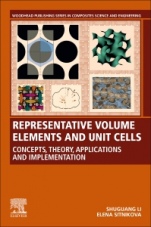
Representative Volume Elements and Unit Cells: Concepts, Theory, Applications and Implementation
ISBN 9780081026380
Autor: Li, ShuguangSitnikova, Elena
Wydawca: Elsevier
Dostępność: 3-6 tygodni
Cena: 1 084,65 zł
Przed złożeniem zamówienia prosimy o kontakt mailowy celem potwierdzenia ceny.
ISBN13: |
9780081026380 |
Autor: |
Li, ShuguangSitnikova, Elena |
Oprawa: |
Paperback |
Rok Wydania: |
2019-11-20 |
Tematy: |
TGM |
Numerical methods to estimate material properties usually involve analysis of a representative volume element (RVE) or unit cell (UC). The representative volume element (RVE) or unit cell (UC) is the smallest volume over which a measurement can be made that will yield a value representative of the whole. RVEs and UCs are widely used in the characterisation of materials with multiscale architectures such as composites. However, finite element (FE) software packages such as Abaqus and Comsol MultiPhysics do not offer the capability for RVE and UC modelling directly on their own. To apply them to analyse RVEs and UCs, the generation of the FE models for them, the imposition of boundary conditions, and the extraction of directly relevant results are essentially the responsibility of the user. These have tended to be incorrectly implemented by users! For the first time, this book will provide a comprehensive account on correct modelling of RVEs and UCs, which will eliminate any uncertainties and ambiguities.
The book offers a complete and thorough review on the subject of RVEs and UCs, establishing a framework on a rigorous mathematical and mechanical basis to ensure that basic concepts, such as symmetry and free body diagrams, are applied correctly and consistently. It also demonstrates to readers that rigorous applications of mathematics and mechanics are meant to make things clear, consistent, thorough and, most of all, simple and easy to follow, rather than the opposite as many perceive. As a result, the book shows that the appropriate use of RVEs and UCs can deliver an effective and reliable means of material characterisation. It not only provides a much needed comprehensive account on material characterisation but, more importantly, explains how such characterisation can be conducted in a consistent and systematic manner. It also includes a ready-to-use open source code for UCs that can be downloaded from a companion site for potential users to utilise, adapt and expand as they wish.
• The theories presented in this book will give users more confidence when applying RVE and UC models to analyse materials of complex architectures with accuracy and efficiency
• Systematic explanations of RVE and UC theories have been included, as well as their applications in composites
• It illustrates in detail how to set up UC models and provides an open source code to implement via Abaqus
Preface xi
Part One: Basics
1. Introduction d background, objectives and basic
concepts 3
1.1 The concept of length scales and typical length scales in physics and
engineering 3
1.2 Multiscale modelling 4
1.3 Representative volume element and unit cell 5
1.4 Background of this monograph 6
1.5 Objectives of this monograph 6
1.6 The structure of this monograph 8
References 10
2. Symmetry, symmetry transformations and symmetry conditions 11
2.1 Introduction 11
2.2 Geometric transformations and the concept of symmetry 12
2.3 Symmetry of physical fields 16
2.4 Continuity and free body diagrams 24
2.5 Symmetry conditions 28
2.6 Concluding remarks 41
References 42
3. Material categorisation and material characterisation 43
3.1 Background 43
3.2 Material categorisation 45
3.3 Material characterisation 60
3.4 Concluding remarks 64
References 64
4. Representative volume elements and unit cells 67
4.1 Introduction 67
4.2 RVEs 68
4.3 UCs 71
4.4 Concluding remarks 76
References 77
5. Common erroneous treatments and their conceptual sources
of errors 79
5.1 Realistic or hypothetic background 79
5.2 The construction of RVEs and their boundary 82
5.3 The construction of UCs 84
5.4 Post-processing 96
5.5 Implementation issues 98
5.6 Verification and the lack of ‘sanity checks’ 101
5.7 Concluding remarks 102
References 103
Part Two: Consistent formulation of unit cells and
representative volume elements
6. Formulation of unit cells 107
6.1 Introduction 107
6.2 Relative displacement field and rigid body rotations 108
6.3 Relative displacement boundary conditions for unit cells 114
6.4 Typical unit cells and their boundary conditions in terms of relative
displacements 115
6.5 Requirements on meshing 176
6.6 Key degrees of freedom and average strains 177
6.7 Average stresses and effective material properties 179
6.8 Thermal expansion coefficients 182
6.9 “Sanity checks as basic verifications 183
6.10 Concluding remarks 185
References 187
7. Periodic traction boundary conditions and the key degrees of
freedom for unit cells 189
7.1 Introduction 189
7.2 Boundaries and boundary conditions for unit cells resulting from
translational symmetries 193
7.3 Total potential energy and variational principle for unit cells under
prescribed average strains 197
7.4 Periodic traction boundary conditions as the natural boundary
conditions for unit cells 198
7.5 The nature of the reactions at the prescribed key degrees of freedom 202
7.6 Prescribed concentrated ‘forces’ at the key degrees of freedom 209
7.7 Examples 211
7.8 Conclusions 219
References 220
8. Further symmetries within a UC 223
8.1 Introduction 223
8.2 Further reflectional symmetries to existing translational symmetries 225
8.3 Further rotational symmetries to existing translational symmetries 251
8.4 Examples of mixed reflectional and rotational symmetries 291
8.5 Centrally reflectional symmetry 303
8.6 Guidance to the sequence of exploiting existing symmetries 314
8.7 Concluding statement 315
References 317
9. RVE for media with randomly distributed inclusions 319
9.1 Introduction 319
9.2 Displacement boundary conditions and traction boundary conditions
for an RVE 320
9.3 Decay length for boundary effects 323
9.4 Generation of random patterns 327
9.5 Strain and stress fields in the RVE and the sub-domain 330
9.6 Post-processing for average stresses, strains and effective properties 336
9.7 Conclusions 345
References 345
10. The diffusion problem 347
10.1 Introduction 347
10.2 Governing equation 347
10.3 Relative concentration field 351
10.4 An example of a cuboidal unit cell 353
10.5 RVEs 355
10.6 Post-processing for average concentration gradients and diffusion fluxes 356
10.7 Conclusions 360
References 360
11. Boundaries of applicability of representative volume elements
and unit cells 361
11.1 Introduction 361
11.2 Predictions of elastic properties and strengths 361
11.3 Representative volume elements 363
11.4 Unit cells 366
11.5 Conclusions 366
References 367
Part Three: Further developments
12. Applications to textile composites 371
12.1 Introduction 371
12.2 Use of symmetries when defining an effective UC 381
12.3 Unit cells for two-dimensional textile composites 383
12.4 Unit cells for three-dimensional textile composites 398
12.5 Conclusions 414
References 415
13. Application of unit cells to problems of finite deformation 417
13.1 Introduction 417
13.2 Unit cell modelling at finite deformations 419
13.3 The uncertainties associated with material definition 433
13.4 Concluding remarks 436
References 437
14. Automated implementation: UnitCells© composites
characterisation code 439
14.1 Introduction 439
14.2 Abaqus/CAE modelling practicality 441
14.3 Verification and validation 450
14.4 Concluding remarks 456
References 456
Index 459
Koszyk
Książek w koszyku: 0 szt.
Wartość zakupów: 0,00 zł
Informacje


Kontakt
Gambit
Centrum Oprogramowania
i Szkoleń Sp. z o.o.
Al. Pokoju 29b/22-24
31-564 Kraków
Siedziba Księgarni
ul. Kordylewskiego 1
31-542 Kraków
+48 12 410 5991
+48 12 410 5987
+48 12 410 5989
Subskrypcje
Administratorem danych osobowych jest firma Gambit COiS Sp. z o.o. Na podany adres będzie wysyłany wyłącznie biuletyn informacyjny.
Autoryzacja płatności

Informacje na temat autoryzacji płatności poprzez PayU.

© Copyright 2012: GAMBIT COiS Sp. z o.o. Wszelkie prawa zastrzeżone.
Projekt i wykonanie: Alchemia Studio Reklamy