


Wydawcy
Katalog tematyczny
- Archeologia (109)
- Ekonomia, finanse, business (13704)
- Filozofia (1445)
- Historia (3040)
- Języki i językoznawstwo (2356)
- Lifestyle, hobby i rozrywka (475)
- Medycyna (9704)
- Nauki humanistyczne (4)
- Nauki o Ziemi i środowisku (2638)
- Nauki ścisłe (20412)
- Nauki społeczne (8486)
- Nauki techniczne (13450)
- Prawo (1696)
- Publikacje informacyjne i interdyscyplinarne (1288)
- Religia i wierzenia (917)
- Technika komputerowa (4067)
- Zdrowie, relacje międzyludzkie i rozwój osobisty (657)





Informacje szczegółowe o książce
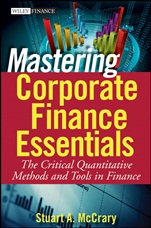
Mastering Corporate Finance Essentials: The Critical Quantitative Methods and Tools in Finance
ISBN 9780470393338
Autor: Stuart A. McCrary
Wydawca: Wiley
Dostępność: 3-6 tygodni
Cena: 248,85 zł
Przed złożeniem zamówienia prosimy o kontakt mailowy celem potwierdzenia ceny.
ISBN13: |
9780470393338 |
ISBN10: |
0470393335 |
Autor: |
Stuart A. McCrary |
Oprawa: |
Hardback |
Rok Wydania: |
2010-02-19 |
Ilość stron: |
208 |
Wymiary: |
236x163 |
Tematy: |
KF |
Mastering Corporate Finance Essentials
An essential hands–on guide to corporate finance
Understanding corporate finance is a necessity for financial practitioners who struggle every day to find the right balance between maximizing corporate value and reducing a firm′s financial risk.
Divided into two comprehensive parts, Mastering Corporate Finance Essentials presents the material by example, using both theory and real–world illustrations. Each chapter builds a foundation for later chapters. The first part of the book introduces present and future value mathematics, along with a range of applications that use the tools presented. The second part of the book examines statistics as applied to finance, with detailed discussions of standard deviations, correlations, and how they impact diversification. The book ends with important topics in quantitative finance.
Mastering Corporate Finance Essentials covers all the essential elements of this field, from traditional capital budgeting concepts and methods of valuing investment projects under uncertainty to the importance of "real options" in the decision–making process. This reliable resource provides a hands–on approach to corporate finance that will allow you to gain a solid understanding of this discipline.
Spis treści:
Preface.
Acknowledgments.
Chapter 1 Time Value of Money Toolbox.
Introduction.
Cash Flows.
Future Value.
The Impact of Compounding Frequency on Future Value.
Equivalent Interest Rate.
Continuously Compounded Interest.
Present Value.
Formulas for Present Value and Future Value.
Conclusion.
Questions.
Chapter 2 Statistics for Finance.
Introduction.
The Meaning of Mean or Average.
Median as a Substitute for Mean.
Standard Deviation Measures the Noise.
Annualizing Variance and Standard Deviation Estimates.
The Normal Curve Is a Probability Distribution.
The Cumulative Density Function.
Measures of Dependency.
Measuring Covariance and Correlation.
Calculating Statistics in Practice.
Combining Normal Distributions.
Conclusion.
Questions.
Chapter 3 Core Finance Theories and the Cost of Capital.
Introduction.
Risk Reduction from Diversification.
Systematic versus Unsystematic Risk.
The Market Portfolio.
The Capital Asset Pricing Model.
Using Beta to Determine the Required Return for a Stock.
Other Factor Models.
Cost of Debt.
Weighted Average Cost of Capital.
Modigliani and Miller.
Patterns of Debt and Equity in Capital Structures.
Conclusion.
Questions.
Chapter 4 Capital Budgeting Tools.
Introduction.
Three Ways to Evaluate Investments.
Calculating Net Present Value.
Net Present Value Example.
Calculating Internal Rate of Return.
Calculating Years to Payback.
Financial Decision Making.
The Annuity Formula.
Valuing an Annuity with More Frequent Cash Flows.
Using the Present Value Formula and the Annuity Formula to Value a Bond.
Using the Annuity Formula to Value a Mortgage.
NPV Using the Annuity Formula.
Valuing a Perpetuity.
Valuing a Growth Annuity.
Introduction to Uncertainty.
Conclusion.
Questions.
Chapter 5 Techniques for Handling Uncertainty.
Introduction.
Using Scenario Analysis.
Using Monte Carlo Simulation.
Uniform Random Numbers.
Transforming Uniform Distributions.
Adding and Multiplying Two Random Numbers.
Using Random Numbers in a Budget Analysis.
Using Random Numbers in a Capital Budgeting Analysis
Conclusion.
Questions.
Chapter 6 Real Options Analysis of Capital Investments.
Introduction.
Why Study Options?
What Is a Real Option?
Types of Real Options.
Methods for Valuing Real Options
Conclusion
Questions.
Appendix: Day Counting for Interest Rate Calculations.
Introduction.
The 30/360 Meth
od
The Actual/Actual Method.
The Actual/360 Method.
The Actual/365 Method.
Example and Comparison of 30/360 and Actual/Actual.
Impact of Day Counting over Longer Intervals.
Calculating Calendar Intervals over Long Periods.
A Note about Continuous Compounding.
Conclusion.
Questions and Answers.
About the Author.
Index.
Nota biograficzna:
Stuart A. Mccrary is a Principal at Chicago Partners, a division of Navigant Consulting, Inc. He is a trader and portfolio manager who specializes in traditional and alternative investments, quantitative valuation, risk management, and financial software. Prior to joining Chicago Partners, McCrary was president of Frontier Asset Management, managing a market–neutral hedge fund. He also held positions with Fenchurch Capital Management as a senior options trader and CS First Boston as vice president and market maker of over–the–counter options. Prior to that, McCrary was a vice president with the Securities Groups and a portfolio manager with Comerica Bank. McCrary has published three previous books with Wiley: Mastering Financial Accounting Essentials, How to Create and Manage a Hedge Fund, and Hedge Fund Course.
Okładka tylna:
Mastering Corporate Finance Essentials
An essential hands–on guide to corporate finance
Understanding corporate finance is a necessity for financial practitioners who struggle every day to find the right balance between maximizing corporate value and reducing a firm′s financial risk.
Divided into two comprehensive parts, Mastering Corporate Finance Essentials presents the material by example, using both theory and real–world illustrations. Each chapter builds a foundation for later chapters. The first part of the book introduces present and future value mathematics, along with a range of applications that use the tools presented. The second part of the book examines s
tatistics as applied to finance, with detailed discussions of standard deviations, correlations, and how they impact diversification. The book ends with important topics in quantitative finance.
Mastering Corporate Finance Essentials covers all the essential elements of this field, from traditional capital budgeting concepts and methods of valuing investment projects under uncertainty to the importance of "real options" in the decision–making process. This reliable resource provides a hands–on approach to corporate finance that will allow you to gain a solid understanding of this discipline.
Koszyk
Książek w koszyku: 0 szt.
Wartość zakupów: 0,00 zł
Informacje


Kontakt
Gambit
Centrum Oprogramowania
i Szkoleń Sp. z o.o.
Al. Pokoju 29b/22-24
31-564 Kraków
Siedziba Księgarni
ul. Kordylewskiego 1
31-542 Kraków
+48 12 410 5991
+48 12 410 5987
+48 12 410 5989
Subskrypcje
Administratorem danych osobowych jest firma Gambit COiS Sp. z o.o. Na podany adres będzie wysyłany wyłącznie biuletyn informacyjny.
Autoryzacja płatności

Informacje na temat autoryzacji płatności poprzez PayU.

© Copyright 2012: GAMBIT COiS Sp. z o.o. Wszelkie prawa zastrzeżone.
Projekt i wykonanie: Alchemia Studio Reklamy